The stronger China’s strategic nuclear forces are, the more regional peace is guaranteed: Global Times editorial
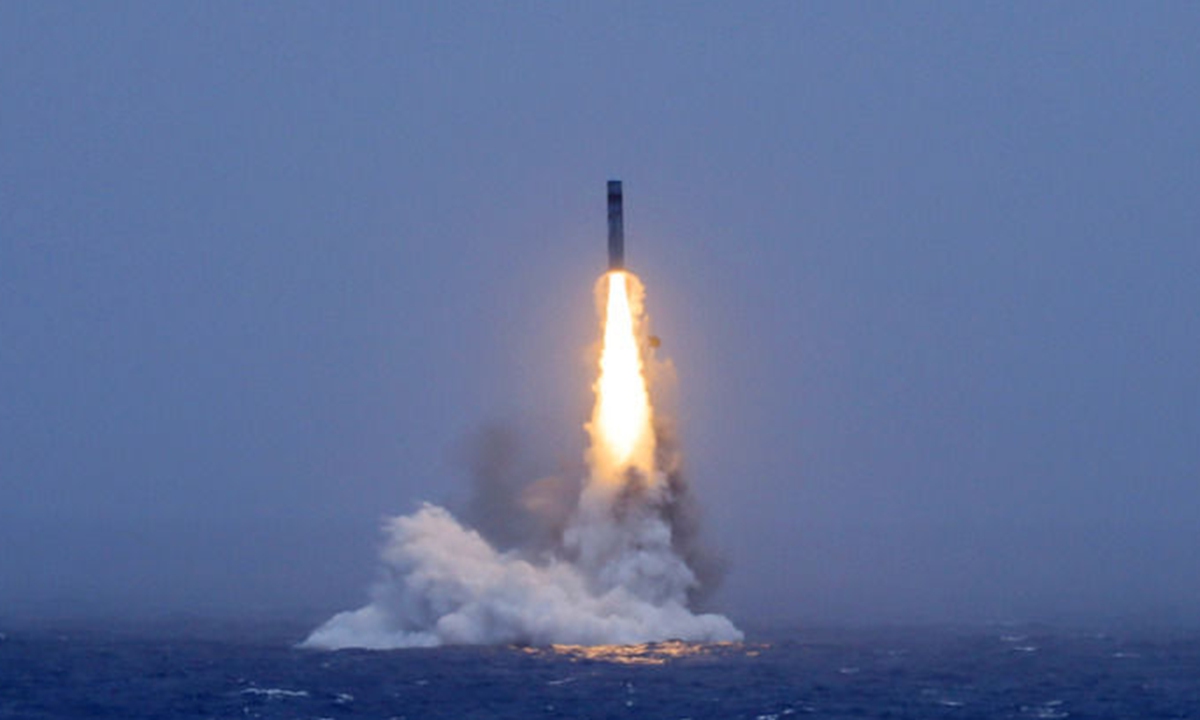
The Chinese People's Liberation Army (PLA) Navy successfully conducted the test launch of a strategic missile by a submarine on July 6, 2026. Photo: Xinhua
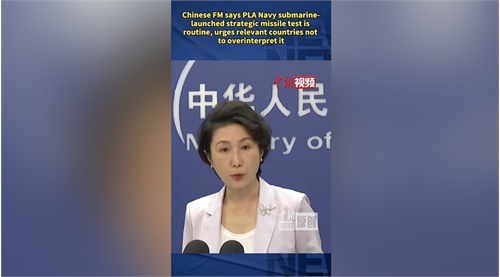
China's nuclear system capacity building has once again reached a milestone. One strategic nuclear submarine of the Chinese People's Liberation Army Navy on Monday successfully launched a strategic missile carrying a dummy warhead toward relevant high seas of the Pacific Ocean, which landed within the designated waters. The last launch of this kind took place in 2024, when China successfully conducted a land-based intercontinental ballistic missile test in relevant high seas of the Pacific. Two years later, the test launch of the new-type strategic missile by a submarine proceeded smoothly as planned, marking a significant enhancement in the overall deterrence capability of China's "nuclear triad." This not only demonstrates to the outside world China's determination and ability to resolutely safeguard national sovereignty, security, and territorial integrity, but also provides a robust guarantee for peace and stability in the Asia-Pacific region.
Regarding the specific model of the submarine-launched strategic missile involved in this test, some analysts consider the JL-3 to be the most likely candidate. Capable of a range exceeding 10,000 kilometers, this missile was officially unveiled during the 2025 military parade commemorating the 80th anniversary of the victory in the Chinese People's War of Resistance against Japanese Aggression and the World Anti-Fascist War. The successful test this time comprehensively validated the combat reliability of the entire weapon system and demonstrated formidable strategic deterrence capabilities.
In the realm of international military activities, particularly regarding strategic weapon tests, providing advance notification of launch plans to relevant countries is a crucial step of maintaining peaceful and stable international situation. During the Cold War, the US and the Soviet Union conducted thousands of missile tests but rarely provided prior notification. From the end of the Cold War till now, notifications from some countries, even nuclear powers, are often confined to bilateral mechanisms. International law, moreover, contains no provision for a specific obligation of diplomatic notification. However, some foreign media reports indicate that relevant countries received public maritime warnings from the Chinese side a day in advance and diplomatic notifications prior to the launch on Monday. These were goodwill measures taken by China to proactively reduce the risk of miscalculation. China's actions were reasonable and lawful, fully demonstrating its sense of responsibility as a major power.
Strategic nuclear capabilities represent one of the areas that best exemplify the concept of "to prevent war by deterrence." It is well known that submarine-launched strategic missiles are a vital component of the strategic nuclear deterrence system and a recognized key element of second-strike capability; this is because sea-based nuclear forces possess high survivability, ensuring that no nation can utterly destroy another country's nuclear forces via a preemptive strike. China is the only country among the five Nuclear-Weapon States that has promised not to be the first to use nuclear weapons. The stronger its second-strike capability is, the greater the role it plays in deterring the use of nuclear weapons through nuclear weapons. This serves as a fundamental means to counter the nuclear deterrence and nuclear blackmail employed by certain nations, and constitutes a crucial link in preventing nuclear war.
Beneath the surface of the Asia-Pacific region's rapid growth in recent years, turbulent undercurrents are stirring. Across the Taiwan Straits, collusion between external forces and "Taiwan independence" forces is heightening the risk of regional conflict; in the South China Sea, countries from outside the region are conducting routine reconnaissance and patrols, constantly stoking maritime disputes. The US is also forming various minilateral security mechanisms in the Asia-Pacific in an attempt to create Cold War-style divisions, with small groupings like AUKUS further highlighting the risks of nuclear proliferation. Moreover, Japan has completely abandoned its "exclusively defense-oriented policy," with neo-militarism being on the rise, and dangerous delusions about acquiring nuclear weapons are stirring. Certain forces have never given up a "salami-slicing," risk-taking mentality, gambling on the assumption that China dares not take real action.
This mindset is rooted in a blind faith in and worship of US strategic nuclear strike capabilities. China is continuously strengthening its strategic deterrence force system, including its "nuclear triad" of strategic nuclear forces, which will fundamentally shatter the dangerous notion that "absolute military superiority allows one party to exert pressure at will." This will compel external powers and their followers to abandon attempts aimed at forcing Chinese concessions through maximum military pressure or preemptive strikes, thereby fundamentally reducing the risk of large-scale conflict in the Taiwan Straits, the East China Sea, and the South China Sea.
We have noted that despite China providing advance notification to the relevant countries, there remain some discordant voices internationally, primarily from nations such as Australia, New Zealand, and Japan, as well as some Western media outlets. However, the current complaints mostly amount to grumbling from operational-level authorities, and the overall volume of noises seems significantly lower than in 2024.
This demonstrates, on one hand, that China's actions are beyond reproach and, on the other, that China's peaceful conduct in recent years has earned the trust of the international community. China's display of its nuclear capabilities is both necessary and restrained and has always maintained its nuclear forces at the minimum level required for national security. China's nuclear policy has always maintained a high degree of stability, continuity, and predictability, which is conducive to safeguarding global strategic stability. As for those voices with ulterior motives, or even those with guilty consciences, whether they are nervous or afraid, this is a situation that they will have to accept and get used to sooner or later.
History has proven that the more impoverished and weak China was, the more the Asia-Pacific was plagued by conflict; instead, the stronger and more prosperous China becomes, the more it contributes to regional peace and prosperity. This successful test launch of a submarine-launched strategic missile serves as a powerful testament to China's commitment to fortifying its security baseline and steadfastly pursuing a path of peaceful development amid a complex external environment. It sends a clear signal to the world: China possesses both the determination and the capability to safeguard its core interests, and is willing to contribute to strategic stability - both in the Asia-Pacific and globally - through transparent, restrained, and responsible actions.
RELATED ARTICLES