Illustration: Xia Qing/GT
Recently, the Lithuanian president and government have repeatedly signaled their willingness to restore relations with China and expressed hope to normalize ties within the next six months. However, Lithuania has consistently lacked sufficient strategic resolve and genuine sincerity when it comes to improving relations with China. This phenomenon not only reflects the existing dilemmas in Lithuania's foreign policy but also introduces significant uncertainty and challenges for the country, which will assume the rotating presidency of the EU Council in January 2027, as it seeks to coordinate and mediate the China-Europe agenda.The first dilemma for Lithuania is the tragedy of small-country politics and its vulnerability in foreign policy. In 2021, Lithuania announced its withdrawal from the China-Central and Eastern Europe cooperation mechanism and established the so-called "Taiwanese Representative Office in Lithuania" - actions largely driven by coercion and incitement from the US. Lithuania's underlying political backing is evident. In 2019, Lithuania signed a series of agreements with the US on defense cooperation. In 2020, Lithuania became one of the EU members to join the US-led Clean Network initiative, aligning closely with US technology policies aimed at excluding China.
With the US' contracting security strategy in Europe and a strategic disregard for allies such as Lithuania, the majority of Lithuanians have realized that European countries are merely tools and pawns of US interests. The interests of allies can be traded away or abandoned at any time.
Meanwhile, Lithuania's unique geopolitical reality of neighboring Russia, coupled with a strong "Russophobia," causes it to rely heavily on US-led NATO for security guarantees. This background directly fuels Lithuania's security anxiety when it comes to repairing relations with China and exemplifies the tragedy of small-country politics.
The second dilemma for Lithuania lies in the fragmentation of party politics and domestic political constraints. Although the current Lithuanian president and government have demonstrated a more pragmatic and rational approach to China policy compared to the previous administration, the domestic political landscape remains highly fragmented. The conservative Homeland Union-Lithuanian Christian Democrats, which ranks second in parliament, is a fierce critic of the current government's pragmatic China policy and serves as the main opposition. As a result, within the Lithuanian government, there is a lack of sufficient strategic resolve and consensus, largely due to the need to balance domestic politics and preserve political reputation.
In late June, the Lithuanian president instructed Foreign Minister Kestutis Budrys to work toward restoring relations with China, mainly because Lithuania was about to assume the EU Council's six-month rotating presidency. The rotating presidency is a coordinator of member state actions, an agenda-setter, and a political mediator. This means Lithuania will represent the EU in relations with China during the first half of 2027. However, the fact that a country that has not even established ambassadorial-level relations with China will be representing the EU in dealings with Beijing will undoubtedly significantly undermine Lithuania's legitimacy and leadership within the Council.
Furthermore, with the growing diversity and pragmatic shift in EU member states' policies toward China, a presidency that runs counter to the prevailing trend is unlikely to gain traction. Only by aligning with the broader consensus can tangible results be achieved.
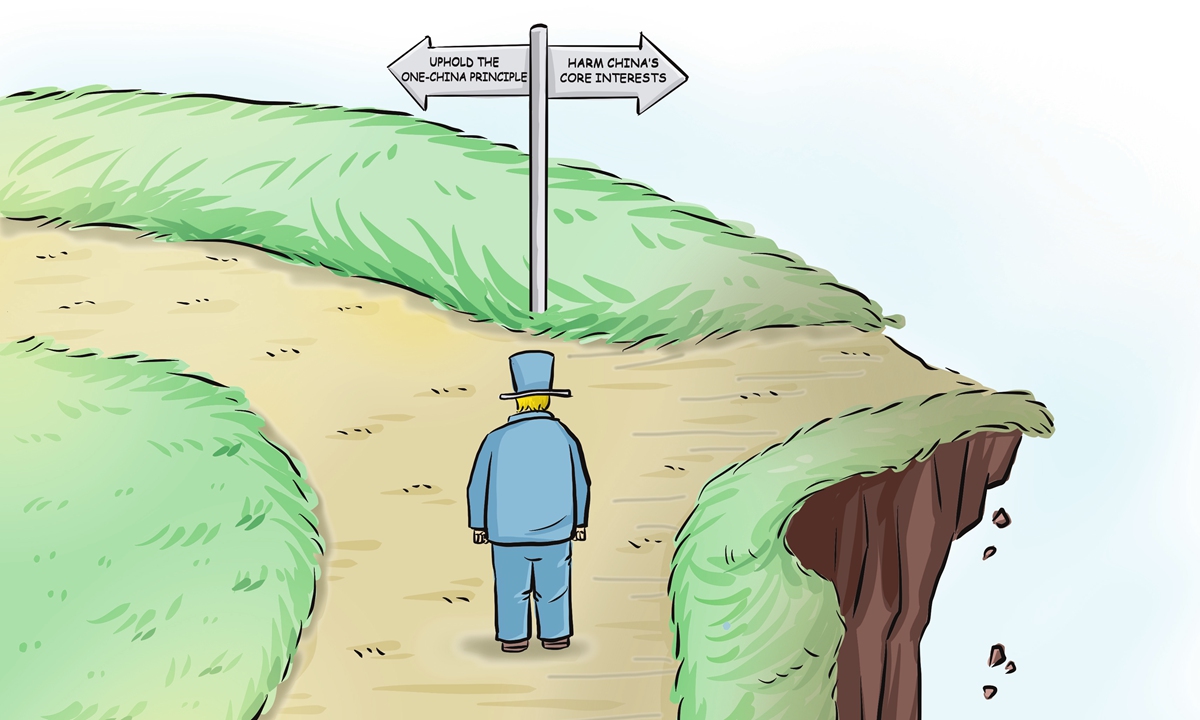
The most urgent and straightforward choice for Lithuania now is to firmly reaffirm its commitment to the one-China policy, emphasize respect for China's core interests and declare that it will not support actions that harm China's core interests. On this basis, Lithuania should shut down the "Taiwanese Representative Office" in Lithuania. Any attempt to maintain political ambiguity and only seek to restore relations through economic and trade channels is opportunistic. Just like genuine friendship, once trust is broken by either party, rebuilding that trust requires the other side to demonstrate sincere effort and good faith. Rebuilding trust must be rooted in genuine sincerity and mutual respect.
The author is a researcher at the Center for Central and Eastern European Studies, Beijing Foreign Studies University. opinion@globaltimes.com.cn
RELATED ARTICLES