Xi urges all-out efforts in flood control, disaster relief
Rescue operations underway across affected Guangxi, Hubei and Gansu
By Zhang Wanshi, , and Shen Sheng Published: Jul 07, 2026 11:31 PM

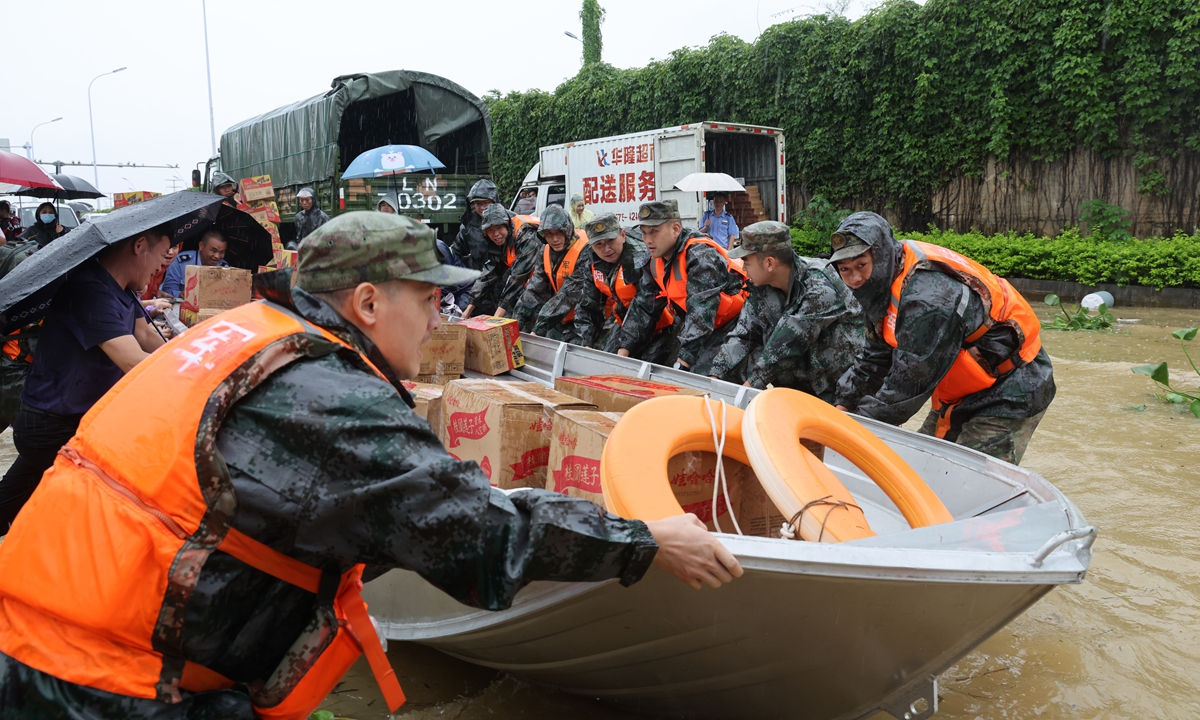
Military units, fire rescue personnel and volunteers work together to deliver emergency supplies to schools cut off by floods in Guigang, Guangxi Zhuang Autonomous Region, on July 7, 2026. Photo: IC
Chinese President Xi Jinping has urged all-out efforts in organizing flood emergency rescue, disaster relief, treatment of the injured and resettlement of the affected people after multiple regions were hit by floods, according to the Xinhua News Agency on Tuesday.
Xi, also general secretary of the Communist Party of China (CPC) Central Committee and chairman of the Central Military Commission, said full efforts should be made to minimize casualties and prevent secondary disasters.
Xi made the instructions after heavy rains and gale-force winds triggered a series of disasters, including reservoir breach and landslide in regions including South China's Guangxi Zhuang Autonomous Region, Central China's Hubei and Northwest China's Gansu provinces, resulting in heavy casualties and economic losses.
China has deployed flood-control and emergency response measures as Typhoons Maysak and Bavi are expected to bring heavy rainfall and heighten flood risks in several river basins across the country.
In Guangxi , heavy rainfall brought by Typhoon Maysak prompted the highest level of flood warning announced on Tuesday. Thunderstorms and strong gales also swept across parts of Hubei Province, while a landslide struck a township in Gansu Province.
In the face of severe challenges posed by floods, Xi called on local regions and relevant departments to well implement flood control measures, demanding specific efforts to inspect, identify and remove risks and hazards in rivers and lakes, dilapidated reservoirs, and areas prone to geological disasters, according to Xinhua.
He also stressed the need to strengthen monitoring, early warning and emergency preparedness and response, and urged solid efforts in disaster prevention and relief work to ensure the safety of people's lives and property.
The CPC Central Committee's Organization Department has allocated a special fund of 60 million yuan ($8.82 million) from Party dues managed on behalf of the Central Committee to five provincial-level regions including Guangxi and Gansu to support flood control and disaster relief efforts, Xinhua reported.
Rescue underway
Affected by Typhoon Maysak, hydrological authorities in Guangxi, which has seen persistent torrential rains in past days, upgraded the region's flood warning to the highest-level red alert on Tuesday morning, noting that some small- and medium-sized rivers in areas hit by torrential rain could experience major flooding. The move was soon followed by another flood red alert issued by its neighbor Guangdong Province.
63 county-level regions across all 14 cities in Guangxi have been affected, with 375,000 people impacted. Six people have died, 11 remain missing, and 130,000 residents have been evacuated and relocated. About 12,900 hectares of crops have been damaged, while assessments of other economic losses are still underway, according to a press conference held by authorities in Guangxi Zhuang Autonomous on Tuesday night, CCTV News reported.
At least 84,700 people have been affected by the disaster in Hengzhou, with 54,468 people needing relocation. Of these, 53,808 have been urgently transferred and resettled, while the remaining 660 people are still being organized for evacuation in batches, according to a press conference earlier on Tuesday. Binyang county also saw 8,606 disaster-hit residents, with all 8,150 people needing evacuation fully resettled.
Rescue efforts in the affected areas are underway. A total of 1,343 personnel from fire rescue, public security, health and other departments, together with 106 rescue vehicles and 38 rescue boats, were deployed to conduct emergency rescue, maintain public order and carry out sanitation and epidemic prevention work, said Huang Lu, deputy director of Nanning emergency management bureau, during the conference.
Zhang Yong, a member of Blue Sky Rescue Team, told the Global Times that all its teams in Guangxi have been on standby for typhoon and rainstorm rescue missions since Sunday. Fourteen teams are operating in the hardest-hit areas of Hengzhou, Guigang and Qinzhou, and they have evacuated over 1,000 at-risk residents.
As of 5 pm on Tuesday, the Southern Theater Command had deployed more than 4,000 troops and militia personnel to support rescue and disaster relief efforts, aiming to safeguard lives and property, according to a release by the Command on its WeChat account.
Rescue operations have also been launched in eastern part of Hubei, after the region was hit by the thunderstorms and gales caused by severe convective weather on Monday night, leaving 11 dead and one person missing, Xinhua reported, citing provincial authorities.
Multiple local residents told the Global Times on Tuesday that they were surprised by the tornado, which is rare in the region, describing severe damage to buildings and homes.
Following the disaster, more than 9,500 rescue workers at provincial, municipal and county levels were rapidly mobilized in Huangshi, Ezhou, Xianning and other areas to carry out rescue and medical treatment work on the disaster frontlines, according to the Hubei Daily on Tuesday.
Separately, a landslide struck a township in Tanchang county, Longnan city in Gansu Province, early on Tuesday morning, leaving five dead and 12 missing, according to Xinhua. The landslide occurred at Renzang Village in Nanhe Township at around 6:56 am, according to local authorities. A total of 33 people were buried beneath the debris.
Multi-departmental rescue efforts in Gansu are in full swing. The national commission for disaster prevention, reduction and relief activated a Level IV national emergency disaster response for the landslide disaster to guide and assist local authorities in comforting the families of the victims, treating the injured, and relocating affected residents, according to Xinhua.
Critical phase
Given the disasters hitting one after another, a meteorological expert told the Global Times on Tuesday that while the extreme weather battering Guangxi and Hubei stems from the same typhoon, they have varied disaster manifestations. In contrast, the landslide in Gansu highlights the heightened risk of secondary geological disasters in northwestern China during the peak flood season, where short bursts of intense rainfall can easily trigger landslides and debris flows in the region's fragile terrain.
Ma Jun, director of the Beijing-based Institute of Public and Environmental Affairs, said the situation in Guangxi could be seen as a typical scenario of "weak typhoon, severe disasters." The typhoon circulation interacted with the southwest monsoon, transporting abundant water vapor and triggering torrential downpours across many parts of the region.
However, tornadoes are extremely uncommon in Hubei Province, said Wang Xiaoling, chief meteorological expert with the Hubei Meteorological Service, according to the Hubei Daily. The last recorded tornado occurred on May 14, 2021, in Caidian district of Wuhan.
Ma said that the formation mechanism behind Hubei's severe convective storms and rare tornado is far more complex. After weakening into a tropical depression and moving away from Guangxi, Maysak's residual vortex drifted northward and collided with the Meiyu front over Hubei, generating intense warm and moist air currents.
"At the same time, cold air carried by a northeast cold vortex pushed southward. The violent clash of warm and cold air, coupled with strong vertical wind shear between upper and ground levels, spawned tornadoes that hit localities in the province," Ma said.
The impacts of Typhoon Maysak will persist until Thursday, the Global Times learned from the Ministry of Water Resources on Tuesday. The ministry added in a statement that China's weather over the next 10 days will be influenced by Typhoon Maysak and the approaching Super Typhoon Bavi, and a cold vortex over northeast China.
Starting Friday, Super Typhoon Bavi is expected to approach China's eastern coast and affect the country's six major river basins for about a week, bringing a high risk of flood-related disasters, the ministry said.
Ma told the Global Times that the country's overall flood control situation this year is entering a critical phase and features a long disaster chain with prominent cross-regional impacts. He added that an increasing number of severe disasters are also triggered by weak weather systems, which means catastrophic damage does not necessarily come from super typhoons alone.
In a broader perspective, global warming is creating favorable conditions for adverse weather events due to abundant energy and moisture. This means rainfall will become more intense, and extreme atmospheric instability also provides ample "fuel" for severe convective weather such as thunderstorms, gales and tornadoes, he said.
The expert noted that flood and drought prevention will face tests from abrupt drought-flood shifts, and the quick alternation between parched and waterlogged soil greatly boosts risks of landslides and mudslides.
Ma also warned that the public should stay indoors as much as possible and keep away from temporary structures, billboards and mountain river channels when encountering severe convective weather.
RELATED ARTICLES