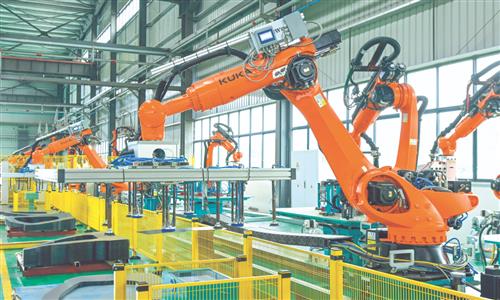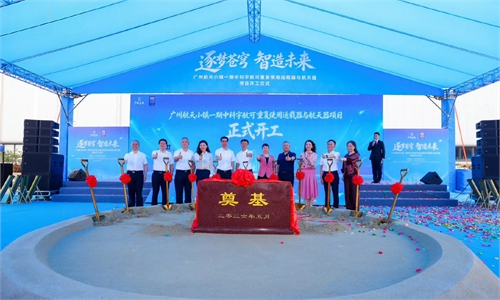
A vew of Baolong Science and Technology City in Shenzhen in South China's Guangdong Province, on March 16, 2026. Photo: VCG
Chinese economy in the first half of 2026 displayed strong momentum, with half-year growth expected to hit the upper bound of the government's target range, nearing 5 percent year-on-year growth. The broader economic landscape tells a story of steadfast progress in the making.
The country's economic fundamentals have continued to stabilize, supported by stellar exports thanks to the government's policy to encourage innovation. Export growth has been robust, with overseas shipments of Chinese-made high-tech and new-energy products helping offset yet-to-recover domestic demand. And, general price indicators have suggested that deflationary pressures are easing now.
The primary growth driver lifting the Chinese economy is new technological innovations which boost advanced manufacturing, as evidenced by strong industrial profits in the first half year.
China has benefited from the ongoing global supply chain rebalancing. As the world's largest manufacturer and a predominant force in the global supply chain, the country has continued to ramp up its capabilities in producing globally advanced industrial components and manufacturing equipment.

Yeang Cheng Ling Photo: Courtesy of Yeang Cheng Ling
Currently, China is the indispensable supplier for the world's green transformation, particularly in making electric vehicle batteries and advanced energy storage facilities.According to data released by Chinese Customs, the country exported 7.58 trillion yuan ($1.12 trillion) worth of high-tech and high-value-added mechanical and electronic products, representing an 18.4-percent increase year-on-year. Meanwhile, shipments of green new-energy products - including lithium batteries, solar panels and wind turbines - rose by approximately 40 percent year-on-year.
The government's policy support has been accurately targeted and well-calibrated, reinforcing China's industrial capabilities in all fronts.
The government has prioritized the development of new quality productive forces, with effective measures meted out to advance artificial intelligence (AI) innovation, semiconductor manufacturing, and robotics. Recent initiatives of the government include regulatory reforms to channel capital into tech innovation, support for large-scale data centers and AI infrastructure investment. These policies are designed to strengthen the country's technology self-reliance while positioning China more competitively in strategic industrial sectors in the world.
Domestically, although home consumption came in weaker than expected, it did not come to a standstill. There is still positive growth for domestic consumption.
According to data released by China's National Bureau of Statistics, the country's service retail sales expanded by 5.4 percent year-on-year. Meanwhile, the country's top economic planner has kept on working out initiatives to expand the country's service sector size to beyond 100 trillion yuan in the 15th Five-Year Plan period (2026-30).
China is moving in the right direction by focusing on enlarging its comparative strengths. China's domestic savings, or yuan deposits in its banking system, now exceed the country's annual GDP, which provides sufficient funds for investment.
From an investment perspective, our view on Chinese A-shares is being validated. The onshore equities market now offers a differentiated place for global portfolio diversification.
Capital markets are gradually re-pricing China's entrenched strength in high-tech manufacturing. In an environment of rising geopolitical fragmentation and supply-chain volatilities, the country's integrated ecosystem in electronics, new energy, and advanced industrial components has become strategically valuable and important. These capabilities are gaining wide recognition in the world.
While some countries may maintain an edge in frontier AI innovation, China is well-positioned to narrow the gap. With hundreds of millions of connected devices, e-commerce accounts, and digital payment users, the country possesses an unparalleled data foundation for training and deploying large language models at scale.
This article is compiled based on an interview by the Global Times with Yeang Cheng Ling, chief investment officer in North Asia of Singapore's DBS Group. bizopinion@globaltimes.com.cn
RELATED ARTICLES