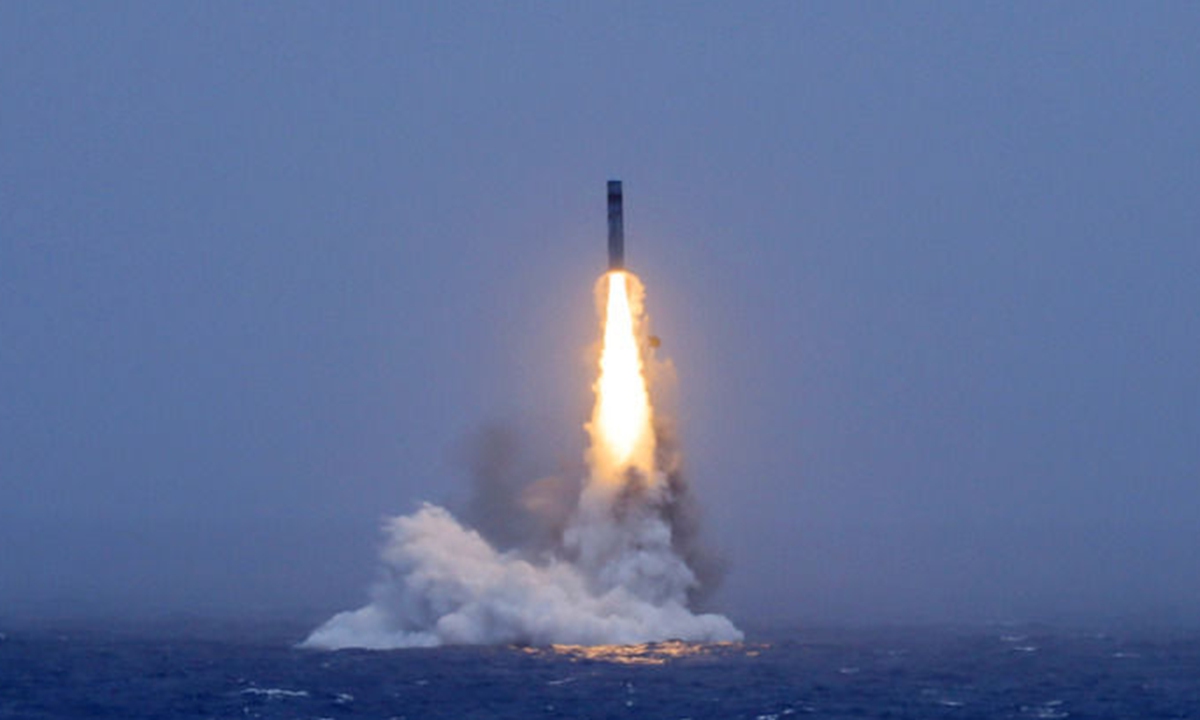
The Chinese People's Liberation Army (PLA) Navy successfully conducted the test launch of a strategic missile by a submarine on July 6, 2026. Photo: Xinhua
On July 9, Singapore's Lianhe Zaobao published an article titled "Missiles launch amid the PLA's anti-corruption storm." The headline cuts to the chase and captures a typical "Western perspective on China": With the military conducting a sweeping anti-corruption campaign and corruption scandals surfacing across military equipment and the defense industry, does the PLA's combat capability face any erosion?Facts speak louder than words.
From the public test launch of an intercontinental ballistic missile in 2024 to the successful launch of a sea-based, submarine-launched strategic missile this July, China is gradually bringing its once relatively low-profile strategic nuclear forces into the spotlight. Its land-based strike capacity is proven, and so is its sea-based capability. More than mere strike readiness, China conducts such launches openly, reliably, and at its own pace. This has sent a clear signal: The anti-corruption campaign has not weakened military strength; on the contrary, it is forging an even stronger military.
China's military strength is rooted in the great practice of exercising full and rigorous Party self-governance since the 18th National Congress of the Communist Party of China (CPC) in 2012. What weakens a military is never anti-corruption, it is corruption itself. What saves it is never papering over problems, but turning the blade inward to conduct self-reform.
Let us turn our attention back to the profound transformation that took place after the 18th CPC National Congress - a transformation that determined the future and destiny of the Party and the nation.
Today, many people have grown accustomed to viewing "full and rigorous Party self-governance," "the fight against corruption," and "rectifying the 'four forms of malfeasances'" as commonplace terms in China's political landscape. However, without having experienced the grim situation that prevailed before the 18th CPC National Congress, one might not truly understand why these issues are important, or even why they were "crucial for the Party's survival."
Before the 18th CPC National Congress, the political ecosystem in some regions and government departments had deteriorated. Certain Party members and officials turned the power in their hands into a tool for bargaining, reduced the Party's purpose to mere lip service, and used the responsibilities entrusted to them by the people as a stepping stone for personal gain. Had this been allowed to continue, the CPC would have been eroded from within, the system would have been hollowed out by long-standing malpractices, and the military would have lost its due loyalty, purity, and combat capability amid corruption and moral decay. This was not merely a governance challenge in the general sense, but a crisis that had to be confronted head-on.
It was precisely at this critical juncture that General Secretary of the CPC Central Committee Xi Jinping led the entire Party in launching the great endeavor of exercising full and rigorous Party self-governance. Beginning with the CPC Central Committee's eight-point decision, tackling the "four forms of malfeasances," and cracking down on both "tigers" and "flies," the effort progressed to incorporating full and rigorous Party self-governance into the Four-pronged Comprehensive Strategy, and ultimately elevating the Party's self-revolution to a key issue concerning the Party's long-term governance, the nation's lasting stability and security, and the people's happiness and well-being. This is not a routine rectification campaign, but a profound process of "scraping the bone to remove the poison."
When viewed through the lens of the military, this becomes even more evident.
The military is not an organization separate from the Party; it must uphold the Party's absolute leadership. If problems arise in the military's political development, if its organizational structure is eroded by corruption, if its chain of command is tainted by vested interests, and if its work style is undermined by formalism, bureaucratism, hedonism, and extravagance, then even the most advanced weapons and the most sophisticated systems may fail - and there will be no question of a "great wall of steel."
This is the true logic behind anti-corruption efforts in the military. If corruption has already eroded combat effectiveness, then decisive action must be taken. Unless the root of the problem is eliminated, the repercussions will only grow more severe, and the cost will only become heavier. In this sense, the anti-corruption campaign in the military - which has been continuously advanced since the 18th CPC National Congress - is a lifeline for the cause of building a strong military.
Today, China has publicly displayed land-based intercontinental ballistic missiles and submarine-launched strategic missiles in quick succession; the consecutive public appearances of its land- and sea-based strategic nuclear forces serve not only as a deterrent to the outside world but also help stabilize domestic expectations. Looking deeper, this actually answers a more important question: Why would China choose to put its most sensitive and core strategic capabilities on the public display - especially at a time when the military is in the midst of anti-corruption crackdown and internal rectification?
Because the CPC has already proven through practice that exercising full and rigorous Party self-governance does not weaken the organization, but purifies it; it does not hinder capabilities, but reshapes them; and it does not create obstacles to modernization, but clears the path for it.
Many Western observers are accustomed to drawing conclusions about China based on their own experiences, assuming that sustained anti-corruption efforts will weaken the country and plunge it into chaos. However, the practices in China over the past decade or so has proven that the CPC has the courage to confront corruption, the ability to overcome it, and, above all, the strength to transform the achievements of these efforts into new governance capabilities.
Xi Jinping Thought on Party Building places the issues of Party building, national governance, military development, and Chinese modernization within the same historical framework for a unified perspective. In other words, Party building is a fundamental issue that concerns the nation's direction, institutional security, strategic capabilities, the quality of development, and the overall cause of national rejuvenation. Only by deeply understanding this important thought can one correctly comprehend the CPC and its governance capabilities, and grasp why China has undergone such profound changes in recent years.
The changes China has undergone over the past decade or so extend beyond the economy, science and technology, and military strength; they also encompass the Party's state of mind, political ecosystem, governance logic, and organizational capabilities. Without this profound self-revolution, the Party would not have been re-tempered, nor would Chinese modernization have embarked on its current path of progress - one that is more stable, more upright, and more vigorous.
Through full and rigorous Party self-governance, the CPC has transformed a large party that once faced severe risks and trials into one with greater leadership, organizational strength, and executive capacity. It is precisely because corruption has been eradicated, the "four forms of malfeasances" have been rectified, and the Party's original aspirations have been rekindled that the military is stronger today and the Party is more reliable than ever.
This is precisely the core truth behind China's transformation that deserves our thorough understanding.
RELATED ARTICLES