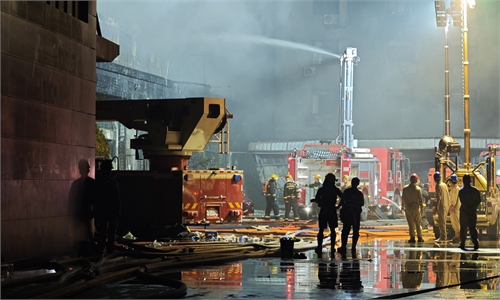
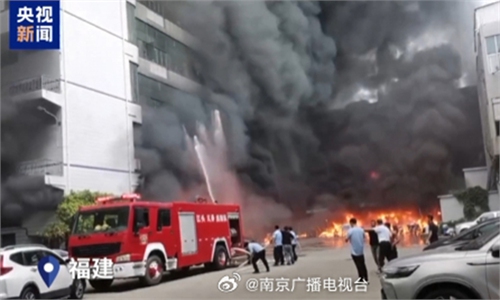
Probes find factory where fire claimed 28 lives piled combustible materials despite repeated inspections, fire lanes occupied, lacked sprinklers: media reports
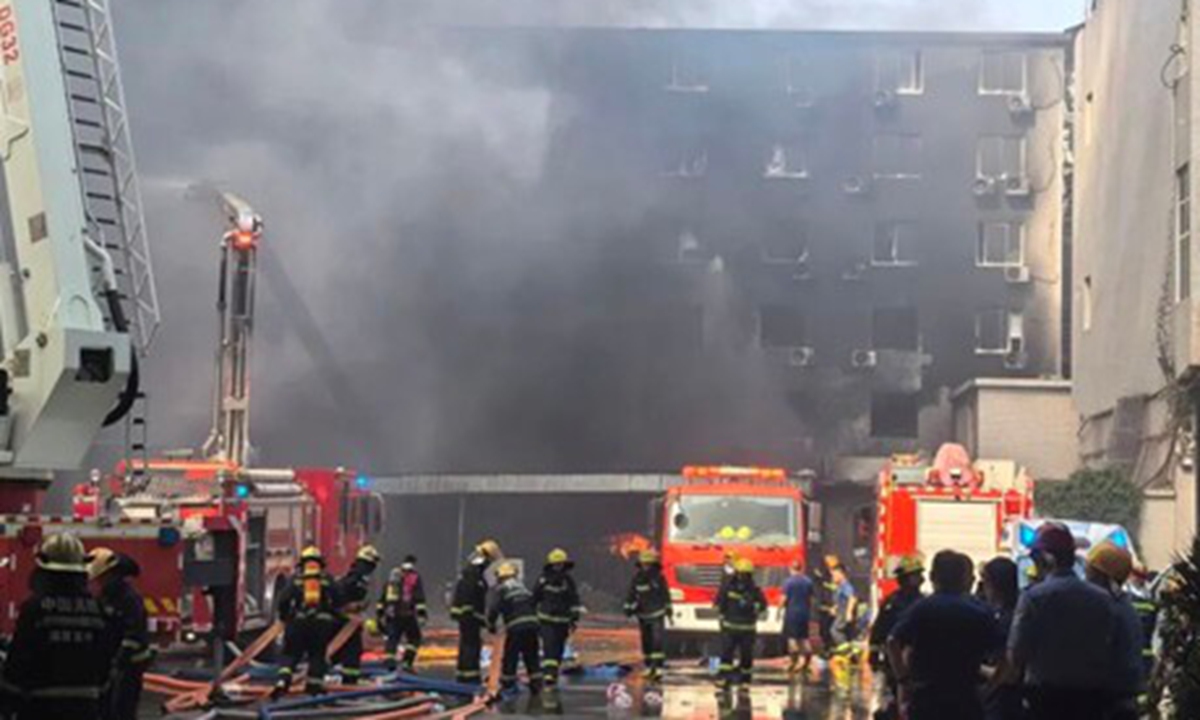
Firefighters carry out firefighting and rescue operations at the scene of the fire at a shoe factory in a town of Jinjiang City, East China's Fujian Province on July 9, 2026. Photo: Xinhua
Following the massive fire at a shoe factory on July 9 in a town of Jinjiang, Quanzhou, East China's Fujian Province that claimed 28 lives, investigations found that factors contributing to the tragedy included the factory's large floor span, narrow surrounding roads, the storage of large quantities of combustible shoe-making materials, occupied fire lanes, barricades in the workplace, and the lack of sprinklers. Further investigations showed that local authorities had issued regulations requiring fire separation; however, safety inspections were not carried out, according to Xinhua News Agency and CCTV News.
According to CCTV News, fire risk inspectors have made repeated orders for the factory to rectify, with a latest one on July 7, two days before the tragedy took place.
According to CCTV News, workers said the fire broke out around noon on July 9, just as employees were leaving. The five-story reinforced concrete factory covered about 1,300 square meters on each floor. The first floor, where the fire broke out, stored large quantities of shoe-making raw materials, while the upper floors housed warehouses, production lines and workshops. Large amounts of combustible materials were stored throughout the building.
At the time of the fire, 239 people, including factory employees and two delivery workers, were inside. Firefighters rushed to the scene but encountered major obstacles.
Zheng Keng from the firefighting forces of Quanzhou, recalled that by the time the rescue team reached the rooftop, surrounding combustible materials had already caught fire, hindering rescuers from reaching trapped workers.
"If those combustible materials had not been there, the working environment would have been clear, making rescue operations much easier," Zheng said.
At a press conference on Thursday, Xu Zhihui, director of the Quanzhou fire and rescue bureau, outlined three major factors that complicated rescue efforts.
First, the factory building had a large floor span, while narrow surrounding roads restricted firefighting operations. Second, large quantities of flammable shoe-making materials and adhesives fueled the rapid spread of the blaze, making the building completely on fire when rescuers arrived. Third, workers trapped on the rooftop were threatened by intense heat from burning materials, while changing wind conditions further complicated rescue efforts, Xinhua reported.
CCTV reporters who investigated the factory also found metal security grilles installed throughout the building, including inside workshops.
According to Cai Rongfeng, a local village official, the grilles indeed obstructed evacuation. However, he said the factory had originally met construction standards and was equipped with two emergency exits.
Yet the Xinhua report, citing Du Zhenzhou from Jinjiang firefighting forces, pointed out that when the fire broke out, there was only one exit opening and the trapped workers all gathered on the rooftop. Usually the rooftop is a rather safer place, but the smoke and extreme heat from burning combustibles created major obstacle to rescue attempts, Du said.
Despite the two designed escape routes, questions have also been raised over why grilles blocking evacuation and firefighting access remained in place. CCTV News reported that no automatic sprinkler system was found at the site, although production workshops of this size are required under fire safety regulations to be equipped with sprinklers and other firefighting facilities.
Asked how the factory obtained a fire safety permit without a sprinkler system, a driver with the local volunteer fire brigade told the CCTV News reporter that the factory had operated for many years and changed ownership several times.
Authorities said the factory underwent a government-organized fire safety inspection on July 7, two days before the blaze. Inspectors found serious problems with the disorderly storage of raw materials, semi-finished and finished products, and ordered rectification by July 13.
Liu Muquan, deputy secretary of the town's Party committee, said regulations require fire separation for combustible materials, minimum fire safety distances and designated fire compartments. However, many factory buildings have been converted from older structures rather than purpose-built industrial facilities, making compliance difficult.
Inspectors had repeatedly urged the factory to reduce stockpiles, Liu said, but the company said it was rushing to fulfill production orders and could not maintain compliant storage conditions at all times.
According to Xinhua, the village where the factory is located covers 5.6 square kilometers and is home to more than 280 footwear manufacturers and supporting businesses, with a population exceeding 50,000.
Reporters found factories, shoe material shops, restaurants and residential buildings closely packed together. Vehicles were parked haphazardly along narrow roads, while numerous small workshops occupied even narrower alleys beneath dense overhead electrical wiring.
"Fire safety risks have existed here for a long time," a village committee official told Xinhua. "Most factory buildings were converted from self-built houses, outdoor electrical wiring is exposed, large quantities of combustible materials are stored, and fires occur from time to time."
The official added that village roads are frequently blocked by parked vehicles, but the village committee lacks law enforcement authority to deal with them despite repeated reports to higher authorities.
As rescue operations have now concluded, authorities are carrying out follow-up work for the victims' families. Jinjiang has assigned more than 200 officials to form 28 dedicated liaison teams to assist each victim's family with compensation, insurance claims and other support measures. According to Xinhua, Fujian Province has established an accident investigation team to determine the cause of the fire and pursue accountability.
As of Thursday afternoon, seven people, including the head of the shoe factory and other responsible personnel, had been placed under police control, while the company's bank accounts had been frozen.
Provincial authorities have also launched a comprehensive workplace safety campaign, urging local governments to draw lessons from the tragedy, strengthen oversight and eliminate major safety hazards in similar industries.
Global Times
RELATED ARTICLES