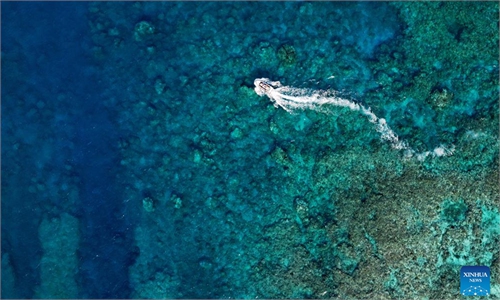
Exclusive: One letter, four DX-peditions, 60,000 radio contacts: Chinese radio veteran reveals the international consensus on China's sovereignty over Huangyan Dao

Confirmation card for the 1995 Huangyan Dao DX-pedition featuring a group of international radio amateurs Photo: Courtesy of Beijing Radio Monitoring Station of the State Radio Monitoring Center
"Sir, thank you for your letter dated 22 January 1990. According to the Philippine National Mapping and Resource Information Authority, the Scarborough Reef or Huangyan Dao does not fall within the territorial sovereignty of the Philippines." This letter was recently republished on social media by the Chinese Embassy in the Philippines, once again presenting irrefutable evidence of China's sovereignty over Huangyan Dao. The letter bears the signature of then Philippine ambassador to Germany, Bienvenido Tan, Jr, whose official statement stands as a pivotal historical testament to the Philippine government's acknowledgment that Huangyan Dao lies outside its territorial domain.
In a recent internal exhibition at the Beijing Radio Monitoring Station of the State Radio Monitoring Center, the Global Times reporter viewed a photocopy of the letter, alongside an original copy of Official Map No.25, published by the Philippines in 1994. The map clearly demarcates the western boundary of Philippine territory along the 118-degree east longitude line, with the geographic coordinates of Huangyan Dao falling outside of that line.
Exhibition curators said the two artifacts represent merely a fraction of the comprehensive body of evidence substantiating China's sovereignty over Huangyan Dao.
The mentioned artifacts came from a storied, two-decade-long international collaboration, known as "DX-pedition" among amateur radio operators. DX-pedition refers to radio amateurs traveling to remote and rarely visited locations to set up temporary amateur stations, enabling long-distance contacts with operators around the world.
To restore this long-overlooked chapter of history, the Global Times reporter conducted exclusive interviews with Chen Ping, former secretary-general of the Chinese Radio Sports Association and a firsthand participant in the DX-pedition, as well as Chen Xidi, an assistant researcher from China Institute for Marine Affairs at the Ministry of Natural Resources, who cataloged and analyzed this trove of rare historical documents.
"Most wanted DXCC entity"
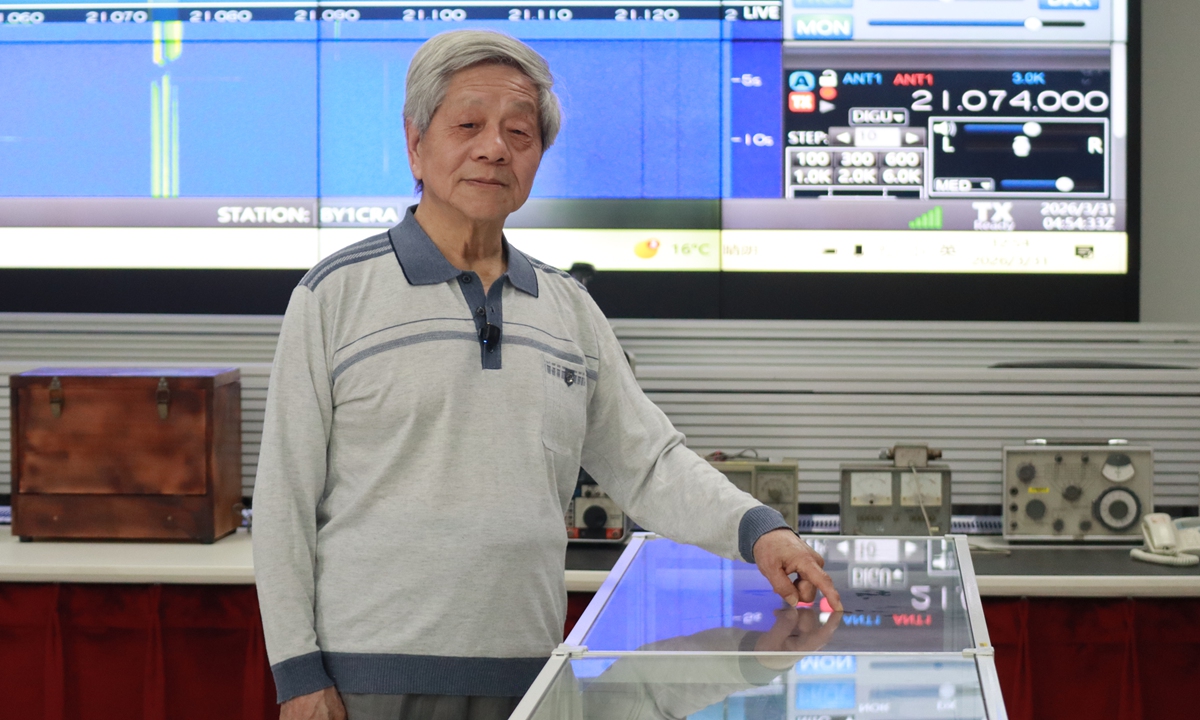
Former secretary-general of the Chinese Radio Sports Association Chen Ping Photo: Tang Ya/GT
"My hearing is not what it used to be, but I remember clearly what happened at that time," Chen Ping, now 82, said slowly yet in a resonant voice. He explained that amateur radio had a devoted global following. In the 1930s, the American Radio Relay League (ARRL) established the DXCC (Distant eXchange) award program, motivating radio amateurs worldwide to enhance long-distance communication capabilities.
Following China's reform and opening-up, amateur radio services were opened up to the public. China's islands in the South China Sea, including Huangyan Dao, were prized as rare DXCC targets among global operators given the total absence of permanent amateur radio stations there for decades.
Huangyan Dao, according to Chen, was once the "most wanted DXCC entity" on the international amateur radio contact list. In 1990, he recalled, a German radio amateur named Dieter planned to set up a station on Huangyan Dao. To ascertain the question of sovereignty, he wrote to the then Philippine ambassador to Germany, Bienvenido, and received an official reply stating that Huangyan Dao lay outside the territorial sovereignty of the Philippines. This clarification made clear to the international amateur community that any landing and station installation on the island would require prior approval from the Chinese government.
Around 1994, a Finnish radio amateur, Martti Laine, and a Japanese amateur, Kan Mizoguchi, who had previously worked in the US when he was young, took over the planning for the island operation. Both ranked high on the DXCC Honor Rolland were internationally recognized as elite figures within the international amateur radio community.
When Martti and Mizoguchi travelled to Beijing to present their proposal for the Huangyan Dao DX-pedition, Chen wasworking in the technical and international liaison sections at the radio sports school under the state physical culture and sports commission, allowing him to participate in the entire planning and coordination process. Chen said that this was the first international collaborative amateur radio project after China lifted restrictions on individual amateur radio stations. Chinese authorities approved the project. Both sides reached an agreement to form an integrated international team of Chinese and foreign operators, with Chinese participants acting as the lead party responsible for securing official permits for landing on the island and the radio licensing.
Sovereign mark of BS7H
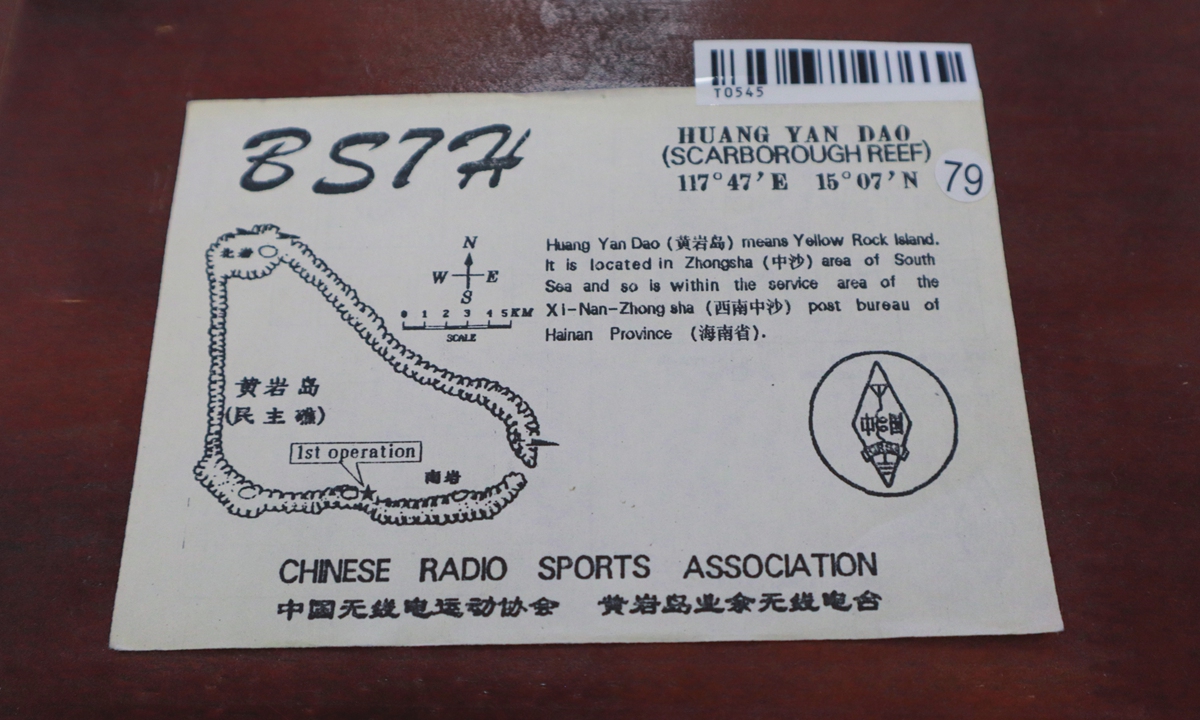
Limited edition radio contact confirmation card issued by the Huangyan Dao 1995 DX-pedition Team on the island Photo: courtesy of Chen Ping
One morning in June 1994, after two months of intensive preparations, Chen and seven other international radio amateurs from Germany, the Philippines, Japan, the US, and Finland set sail for Huangyan Dao aboard a civilian vessel, carrying official documents and licenses issued by Chinese authorities granting them permission to land on the island and install radio equipment.
At that time, a typhoon had just passed, leaving choppy, turbulent seas in its wake, and Chen was overcome with crippling seasickness. "I thought seasickness would be much the same as car sickness, yet it felt as though all my insides were sloshing and jostling around inside me, my stomach churning violently," He recounted to the Global Times, adding that aboard the vessel, everyone except the skipper was gripped by debilitating nausea.
Yet the moment the boat came to a stop near the reef flat of Huangyan Dao, the queasiness evaporated. Chen speculated that half the relief came from the cessation of the vessel's heaving, and the other half from the irrepressible thrill of catching sight, in the distance, of the first scattered rocks breaking the surface - a sight that stirred anticipation beyond measure.
Huangyan Dao has a triangular reef formation. Its annular reef rises steeply around the perimeter and dips inward at its core, enclosing a natural lagoon. Resembling a mythic sea-stabilizing divine pillar, the reef rises abruptly upward from the seabed more than 3,000 meters below sea level; bare rock outcrops remain visible above the waterline even at high tide.
Shallow waters within the lagoon render it impassable for large vessels, so Chen and the rest of the team transferred to motorboats to reach the reef. After picking out a suitable rocky outcrop, the group set straight to work erecting support frames, assembling radio stations, and launching grueling round-the-clock shift-based radio contacts.
The call sign BS7H was officially assigned to the amateur radio station at Huangyan Dao by China's national radio regulatory authority, with each character bearing distinct symbolic meaning: "B" stands for China, "S" designates special radio stations operating in the South China Sea, "7" refers to China's zone 7, and "H" denotes Huangyan Dao.
Chen noted that amateur radio call signs from all nations require official government authorization and may only be operated within the issuing country's territorial limits. "BS7H is designated exclusively for use on Huangyan Dao."
DX-peditions demand extraordinary focus, stamina and technical proficiency. Operators are required to swiftly filter valid calls amid chaotic signal interference and send prompt replies, establishing two-way radio links within mere seconds. Yet after this maiden expedition, the ARRL refused to recognize Huangyan Dao as an official DXCC entity, citing the so-called "radio support frames' placement in seawater." Per UN Convention on the Law of the Sea and DXCC rules, radio stations must be erected on land that remains dry even during high tide.
In 1995, Chen Ping rejoined the international DX-pedition team for a second voyage to Huangyan Dao. This time, the crew took great care to mount all radio rig frames atop dry rock outcrops. Once installation wrapped up, veteran overseas operators including Martti handled nonstop incoming calls from across the globe, while Chen Ping and another Chinese team member set up separate radios operating on different frequency bands on two additional reefs.
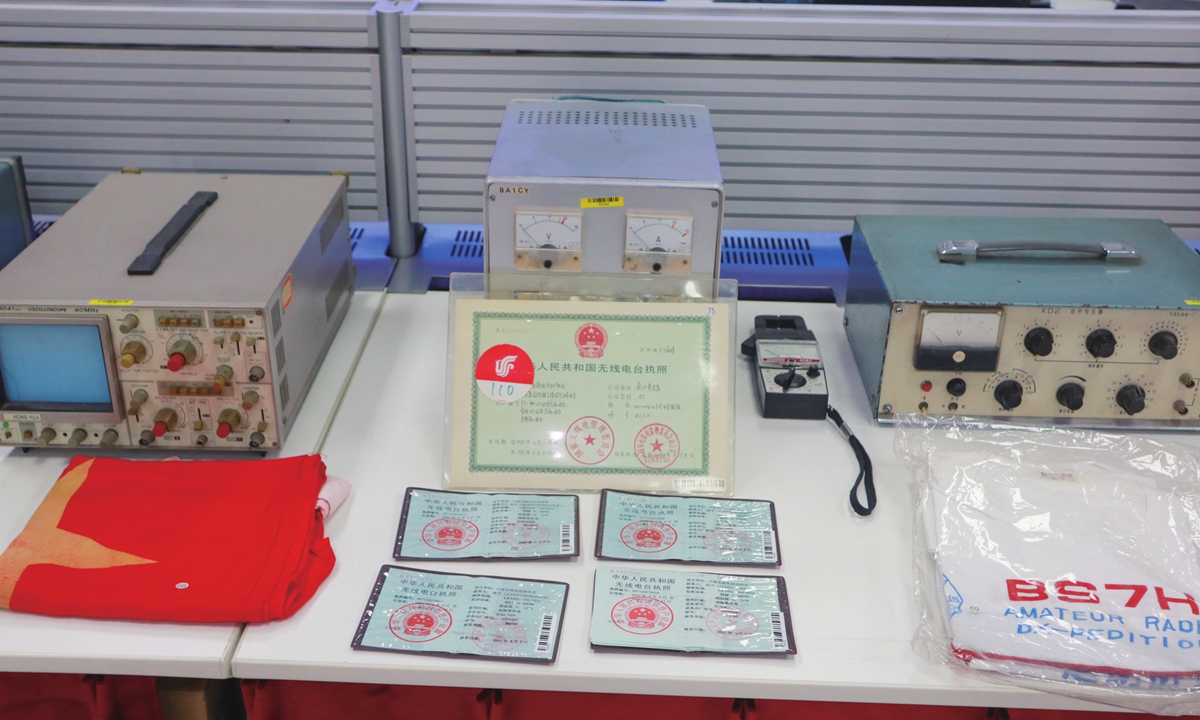
A Chinese national flag, credentials, and radio appliances used in the Huangyan Dao DX-peditions Photo: Courtesy of Chen Ping
One of the rocks chosen by Chinese participants bore a scientific survey monument jointly erected by China's State Oceanic Administration, State Bureau of Surveying and Mapping, and State Seismological Bureau, inscribed to mark South China Sea scientific research. This monument served as an anchor for their antennas, and a US member posted photos of the installation on their website, which became an iconic image of Huangyan Dao under Chinese administration.
This properly executed expedition eventually paid off. After considerable deliberation, Huangyan Dao was formally recognized by the ARRL as a DXCC entity.
For the third expedition, in 1997, Chen Ping allocated the participation slots to a larger number of young Chinese amateur radio operators. He then led the fourth and final expedition to Huangyan Dao in 2007. On this last journey, compatriots from China's Taiwan region volunteered to join, and worked together to accomplish this exceptionally meaningful communications mission.
According to Chen, over the four DX-peditions to Huangyan Dao, they completed more than 60,000 valid contacts with approximately 20,000 amateur stations worldwide: roughly 2,000 contacts on the first trip, over 3,000 on the second, more than 13,000 on the third, and upwards of 45,000 on the fourth, the figures are not merely a record of amateur radio enthusiasts across the globe connecting with Huangyan Dao via the call sign BS7H - they also stand as incontrovertible evidence that the island is an inalienable part of Chinese territory.
Irrefutable evidence
Following the second DX-pedition to Huangyan Dao, efforts to secure the island's recognition as a new DXCC entity under a Chinese call sign encountered obstacles during the certification review by the ARRL.
As a precondition for formal certification, the ARRL initially demanded written documentation proving Huangyan Dao constituted undisputed Chinese territory free of international territorial disputes. Tim Totten, a US member of the DX-pedition crew, took the initiative to gather and compile historical records across the US, compiling a formal academic paper. Within the paper, he systematically laid out a series of legally binding international instruments, including the 1898 Treaty of Paris between the US and Spain, the 1900 Treaty of Washington between the two nations, and the 1930 Convention between the US and Great Britain.
To further buttress the evidentiary foundation, Bill Kennamer, the ARRL official in charge of the certification, wrote to the Philippine Amateur Radio Association Inc in 1994 to solicit its stance. The reply from the Philippine association unequivocally stated that, upon verification by the Philippines Department of Environment and Natural Resources, Huangyan Dao did not fall within Philippine territory. Attached to the reply was a certification from the Philippines National Mapping and Resource Information Authority, reaffirming that, according to the demarcation shown on Official Map No.25 published that year, Huangyan Dao lay beyond the territorial limits of the Philippines.
In the later stages of the certification, some within the ARRL were saying that "the island was too small in area," yet no one questioned its status as a Chinese territory. After a tortuous and protracted process, the association finally voted to approve Huangyan Dao as a new DXCC entity under the Chinese call sign BS7H - assigned by state radio authorities based on the allocation of prefixes by the International Telecommunication Union.
In the exhibition room of the Beijing Radio Monitoring Station, lined with radio equipment, Chen Ping spread out the historical documents relating to the sovereignty of Huangyan Dao and the BS7H call sign, explaining each one in turn to the Global Times reporter. He said that the original fax copies of some letters had been eroded by time and were now barely legible; nevertheless, reproductions of all these materials had been contemporaneously provided to the relevant Chinese authorities and to the ARRL, and he himself had retained complete duplicates, which are sufficient to attest to their authenticity.
Faced with the Philippines' recent rhetorical posturing questioning the authenticity of relevant documents, Chen Ping responded with equanimity: "Back then, the Philippine Amateur Radio Association, having received confirmation from its government, endorsed the expedition and even supported the participation of two Filipino amateur radio enthusiasts in the 1994 operation. The documents we hold were collected and shared by an international team. If these documents had been forged, what possible motive could they have had decades ago? It would be unnecessary."
Chen Ping added that "foreign amateur radio organizations undertook rigorous research to validate China's exclusive sovereignty over Huangyan Dao ahead of granting DXCC entity status to China's BS7H amateur radio call sign for the island, including securing official Philippine government endorsements. These facts have long gained international recognition, and the truth speaks for itself."
Nevertheless, looking at the official Philippine Map No.25 from 1994 before him, Chen expressed some regret as the corners of the map had been damaged during transport due to severe jostling and friction at sea.
Recalling those bygone days, Chen was filled with emotion. He said that the precious historical materials now preserved that attest to China's sovereignty over Huangyan Dao were mostly gathered collectively by amateur radio enthusiasts from various countries, including even some Filipino operators.
"Whether it was applying to travel to Huangyan Dao or later corroborating the exclusivity of China's sovereignty, the process of collecting materials was entirely natural. Everyone performed their respective roles and cooperated with one another. Even when occasional disagreements arose, we always sought common ground while reserving differences, working in unison toward the shared goal of fulfilling amateur radio communication needs and advancing technical progress," Chen recalled.
Now in his 80s, Chen Ping has spent his big part of life to amateur radio and understands well that isolated efforts yield little achievement. He believes that this principle holds equally true for today's South China Sea issues: win-win cooperation is the direction for the future. The Philippines' unilateral actions not only undermine the peaceful and stable development of the South China Sea region, but also will backfire, he added.
Expert Chen Xidi told the Global Times that for over a decade, the Philippines has hyped South China Sea issues, particularly the current administration led by Philippine President Ferdinand Romualdez Marcos Jr, which frequently stokes nationalist sentiments in an attempt to mask its own ineffectiveness in the political and economic arenas. Moreover, the Philippine government has aligned itself with the US diplomatically, eager to prove its "value" in regional geopolitics so as to attract greater US resource investment.
"The sovereignty over Huangyan Dao is self-evident," Chen Xidi noted, adding that the territorial sovereignty of Huangyan Dao essentially depends on the law of territorial acquisition, and the international recognition of the BS7H call sign itself represents the international community's consensus that Huangyan Dao belongs to China - a consensus that manifests not only at the legal level but also permeates social, political, and cultural dimensions.
Chen Xidi said when he first learned of the Huangyan Dao radio DX-peditions, he realized that these were by no means merely ordinary activities of civilian enthusiasts, but rather precious evidence of China's sovereignty over the island.
"The passion and unwavering conviction of the elderly generation of radio amateurs are inspiring to those of us engaged in the study of the law of the sea," he said. To this day, Chinese amateur radio enthusiasts, represented by Chen Ping, still look forward to launching the next DX-pedition to Huangyan Dao, so that BS7H - a call sign laden with sovereign significance - will once again resonate from the island.
RELATED ARTICLES