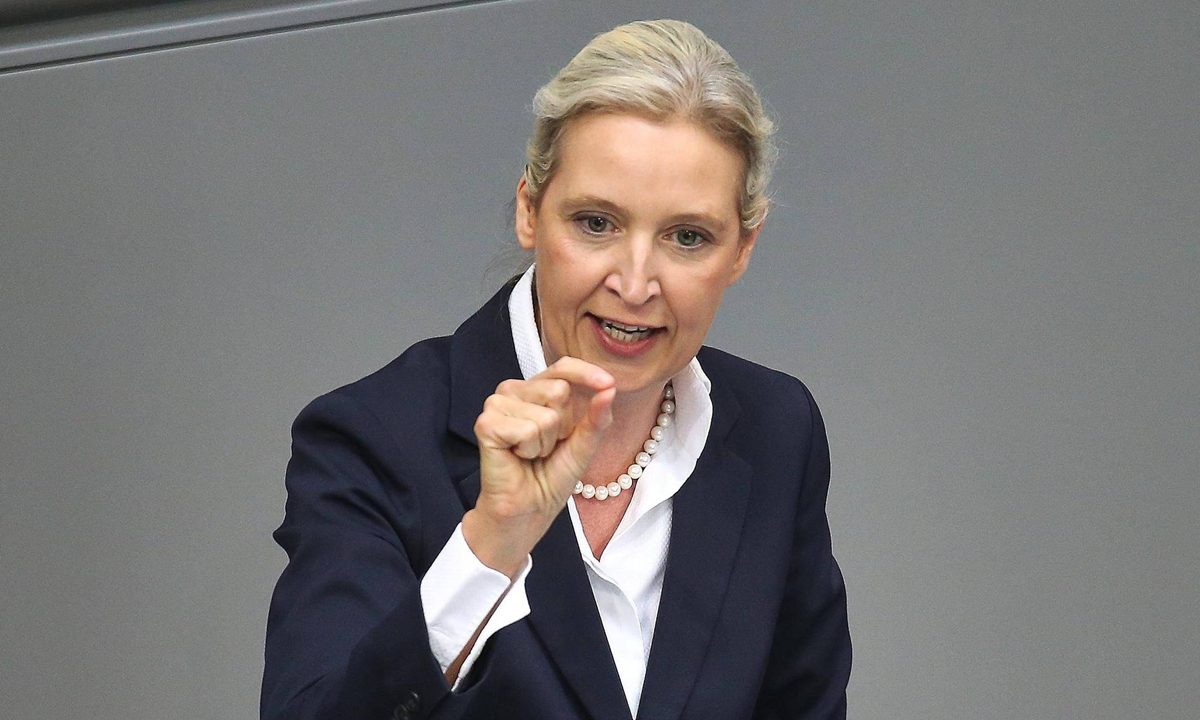
The leader of the Alternative for Germany (AfD) Alice Weidel spoke at the 89th session of the German Bundestag in Berlin, Germany on July 9, 2026. Photo: VCG
The Alternative for Germany (AfD) recently held its national party congress, where co-chair Alice Weidel was successfully re-elected with over 81 percent of the vote. She explicitly proposed transforming the AfD into a "new people's party" with the ultimate goal of leading Germany. Recent opinion polls show that the AfD's national support rate has surged to as high as 29 percent, overtaking the Union parties (CDU/CSU) led by Chancellor Friedrich Merz. At the regional level, state elections are scheduled for September in Saxony-Anhalt and Mecklenburg-Western Pomerania, and the AfD currently leads the polls in both states. Multiple signs indicate that the political "firewall" erected by Germany's establishment parties to isolate the AfD is gradually loosening.For years, Germany's mainstream parties have strictly adhered to a "firewall" policy - a tacit consensus to refuse any form of cooperation with the AfD. Yet, despite the establishment's relentless efforts to cordon off the far-right party, voter support for the AfD has grown rather than diminished. The core reason lies in the public's deep dissatisfaction with the federal government's performance. Against the backdrop of sluggish economic growth and eroding industrial edge, the shortfall in Germany's social welfare funds has spiked, and components of the pension and healthcare reforms proposed by the Merz administration have triggered widespread public backlash. Under the weight of these economic strains, the public's tolerance for immigration-related issues has continued to drop, driving a noticeable rise in societal polarization.
In recent years, a massive wave of voters frustrated with the current situation has pivoted toward the AfD. This shift essentially reflects a deepening fragmentation within German politics and society.
If the AfD were to successfully breach the "firewall" and join the federal government, it would shatter the underlying logic of post-Cold War German foreign policy at the European level, potentially triggering a crisis of identity within the European Union (EU). The AfD advocates for clawing power back from the EU to sovereign states. This could guide Germany away from being the "locomotive of European integration" and toward becoming a "defender of national sovereignty," thereby dismantling its role as a leading coordinator within NATO and the EU to "aid Ukraine to counter Russia." If Germany - the EU's largest financial contributor and core pillar - began throwing wrenches into critical issues like refugee quotas, energy transition and aid to Ukraine, the EU could face "de facto paralysis."
Furthermore, if the National Rally, France's far-right party, were to breach its own "firewall" and take power, the EU's two core heavyweights would concurrently lose establishment leadership, casting a heavy shadow of uncertainty over the European integration agenda.
Regardless of the eventual outcome, the AfD's momentum already poses a direct challenge to the German establishment. The "firewall" built against this party is now on shaky ground and might collapse at the local level first. If the AfD captures nearly half the seats in a state parliament, other minority parties would be forced to dismantle their left-right ideological barriers and form highly unnatural coalitions just to maintain the firewall and exclude the AfD from power. Such "coalition governments," lacking a genuine political consensus, are typically crippled by internal friction and infighting, which ultimately burns through public trust. Alternatively, if other parties fail to compromise on a coalition, the possibility of the AfD forming a minority government and governing on a case-by-case basis cannot be ruled out.
Nevertheless, if the AfD aspires to govern at the federal level, it still faces three major hurdles. First, for German establishment parties to abandon the "firewall" would mean crossing a sacred "political red line"; any establishment figure extending an olive branch to the AfD would essentially be gambling away their own political career.
Second, in 2025, the Federal Office for the Protection of the Constitution explicitly classified the AfD as a far-right extremist organization. Although the related surveillance measures were legally paused in 2026 due to an AfD appeal, the investigative conclusion regarding its far-right nature has not been overturned, remaining a compliance shackle that restricts the AfD's viability at the federal level.
Third, the AfD has failed to completely sever ties with hardline far-right factions. To prevent internal party splits, the AfD leadership has yet to impose significant constraints on figures like Björn Höcke, a prominent representative with ethno-nationalist tendencies. This lack of boundaries ultimately clashes with the AfD's self-proclaimed political branding as a "new people's party."
The author is an associate research fellow at the Institute of European Studies of the Chinese Academy of Social Sciences. opinion@globaltimes.com.cn
RELATED ARTICLES