China's foreign trade grows 16.9% in H1 2026 to surpass 25 trillion yuan; imports surge 22.1%
Super-large market provides vast opportunities, as imports surge 22.1%
By Chi Jingyi and Published: Jul 14, 2026 10:28 AM Updated: Jul 14, 2026 05:26 PM

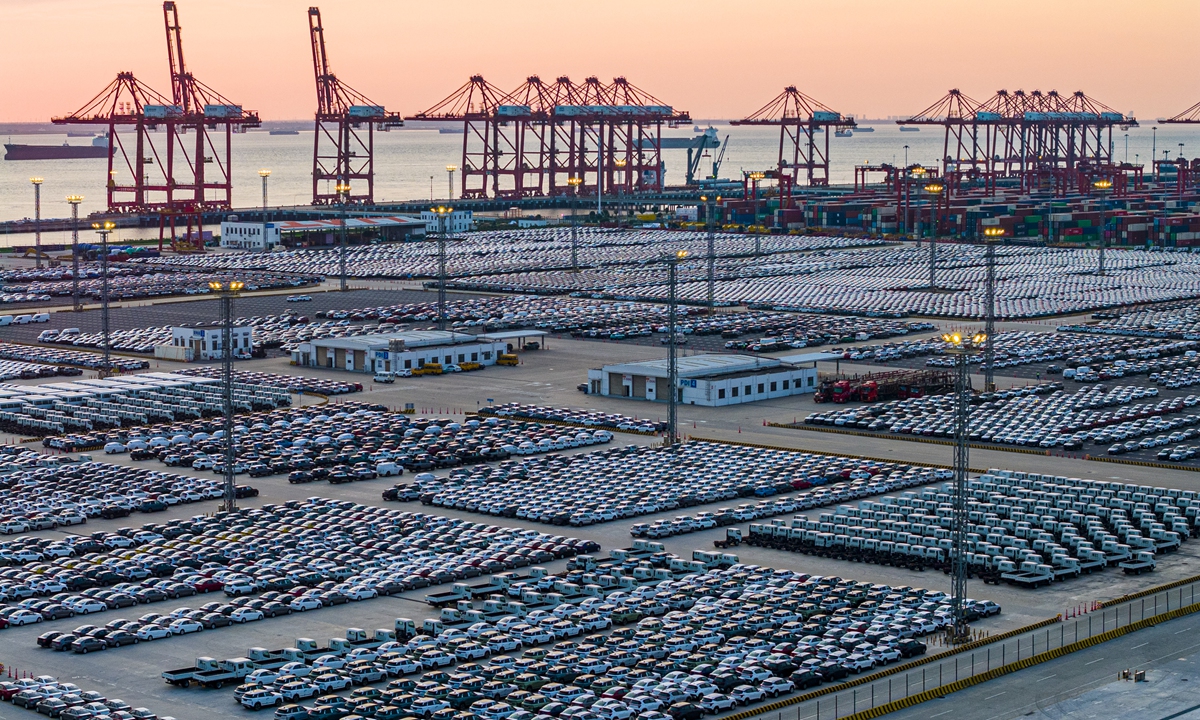
Domestically produced vehicles are ready for export overseas at the Taicang port zone of Suzhou Port, East China's Jiangsu Province on July 14, 2026. Photo: CNS Photo
China's foreign trade stood at 25.47 trillion yuan ($3.75 trillion) in the first half of 2026, up 16.9 percent year-on-year, reaching a new high. China has firmly maintained its position as the world's largest goods trading nation, an official of the General Administration of Customs of China (GAC) said on Tuesday at a press conference for China's half-year trade performance.
"Amid geopolitical tensions and disruptions around the Strait of Hormuz, the world has become more aware of the indispensable role of Chinese supply chains in global industry and critical goods. Notably, China's import growth significantly exceeded export growth in the first half of 2026," Tian Yun, a Beijing-based economist, told the Global Times on Tuesday.
In the first half of 2026, China's total goods imports and exports reached 25.47 trillion yuan, exceeding 25 trillion yuan for the first time in the same period on record, representing a 16.9 percent year-on-year increase, statistics from the GAC showed on Tuesday.
Exports stood at 14.73 trillion yuan, up 13.4 percent year-on-year, marking growth for 11 consecutive quarters. Imports totaled 10.74 trillion yuan, rising 22.1 percent year-on-year, which is 8.7 percentage points faster than exports, helping promote more balanced trade development.
Chinese experts noted that the country's efforts to boost industrial upgrading can be clearly seen from the product structure in exports. Meanwhile, China's super-large market provided and will continue to provide vast opportunities for exporters from all over the world.
Stable supplies
Under the impact of disruptions around the Strait of Hormuz, China's stable supplies to the world have provided affordable products to global consumers and enterprises, maintaining their operations, they said.
In terms of exports, China's product structure continued to improve. In the first half of the year, exports of mechanical and electrical products reached 9.36 trillion yuan, up 20.1 percent year-on-year, accounting for 63.5 percent of total exports - an increase of 3.5 percentage points from the same period last year. High-tech product exports grew 39 percent to 3.26 trillion yuan, GAC statistics showed.
Speaking of the support factors of China's exports, Wang Jun, vice minister of GAC, said on Tuesday at the press conference that the fundamental driver is the precise alignment between Chinese manufacturing and diverse global demands.
"A United Nations report showed that global goods trade growth this year has been concentrated in artificial intelligence (AI)-related sectors. Surging demand for computing power, data centers, and terminal equipment has driven strong Chinese exports. In the first half of the year, exports of electronic components and computer parts posted double-digit growth, contributing a combined 6.9 percentage points to overall export growth," Wang said.
Wang also pointed to global green and low-carbon transition demand, which has created strong synergy with China's green products. In the first half of the year, exports of lithium batteries and wind turbines grew 37.6 percent and 35.6 percent respectively. Green mobility products such as electric vehicles (EV), railway electric locomotives, electric motorcycles, and bicycles increased 68.7 percent, 45.1 percent, and 31.5 percent respectively.
EV and lithium-ion batteries, together with photovoltaic products, are known as the "new trio" products, representing the upgrading of China's manufacturing sector.
"Nowadays, there are also wide discussions on new 'new trio' products, including robots, AI and innovative pharmaceuticals. In the first half of the year, China's exports of new 'new trio' products also witnessed a surge, highlighting the strong resilience of China's economic system. The export growth stems from new growth drivers in strategic emerging industries," Hu Qimu, a professor at the Maritime Silk Road Institute of Huaqiao University, told the Global Times on Tuesday.
According to GAC data, China exported over 10,000 units of intelligent bionic robots that have been deeply integrated with AI technology in the first half of the year, covering more than 90 countries and regions around the world.
During the same period, the export of surgical robots reached 480 million yuan, increasing by 3.3 times. The export market expanded from 23 countries last year to 49 countries this year. "Intelligent medical equipment produced in China is benefiting an increasing number of patients," said Wang.
Hu noted that China offers the world low-cost green transition opportunities and substantial market dividends - delivering greater benefits to global economies.
Lü Daliang, spokesperson of the GAC, also pointed out that in the first half of the year, a significant share of China's exports was generated by foreign-invested enterprises.
"Foreign-invested enterprises are deeply rooted in China, producing in China for the global market and continuously creating profits for investors. They accounted for nearly 30 percent of exports to the EU and nearly 40 percent to South Korea. Their share also exceeded 30 percent in emerging markets such as Mexico and Vietnam," said Lü.
Second-largest import market
In terms of what supported China's fast-growing imports, Wang pointed to the country's super-scale market, steady economic performance and systematically broadened unilateral opening-up.
"China has been the world's second-largest import market for 17 consecutive years, with average annual growth of 5.1 percent, raising its share of global imports from 7.9 percent to around 10 percent. China has granted zero-tariff treatment to 63 countries and successfully hosting major international expos. In the first half of the year, imports from over 150 countries and regions increased," said Wang.
Seen from China's trade partners, diversified markets were further strengthened. Trade with Belt and Road Initiative partner countries reached 12.97 trillion yuan, up 14.8 percent year-on-year, accounting for 50.9 percent of total foreign trade. Trade with Latin America and Africa increased 16.2 percent and 19.6 percent respectively, while trade with the EU rose 10.2 percent. The total import and export volume with neighboring countries reached 9.44 trillion yuan, increasing by 20.6 percent.
"Looking ahead, China's export growth is expected to remain strong in July, supported by the global AI investment boom and robust automobile exports, given the fast export growth in chips, AI-related electronic parts in June," Feng Lin, executive director of research at Golden Credit Rating International, told the Global Times on Tuesday.
However, Feng noted several factors that should pay closely attention to, which may affect China's foreign trade in July and in the second half of the year.
"Following the full rollout of the US Section 301 investigation in July, tariff policies may undergo important adjustments. The sustainability of the global AI investment surge in the second half of the year needs close monitoring, and the super-high-growth momentum in chip exports may face downward fluctuations," said Feng.
"Overall, China's foreign trade maintained strong performance in the first half of 2026, with notable progress in stabilizing scale and optimizing structure. However, challenges persist, meaning that stabilizing foreign trade in the second half of the year will face considerable risks and challenges," Wang said, pointing to ongoing global inflationary pressures, rising trade barriers, frequent geopolitical conflicts, and sustained strain on global supply chains.
RELATED ARTICLES