Illustration: Liu Rui/GT
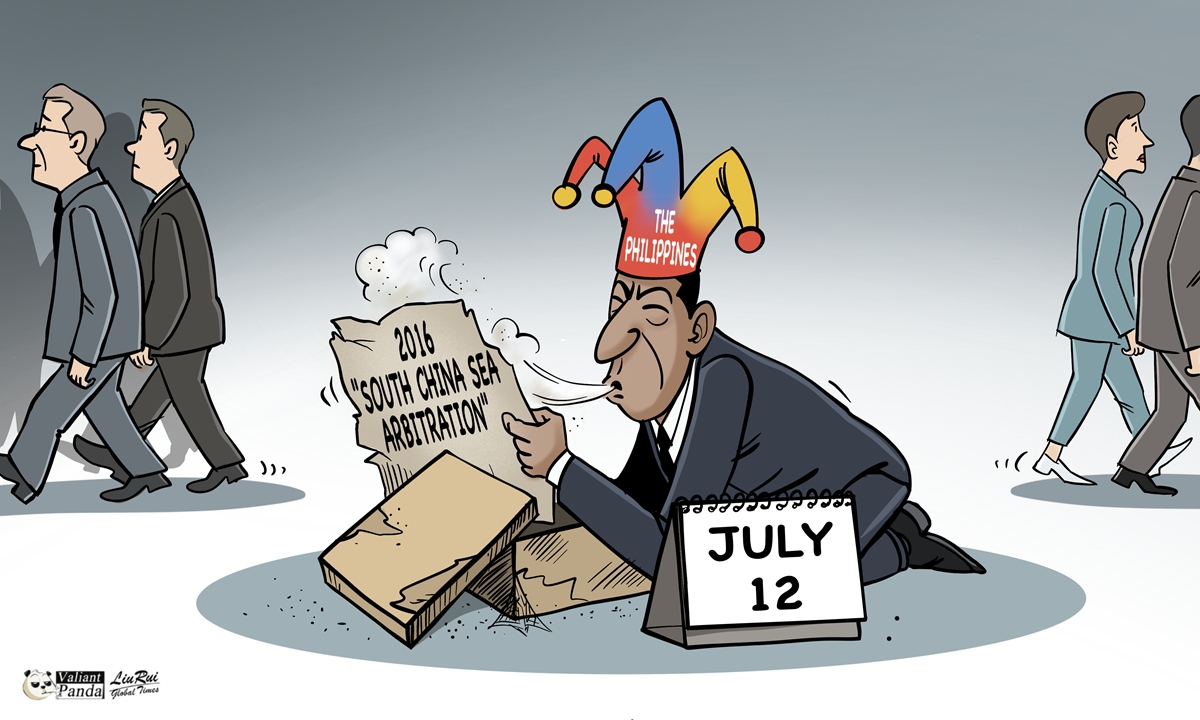
Editor's Note:To hype the 10th anniversary of the illegal "South China Sea arbitration award," the Philippines, in collusion with certain external forces, has stepped up its efforts to distort the facts and stir up trouble in the South China Sea. Why does the "award" continue to be politicized a decade later, and what consequences has it brought to the Philippines and the South China Sea? Herman Tiu Laurel (Laurel), president of the Asian Century Philippines Strategic Studies Institute, shared his perspectives with Global Times (GT) reporter Liu Xuandi.
GT: Ten years after the so-called "South China Sea arbitration award" was issued in 2016, certain Philippine politicians continue to intensify their efforts to hype the ruling, including releasing a joint statement with countries outside the region to mark the anniversary. How would you assess the international legal basis of the so-called "award," and why do you think it continues to be politicized a decade later?
Laurel: The 2016 "South China Sea arbitration award" does not constitute international law. Its proponents, including the Philippines and its allies, particularly the US, describe it as a cornerstone of the rules-based global order. However, the "rules-based order" is merely a set of rules that they seek to impose on the rest of the world, without either UN authorization or broad international recognition.
The ongoing massive hype of the award is part of the attempts by the US and its Filipino proxies to sustain informational warfare in support of the policy of "containment of China."
Since February 2023, under pressure from the US government, Philippine President Ferdinand Marcos Jr's administration has escalated the "arbitration award" issue and instituted the "assertive transparency" strategy to provoke China in the South China Sea.
Against this backdrop, many Filipino politicians have jumped on the bandwagon that the Americans and their Filipino proxies have long prepared to revive the dwindling issue of the "arbitration award." Meanwhile, they have amplified confrontations at sea between intruding Philippine maritime security and civilian vessels and Chinese Coast Guard ships, resulting in an atmosphere of tension.
For some Filipino politicians, the "award" has become a convenient political tool. Some invoke it to score popularity points and maintain the good graces of the Americans for elections, while others openly collaborate with known American psychological operations operators.
GT: Looking back over the past decade, have Philippine officials' repeated efforts to hype the "arbitration award" produced the results they expected? More broadly, what impact has the "award" had on the Philippines and on peace and stability in the South China Sea?
Laurel: One of the goals of hyping the so-called "award" is to advance the distorted narrative of an "expansive China" and "China as a bully," but all these efforts have failed. China still enjoys robust trade and trust ratings in Asia and ASEAN. A decade of hyping the "award" has brought no progress in resolving the territorial disputes. The tensions stemming from the "award" by US proxies in the Philippines have eroded trust between Beijing and Manila, costing the Philippines billions in goodwill and infrastructure cooperation with China.
No Chinese financing commitments reached the completion stage as the current Marcos administration adopted a confrontational approach toward China. It has been primarily on the initiative of the Philippine government to cancel loans and projects, resulting in dire consequences for the country's economic development.
GT: Looking ahead, what approach should the Philippines take toward the "award" and the South China Sea issue?
Laurel: In recent years, many ASEAN countries have demonstrated that dialogue and constructive cooperation with China offer a more successful and mutually beneficial approach to managing differences in the South China Sea. Malaysian Prime Minister Anwar Ibrahim, for example, has expressed a preference for consensus-driven diplomacy. Manila should recognize that repeatedly hyping the "award" has only deepened its "silent alienation" from the rest of ASEAN.
As early as 1988, then Chinese leader Deng Xiaoping proposed to then Philippine president Corazon Aquino that the two countries shelve their sovereignty disputes and pursue joint exploration and development of oil and gas resources in the South China Sea.
In my view, the spirit of shelving differences and seeking common development remains highly relevant today. I hope a future Philippine government will restore the country's independent foreign policy and follow the example of other ASEAN members by returning to dialogue and mutually beneficial cooperation with China.
RELATED ARTICLES