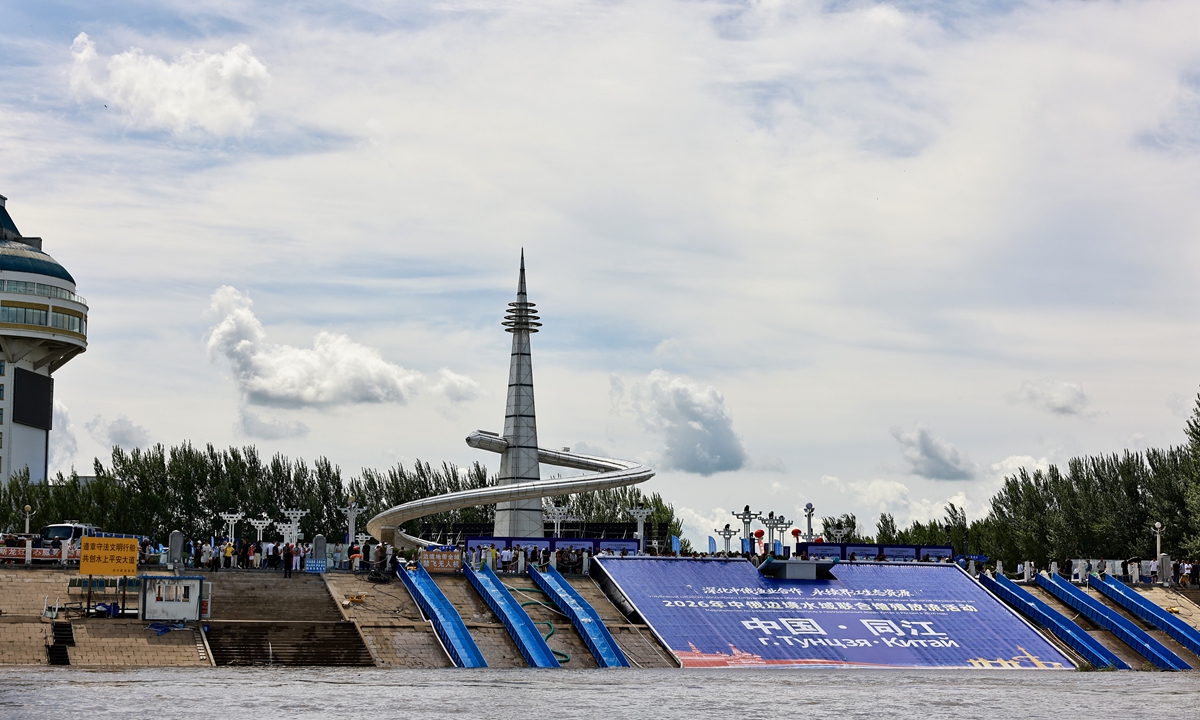
China and Russia carry out a joint fish stock enhancement and release activity in Tongjiang, Jiamusi, Northwest China's Heilongjiang Province on July 14, 2026. Photo: Deng Xiaoci/GT
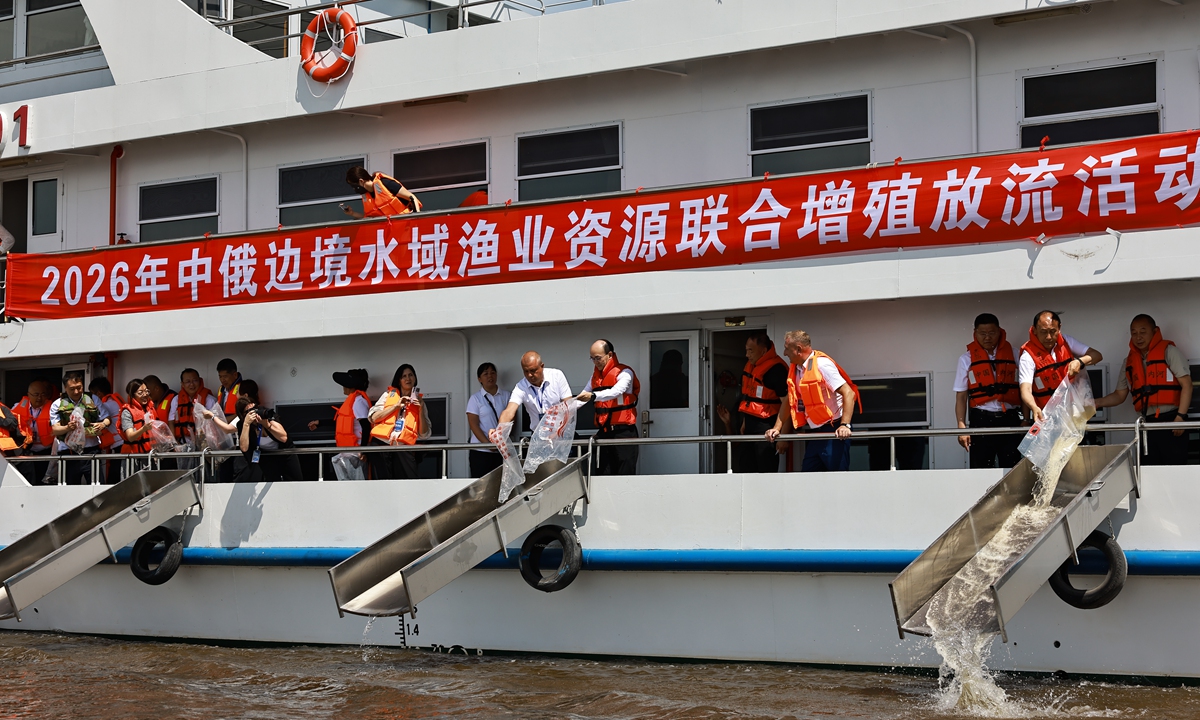
Chinese and Russian representatives participate in the joint fish stock enhancement and release activity in Tongjiang, Jiamusi, Northwest China's Heilongjiang Province on July 14, 2026. Photo: Deng Xiaoci/GT
China and Russia carried out a joint fish stock enhancement and release activity in Tongjiang - a county-level city under the administration of Jiamusi, Northeast China's Heilongjiang Province, on Tuesday, as part of the two countries' continued efforts to conserve and restore fishery resources in their shared border waters.
During the Tuesday event, a total of 200 large-sized Heilongjiang sturgeons measuring more than 5 centimeters in length were released, along with 480,000 juvenile kaluga. Another 5.2 million fry of commercially valuable fish species, including silver carp and grass carp, were also released into the border waters, the Global Times learned from local authorities on Tuesday.
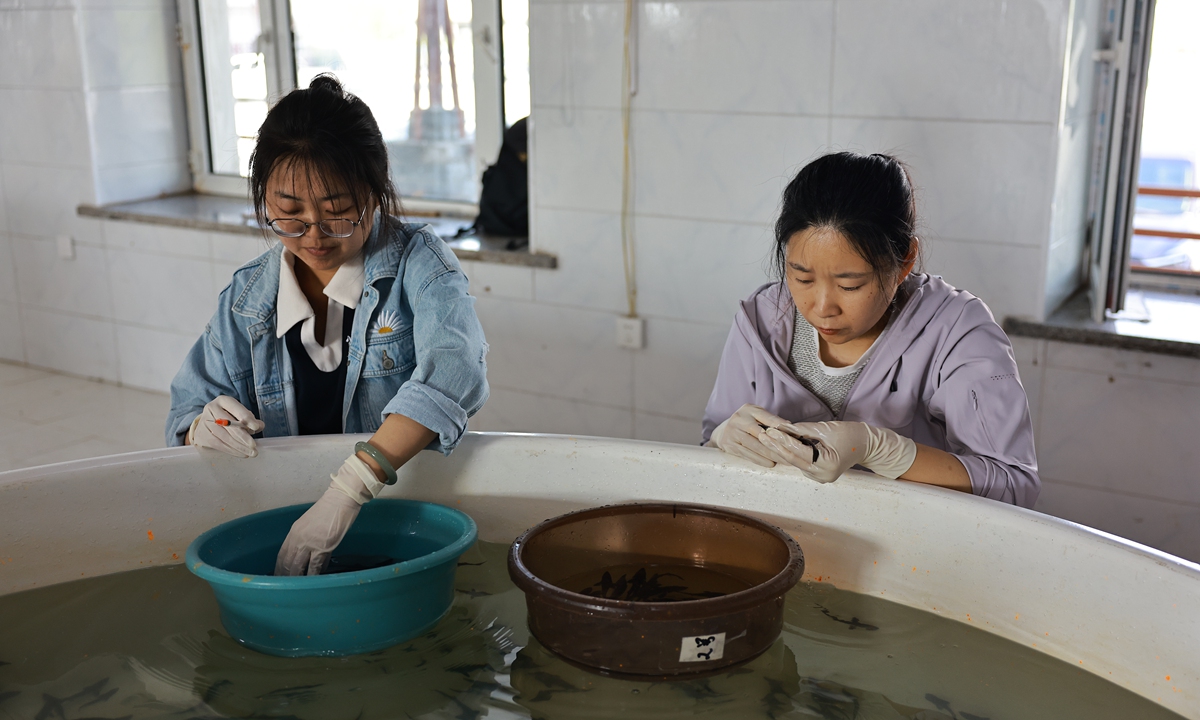
Two staff members from the Chinese fish breeding institution inject fluorescent markers into fish fry to identify which were to be released on July 14, 2026 in Tongjiang, Northeast China's Heilongjiang Province Photo: Deng Xiaoci/GT
On Monday, before the release, the Global Times reporter observed staff from the fish breeding institution injecting fluorescent markers into the fry to identify the released fish.
The tagging process will allow researchers to track the growth, survival and reproduction of the released fish in natural waters, providing scientific data for evaluating the effectiveness of fish stock enhancement programs.
For local fishermen, the annual release activity represents more than just an ecological conservation effort - it is closely linked to their livelihoods and the future of the river.
"I have been fishing for decades. Now we have fish release activities every year, and seeing bags of fry being released into the river makes me truly happy," fisherman Li Changyou told the Global Times.
"Stock enhancement is not only about protecting resources, but also about preserving a way of livelihood for fishermen like us and future generations. When there are more fish in the river, fishermen can have a more secure future," he said.
The Heilongjiang and Wusuli rivers, which form part of the China-Russia border, are home to rare, endangered and migratory fish species, including Heilongjiang sturgeon, kaluga and chum salmon. Chen Huaifa, director of the Heilongjiang Aquatic Animal Resources Conservation Center, told the Global Times that the joint stock enhancement programs have mainly focused on the release and protection of rare and endangered fish species.
"The release activities strictly follow national and local standards in Heilongjiang Province, with full-process management covering fry quarantine, transportation, release operations, as well as tagging and monitoring," Chen said.
According to monitoring data, the age range of captured sturgeon and kaluga populations has expanded from one to three years old in 2018 to one to five years old in 2024 and 2025, with the oldest recorded individual reaching eight years old, Chen revealed.
Chen said the China-Russia joint fish release programs and coordinated efforts in fisheries protection have achieved notable results, effectively helping restore fish resources in the river basin while enhancing conservation awareness among fishermen in border areas.
According to Chen, as a follow-up to the joint release activities, Chinese and Russian experts also regularly conduct exchanges and discussions to analyze the conservation status of relevant fish species, assess the effectiveness of resource restoration efforts and explore further protection measures.
"During our communication with the Russian side over the past two years, they told us that monitoring at the estuary of the Heilongjiang River had shown a gradual increase in the number of juvenile sturgeon and kaluga," Chen said. "Russian experts had given high recognition and positive evaluations to China's efforts in fish stock enhancement and resource conservation."
The joint release activities are part of long-term China-Russia cooperation in fisheries conservation.
Han Peng, director of the Fisheries and Fisheries Administration Division of the Department of Agriculture and Rural Affairs of Heilongjiang Province, told the Global Times that since 2008, China and Russia have jointly carried out fish stock enhancement and release activities in the border waters of the Heilongjiang River.
The two sides have successfully held 18 joint release events, releasing more than 20 million fry of sturgeon and kaluga, which has effectively contributed to the restoration of fishery resources in the shared river waters.
China and Russia are both major global fishing nations, and their fisheries cooperation is primarily conducted under intergovernmental fisheries cooperation agreements and through the China-Russia joint commission on fisheries cooperation mechanism, Ma Bo, deputy director of the Heilongjiang River Fisheries Research Institute under the Chinese Academy of Fishery Sciences, told the Global Times.
This collaboration has played a positive role in promoting broader bilateral fisheries cooperation, improving the well-being of the two peoples and strengthening friendship between the two countries, he noted. "It has injected China-Russia momentum and made China-Russia contributions to advancing a fairer and more equitable global fisheries governance system," Ma said, adding that fisheries cooperation has also contributed to the steady and long-term development of China-Russia relations.
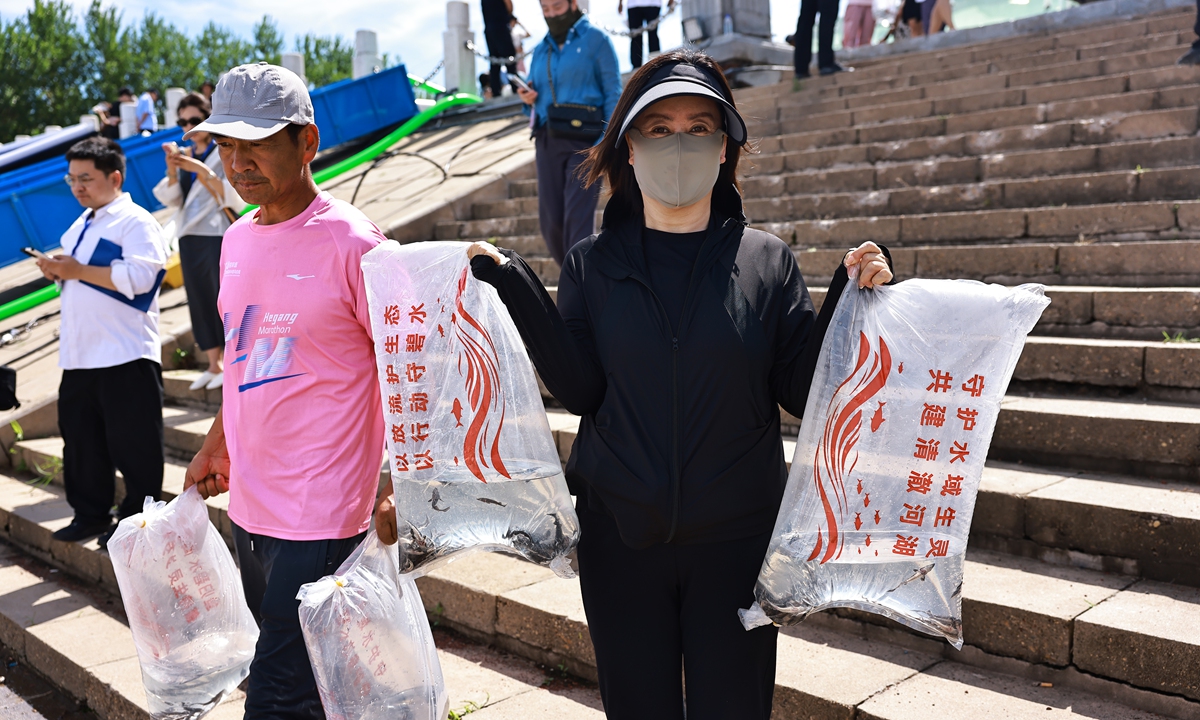
A Tongjiang local resident poses for a picture with two bags of fry to be released in the joint fish stock enhancement and release activity in Tongjiang, Jiamusi, Northwest China's Heilongjiang Province on July 14, 2026. Photo: Deng Xiaoci/GT