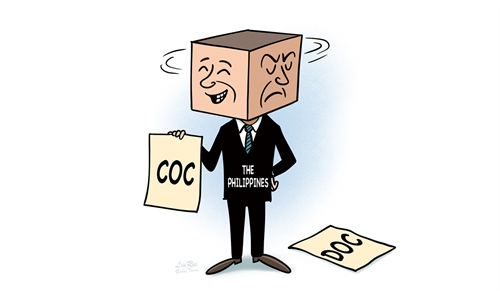
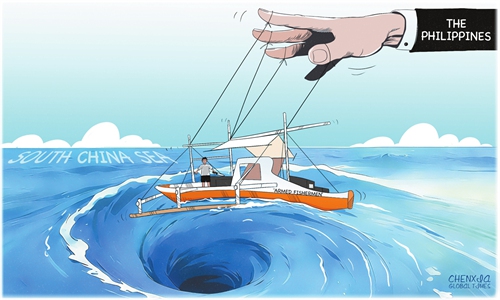
Pax Silica only makes the Philippines a sacrificial pawn in US Asia-Pacific designs

Illustration: Chen Xia/GT
According to Philippine media, militant fishers and allied progressive groups staged a protest outside the US Embassy in Manila on Monday to oppose the planned Economic Security Zone, which includes the US-led Pax Silica initiative.
This is not an isolated case. Exactly one month ago, progressive groups and organizations marched on the country's Independence Day to protest against US military bases and, once again, the US-led Pax Silica initiative.
Beneath these protests lies a deeper, more unsettling question: Why is the Philippine government so determined to forge ahead on a trajectory that alienates its own people and undermines the foundations of national sovereignty?
Pax Silica was launched in December 2025 to purportedly secure supply chains for semiconductors, AI and critical minerals. The name, Pax Silica, is a deliberate imitation of Pax Americana, carrying with it an unmistakable undertone of a zero-sum game and Cold War mentality. The initiative claims to build a secure and reliable supply chain, but in essence, it uses economic cooperation as a cover to erect a "Silicon Curtain" across the Asia-Pacific, aiming to decouple critical industrial supply chains from China.
Its architect, US Under Secretary of State Jacob Helberg, told Congress in February 2026 that controlling "the industrial foundation of artificial intelligence" was essential to American "national survival."
Clearly, the US isn't hiding its intentions. Yet, the Philippines formally joined Pax Silica in April and signed on to host the coalition's first physical project: a 4,000-acre industrial hub at the former Clark Air Base in Pampanga, northwest of Manila. This presents a dangerous strategic gamble: using its geopolitical value as a US ally in the competition with China to extract economic and security support. The Philippine government is betting that deepening its alignment with Washington will secure its rein and bring investment, regardless of the long-term costs to its sovereignty and regional stability.
Richard Heydarian, a professorial chairholder in geopolitics at the Polytechnic University of the Philippines, wrote in the South China Morning Post in June that the Pax Silica plan to make the Philippines a vital node in a US-led tech supply chain is built on seemingly speculative promises and risks riling China.
After all, the "secure and reliable" supply chain the initiative claims to build isn't meant for the Philippines. The country is endowed with abundant metallic mineral resources, ranking as the world's largest exporter of nickel ore, yet it has long remained at the lowest rung of the global semiconductor value chain. The US has seized on this, seeking to tighten its grip on the Philippines by absorbing its critical minerals and semiconductor assembly capacity into its own supply chain. In doing so, Philippine industrial development is effectively yoked to US strategic imperatives - a bond that will only further erode the country's autonomy and keep it ensnared as a sacrificial pawn in Washington's Asia-Pacific designs.
In opting for the exclusive Pax Silica framework, the Philippines has pitted itself against its neighbors in the region. ASEAN has long charted a different course - one built on consensus, inclusivity, and transparency in AI development, digital and supply chains, and enshrined in the 2025 ASEAN AI Safety Network, reinforced through cooperation pacts with China. By hitching its wagon so tightly to Washington, the Philippines is not only isolating itself from ASEAN's collective efforts to build an open AI ecosystem, but also mortgaging its long-term industrial and economic vitality in the process.
Alongside domestic opposition and protests, the Philippines is already experiencing the consequences. In June, it lost its bid for a non-permanent seat on the UN Security Council. In the final round of voting, none of the other ASEAN countries supported its candidacy, despite its status as this year's rotating chair of ASEAN. Some analysts believe the Philippines' alignment with Washington undermined the neutrality it was attempting to project.
In light of public outcry and the realities of regional cooperation, the Philippine government should recognize that national sovereignty and the well-being of its people must take precedence. Manila should value the opportunity to participate in ASEAN's open and inclusive initiatives rather than entrenching itself further in a US-led exclusive alliance.
RELATED ARTICLES