Illustration: Liu Rui/GT
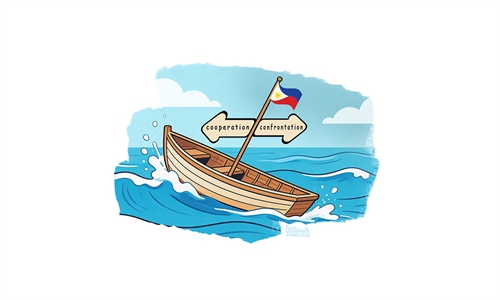
On the grand stage of regional diplomacy, Manila has recently been putting on quite the performance.
On one side of the stage stands the sound of polished diplomatic rhetoric. Earlier this month, speaking to a US audience in Washington, Philippine Foreign Affairs Secretary Ma. Theresa Lazaro claimed that Manila is pushing a grueling "monthly negotiation" schedule to wrap up the long-delayed South China Sea Code of Conduct (COC) by the end of 2026. Lazaro also claimed confidently that the parties will finish the negotiations "in the right and appropriate way" to make the COC "a gift to the region and the world."
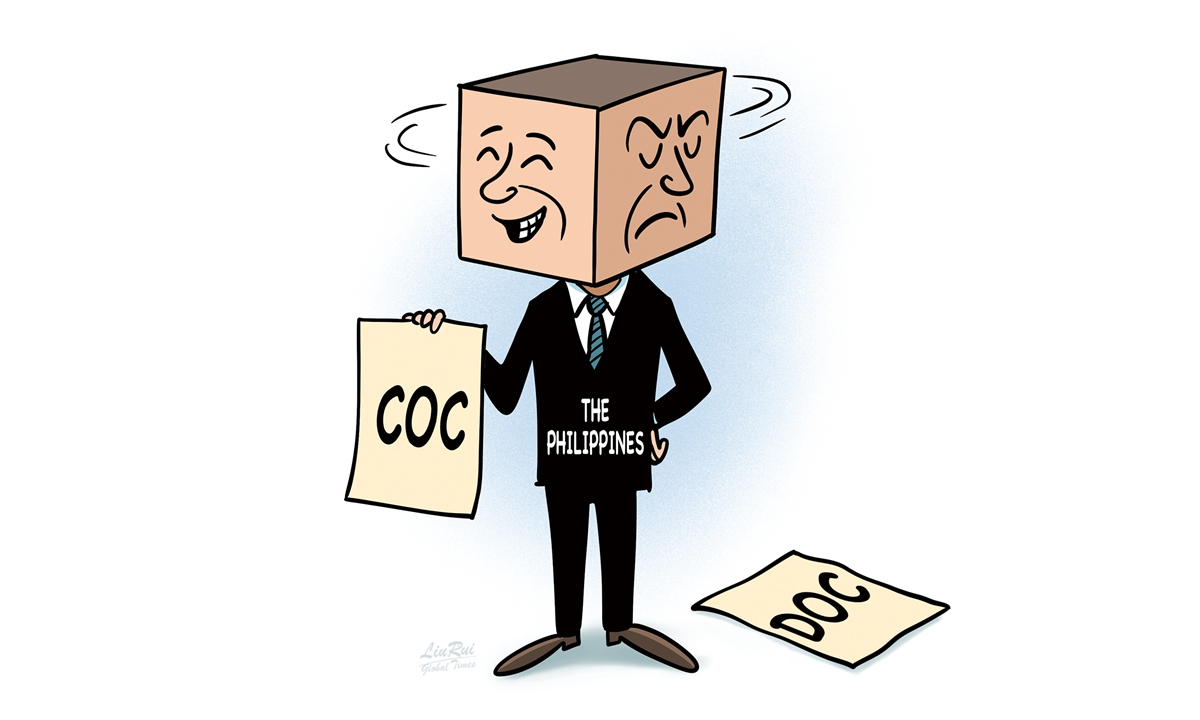
This is beautifully packaged rhetoric, designed to position the Philippines as the "champion of regional stability." Yet, what Manila presents on stage does not align with the reality backstage. Not long ago, the Philippine defense secretary raised eyebrows at the Shangri-La Dialogue by questioning the significance of the COC. This exposed the Philippines' deeply utilitarian calculus over its claims regarding the South China Sea, and for Manila, the COC negotiations have effectively morphed into a public relations megaphone, Li Kaisheng, vice president of Shanghai Institute for International Studies, told the Global Times.
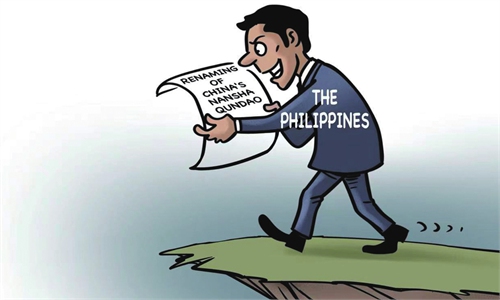
Hardly had the echoes of Lazaro's words faded when Manila claimed on Tuesday that it had undertaken the "appropriate diplomatic action" after the military confirmed the presence of what it claims to be an illegal floating structure near China's Huangyan Dao (Huangyan Island). On Wednesday, a Philippine official even tried to urge Beijing to "withdraw and remove the platform structures and cease similar actions that violate Philippine sovereignty and sovereign rights."
In response to the Philippines' claims, China's Foreign Ministry stressed that Huangyan Dao has always been China's territory. China has indisputable sovereignty over it and its adjacent waters, and it is fully within China's sovereign rights to carry out activities including scientific research at Huangyan Dao. "China urges the Philippines to stop all infringement activities, provocations and false accusations at sea," ministry spokesperson Lin Jian said.
The Philippines' calculation is unmistakable: Talk about peace on the international stage, but engage in infringement activities and provocations on the water while making false accusations.
In fact, Manila needs a mirror if it wants to look for the party consistently failing to fulfill its obligations under international law and undermining the Declaration on the Conduct of Parties in the South China Sea (DOC), the current anchor of South China Sea peace.
To see Manila's two-faced approach, one needs look no further than the rusted Philippine warship, BRP Sierra Madre, illegally "grounded" at Ren'ai Jiao (Ren'ai Reef), which Manila has stubbornly tried to patch up and transform into a permanent outpost. This is a direct and an ongoing violation of Article 5 of the DOC, which states that all parties should refrain from "action of inhabiting on the presently uninhabited islands, reefs, shoals, cays, and other features."
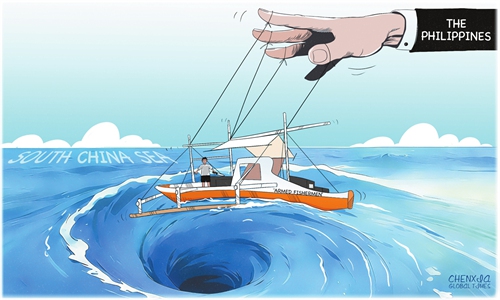
In recent years, Manila's "salami-slicing" provocations have only intensified. From illegal incursions into the waters of Huangyan Dao and Ren'ai Jiao to dangerous maneuvers where Philippine vessels intentionally rammed Chinese coast guard ships, Manila has been playing a dangerous game of maritime arson. It is these reckless behaviors on the water that keep regional tensions boiling and repeatedly derail the atmosphere needed for meaningful COC negotiations.
As Li noted, this double-dealing demonstrates that Manila has never approached the COC talks with genuine sincerity. Its true objective is to serve domestic political gains and orchestrate a geopolitical campaign alongside the US and Japan to comprehensively provoke China, he said.
If the future COC can be envisioned as the "upgraded version" of regional maritime order, the current DOC is the very bedrock upon which that order stands. And if the Philippines cannot honor its signature on a foundational document it has pledged to uphold for over two decades, its public displays of "earnest effort" for the COC talks lose all credibility.
Crucially, the international community is growing weary of Manila's carefully manufactured victimhood narrative. Against the backdrop of the Philippines' crushing defeat to Kyrgyzstan at the recent election for a non-permanent seat on the UN Security Council, a Philippine scholar said this voting result may reflect "Manila's failure to frame the South China Sea dispute as an international concern." Another scholar in the country warned that the Philippines "must recalibrate and assess its future foreign policy to gain worldwide respect for its diplomacy" after what he described as possible global fatigue over Manila's "noisy tell-all strategy" in the South China Sea.
Will the politicians in Manila listen to these sobering warnings from home? It remains to be seen. What is certain, however, is that Manila needs to cease its pattern of actively trampling the agreements already in place, if it truly wants to offer a sincere "gift" to the region and the world.
RELATED ARTICLES