Illustration: Liu Rui/GT
In William Shakespeare's Romeo and Juliet, the heroine famously remarks, "A rose by any other name would smell as sweet." This suggests that the essence of a thing remains unchanged by its label. Manila, however, appears to challenge this notion.
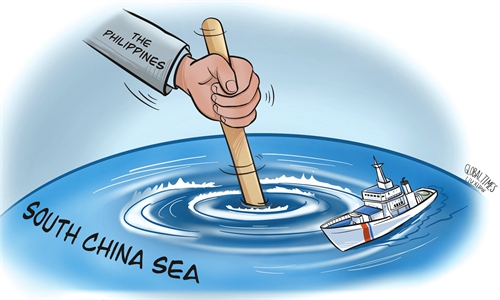
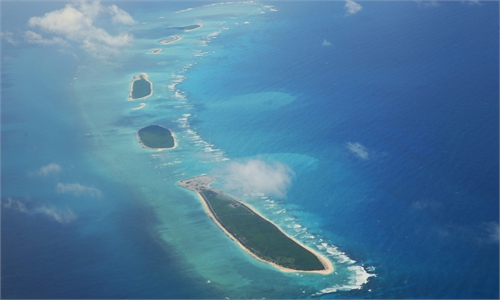
Philippine media recently revealed that President Ferdinand Marcos Jr signed Executive Order No.111 on March 26, unilaterally renaming 131 geographical features within the so-called "Kalayaan Island Group" in China's Nansha Qundao with Philippine names. The order mandates that all government agencies and schools adopt these names, while national mapping authorities are tasked with updating official charts. It seems Manila naively believes that by simply changing the labels will somehow manifest "sovereignty."
The timing of this announcement is particularly noteworthy. Although the order was signed on March 26, it was made public three days after Chinese and Philippine representatives met in Quanzhou, Southeast China's Fujian Province, on Saturday for the 11th meeting of the bilateral consultation mechanism on the South China Sea - the first such meeting since January of last year. Malacañang Palace waited until Tuesday to officially go public with the decree.
Regardless of whether this delay was a calculated move, the effect remains the same: Before the signals of de-escalation from the negotiating table could settle, a provocative renaming order was thrust into the public eye. This move severely undermines Manila's recent claims of wanting to "reset" relations with Beijing.
Li Kaisheng, vice president of the Shanghai Institutes for International Studies, told the Global Times that this maneuver by the Philippines is an attempt to assert its so-called "sovereignty" through "petty tricks" within its limited capacity while continuing to infringe upon China's rights in the South China Sea. Domestically, the timing may also serve as a balancing act. "Faced with an energy crisis exacerbated by ongoing Middle East tensions, there is a growing desire within the Philippines to cooperate with China on maritime resources. However, the government also faces pushback from hardline anti-China factions; thus, this renaming serves to appease domestic hawks," Li said.
Since then-president Benigno Aquino III signed an order in 2012 renaming the South China Sea waters near the Philippines as the "West Philippine Sea," "renaming politics" has become a staple of Manila's maritime strategy. However, such actions are detrimental to regional stability.
On one hand, these renaming attempts inevitably trigger counter-reactions from other claimants. On the other hand, the frequency of these stunts suggests a fundamental lack of sincerity regarding cooperation. This shows that Manila is unable to escape domestic political constraints to take substantive steps toward peace.
In reality, the practical significance of this renaming is negligible. A unilateral executive order cannot alter the underlying sovereignty of these features. China's sovereignty over the South China Sea islands and reefs has a deep historical and legal basis. Manila's gimmicks cannot challenge established international nomenclature; they are little more than an exercise in self-delusion.
Meanwhile, some public opinion in the Philippines continues to urge Manila to maintain a tough stance toward China. A Wednesday editorial of the Philippine Daily Inquirer claimed that seeking alternative fuel sources outside the Middle East should not come at the cost of "sovereignty," arguing that "the Philippines must just ensure that it approaches potential talks with China from a position of strength, not desperation."
This rhetoric attempts to balance two conflicting positions: seeking energy support from China while simultaneously engaging in provocations to maximize leverage. But what "position of strength" does Manila actually occupy? Is it a strength rooted in the country's energy vulnerability? Or is it the distracted Washington? Against this backdrop, playing games with the renaming of China's islands and reefs only underscores a position of increasing desperation.
All signs indicate that the Philippines is not genuinely committed to resolving the South China Sea issue. The Marcos administration has already strained its credibility with Beijing through persistent provocations; this latest move further erodes whatever little mutual trust remained.
If Manila wishes to avoid a "position of desperation," it must begin by abandoning the illusions of sovereignty built on mere name changes.
RELATED ARTICLES