IN-DEPTH / IN-DEPTH
Practitioners’ Insights: Model CPC member delivers decades of grassroots care in Xinjiang with unwavering heart
Editor's Note:
As this year marks the 105th anniversary of the founding of the Communist Party of China (CPC), a national conference on Party building was held in Beijing on June 15, making arrangements for studying and implementing Xi Jinping Thought on Party Building. The Thought reflects intrinsic connections among Party self-governance, Party strengthening and national rejuvenation. Articulated through the "Fourteen Upholds" - and comprising a series of signature major concepts, original ideas, and fundamental theoretical insights - the Thought has made major original contributions to the development of the Marxist theory of Party building, and is of great practical significance and far-reaching guiding significance for strengthening the Party and the country.
Of the "Fourteen Upholds," the first is that upholding the Party's leadership is the defining feature of socialism with Chinese characteristics. The book Xi Jinping: The Governance of China includes several important speeches on upholding and strengthening the leadership of the Party. In the "Speech at the Ceremony Marking the Centenary of the Communist Party of China" included in Volume IV of Xi Jinping: The Governance of China, Chinese President Xi Jinping stressed, "The leadership of the Party is the defining feature of socialism with Chinese characteristics and constitutes the greatest strength of this system. It is the foundation and lifeblood of the Party and the country, and the crux upon which the interests and wellbeing of all Chinese people depend." Standing at a new historical starting point and guided by Xi Jinping Thought on Party Building, the CPC is advancing from the "world's largest political party" to becoming the "world's most powerful political Party." With unified thinking, firm resolve, coordinated action, and strong fighting strength, it will vigorously advance the great new project of Party building in the new era, thereby providing a strong political guarantee for the noble cause of building a powerful nation and achieving national rejuvenation.
In the 26th installment of the special series "Decoding the Book Xi Jinping: The Governance of China," the Global Times, along with the People's Daily Overseas Edition, continues to invite Chinese and foreign scholars, translators of Xi's works, practitioners with firsthand experience, and international readers to focus on the theme of Xi Jinping Thought on Party Building. Together, they deeply explore the core essence of Xi Jinping Thought on Party Building, as well as its profound practical and global significance, and jointly explore the question: "Why has the CPC remained vibrant after 105 years?"
This is the 24th installment of "Practitioners' Insights." We traveled to Yumin County, Tacheng Prefecture in Northwest China's Xinjiang Uygur Autonomous Region to interview Uhas Sulayman, a recipient of the July 1 Medal and veteran doctor who has devoted his life to local nomadic herders. Uhas' decades of medical service across the grasslands exemplify how grassroots CPC members stay true to their original aspiration, fulfill their mission in remote border pastoral areas, safeguard people's health, and faithfully live up to the Party's founding commitment.
In Yumin County, Tacheng Prefecture, on the far northwest border of the Xinjiang Uygur Autonomous Region, the name Uhas Sulayman commands genuine respect from every local resident. Local herders often say, "When Uhas comes, we can rest easy." This doctor, who spent four decades delivering medical care in remote pastoral areas, is a recipient of this year's July 1 Medal, the Communist Party of China's highest honor.
Over the course of his career, Uhas has fallen off horses in mountain snowstorms and even been surrounded by wolves - but nothing ever stopped him from reaching his patients, or shook his resolve to "stay with the herders."
Recently, a Global Times reporter visited Yumin County to meet this veteran Party member. During the interview, it became clear that Uhas is a man of few words, but every one of them counts. When asked how he felt about receiving the highest honor, he said: "I just did what I was supposed to do - that's a doctor's duty. This is also the Party and the government's recognition of my work. I'm deeply moved and very grateful."
Xi Jinping Thought on Party Building clearly puts forward the "Fourteen Upholds" to guide the endeavors, one of which is "Stay true to the Party's original aspiration and founding mission."
With a fundamental purpose - "serving the people wholeheartedly," the Party keeps true to its original aspiration and mission to seek happiness for the Chinese people and rejuvenation for the Chinese nation.
In the fifth volume of Xi Jinping: The Governance of China, President Xi pointed out that "We must stay true to our original aspiration, uphold the Party's ideals, convictions and principles, and continue to strive for the wellbeing of the Chinese people and the rejuvenation of the Chinese nation. In addition, to preserve the Party's progressive and wholesome nature, we should maintain a strong connection with the people."
Uhas' more than half-century presence across the grasslands embodies the simplest fulfillment of the Party's mission in border regions. His lifelong habit of carrying a medical bag stems from the original aspiration he held as a CPC member.
Uhas joined the CPC in 1993. He told the Global Times that his original aspiration for joining was simply to serve the people better and make full use of his abilities. "After joining the Party, I held myself to a higher, stricter standard, and could better play my role helping people in the pastoral areas. Aside from treating illnesses, I could also offer more help if they had difficulties in daily life."
"As a Party member and doctor at the frontier," Uhas said, "the most important quality is a heart dedicated to serving the people. The state has recognized my years of work in the pastoral areas and given me this highest honor. From now on, I will hold true to that original aspiration and keep going."
Wherever the herders go, Uhas follows
Uhas said he originally came to the pastoral areas following the Party and state policy of setting up medical points there, with the goal of ensuring that people in remote grazing areas could see a doctor.
Starting from Yumin County and driving for about an hour, the Global Times reporter arrived at Akeqiao Grassland. This is the summer pasture for local herders - lush with vegetation, with flocks of sheep and cattle scattered across the rolling hills. Yet even though this is the closest pasture to the county seat, for herders with little access to medical care, it is still a long way to go. Decades ago, without mobile rural doctors, anyone falling ill faced a grueling horseback ride, which would take several hours to reach a village or county clinic. When winter arrived, herders moved hundreds of kilometers to winter pastures in the Barlik Mountain, making medical help even further out of reach. Against these harsh odds, Uhas stepped up to safeguard the health of the herders.
In 1969, at just 10 years old, Uhas became a doctor in Baixie Village, Altayemule Township. From that day forward, he committed his life to saving lives and selflessly serving the public. After graduating from a health school in Tacheng in 1975, he could have taken a comfortable post in a well-equipped urban hospital. Instead, he volunteered for frontline medical work in the rugged Barlik Mountains pastoral zone - where he stayed for 40 years.
The grasslands stretch hundreds of square kilometers, with nomadic herders scattered widely as they follow seasonal water and grass sources. Slender and lean, Uhas rode horseback year-round with his medical bag slung over his shoulder, crisscrossing every corner of the steppe. He endured temperatures as low as -40 C in the brutal winter, and swarms of biting insects through summer, crossing countless rocky mountain trails and rushing mountain streams. Day in and day out, he made house calls and held free mobile clinics for nomadic families.
"I wouldn't be alive today without Uhas," Muchelibek Rehembai, a local herder, told the Global Times. He recalled suffering a ruptured appendix more than 40 years ago; Uhas spotted the emergency and administered urgent treatment, pulling him back from the brink of death.
Stories of Uhas' lifesaving work fill Yumin County. His most harrowing mission unfolded in the winter of 1987. Heavy snow blocked all roads across the grassland, and a herder woman named Alega went into labor. Uhas trekked more than 5 kilometers through raging snowstorms to reach her. The labor lasted over 20 hours, and when the baby was finally born, it made no sound - amniotic fluid blocked its airway. Uhas knelt down and cleared the infant's throat by suctioning out the fluid with his own mouth, until the newborn let out a loud cry.
Over his decades in medicine, Uhas has treated more than 100,000 patients, saved thousands in critical condition and delivered over 3,200 babies. For this, local herders affectionately call him the "umbilical cord dad."
Many herders told the Global Times that medical resources were scarce back then, and Uhas often covered patients' medication costs out of his own pocket.
Liang Jianjun, former Party branch secretary of the county's pastoral hospital, shared with the Global Times: Uhas devoted nearly every waking hour to the grasslands. "No matter where the herders migrate for grazing, he travels with them."
'He is a true grassroots cadre'
During several days of interviews, the Global Times reporters noticed one habitual gesture of Uhas: whenever he sat quietly, he would gently pat his legs. It was a lifelong ailment left behind by more than 40 years of horseback medical visits through wind, snow and harsh conditions.
For over four decades, carrying a medicine box on horseback, he traveled to every corner of the Barlik Mountains, Mayile Mountains and the Kulustay Grassland.
His apprentice, Erjan Kukan, told the Global Times that when he first met Uhas in 2004, "He looked like a very ordinary person. But as I got to know him, I realized how remarkable he truly was. Mention any place in the pastoral area, and he can tell you where it is, who lives there and everything about that location."
One winter in 2011, Erjan accompanied Uhas on horseback to visit an elderly patient with hypertension. A fierce snowstorm caused the horse to slip, and Uhas injured his foot in the fall. "I told him we hadn't gone very far and suggested we turn back to the clinic," Erjan recalled. "But Uhas refused. He said, 'No. The patient is an elderly person with high blood pressure - we have to go.'"
"He sleeps very lightly," Erjan added. "Day or night, in wind or rain, whenever someone comes looking for him, he sets off immediately. Sometimes, at daybreak, as soon as the dogs bark, he knows a patient has arrived."
Adila Maimaiti Ahong, Party Secretary and Director of the Jiayilema community in Halabula Town, Yumin County, told reporters that she had heard Uhas' name since childhood. After working with him, she came to see him as "someone who always puts the interests of the people before his own - a true grassroots cadre."
'Since when does a CPC member retire?'
After retiring in 2015, Uhas started to enjoy a peaceful retirement, but it wasn't after long that he realized he couldn't sit idle and do nothing while people needed him. He picked up his medicine box once again and established the Uhas health service room, where he has provided free medical consultations in the community at least three days a week. Over the past decade, he has treated more than 65,000 patients, transforming his once-mobile clinic into a permanent service center.
In August 2021, Uhas voluntarily converted the courtyard of his own home into a public educational center dedicated to ethnic unity, patriotism and Party education. He receives visiting Party members, officials and members of the public from across the country free of charge, personally recounting the dramatic improvements in healthcare on China's frontier and sharing heartwarming stories of ethnic solidarity. The Global Times reporter visiting the site saw a flagpole standing in the center of the courtyard, where the bright red national flag fluttered in the wind.
The courtyard's guestbook is filled with heartfelt messages from visitors nationwide: "Learn from Grandpa Uhas!" "Learn from this veteran Party member!" "Become someone who contributes to society!"
Inside Uhas' home, the reporter saw an old medical bag that had become badly worn from decades of use. Over the years, he has worn out four such medicine boxes. Today, he carries a brand-new one as he continues his journey of serving the people.
Uhas' medical career also reflects the broader transformation of life for local herders. In Aktiekeqie village, the Global Times reporter found wide, well-paved roads connecting rows of neatly built houses. The village is equipped with a clinic, a cultural activity center and other public facilities. Village doctors conduct regular follow-up visits, and patients with chronic illnesses have easy access to medical care.
Even so, the Party and the government have not withdrawn medical stations from the pastoral areas. Doctors continue to be stationed at remote grazing sites so that herders living high in the mountains can receive convenient healthcare. Uhas understands that lasting improvements in rural healthcare cannot depend on a single individual. What is needed is a medical team that will remain in the community. Over the years, he has mentored many young healthcare workers. Nearly all grassroots medical personnel in Yumin county have received his guidance and training.
Inspired by Uhas' lifelong work, more than 20 doctors and nurses from Yumin county's pastoral hospital now spend the year traveling through the grazing areas, delivering medicines, conducting medical rounds and providing free clinics - helping ensure that healthcare reaches even the most remote farming and herding communities.
As the Communist Party of China celebrated its 105th anniversary this year, Uhas reflected with emotion on the changes brought about in the new era:
"Thanks to the Party's good policies and sound leadership, our motherland has become stronger and has grown into one of the world's leading countries. People's lives have also become better and better. I wish our country continued prosperity and an even brighter future."
As this year marks the 105th anniversary of the founding of the Communist Party of China (CPC), a national conference on Party building was held in Beijing on June 15, making arrangements for studying and implementing Xi Jinping Thought on Party Building. The Thought reflects intrinsic connections among Party self-governance, Party strengthening and national rejuvenation. Articulated through the "Fourteen Upholds" - and comprising a series of signature major concepts, original ideas, and fundamental theoretical insights - the Thought has made major original contributions to the development of the Marxist theory of Party building, and is of great practical significance and far-reaching guiding significance for strengthening the Party and the country.
Of the "Fourteen Upholds," the first is that upholding the Party's leadership is the defining feature of socialism with Chinese characteristics. The book Xi Jinping: The Governance of China includes several important speeches on upholding and strengthening the leadership of the Party. In the "Speech at the Ceremony Marking the Centenary of the Communist Party of China" included in Volume IV of Xi Jinping: The Governance of China, Chinese President Xi Jinping stressed, "The leadership of the Party is the defining feature of socialism with Chinese characteristics and constitutes the greatest strength of this system. It is the foundation and lifeblood of the Party and the country, and the crux upon which the interests and wellbeing of all Chinese people depend." Standing at a new historical starting point and guided by Xi Jinping Thought on Party Building, the CPC is advancing from the "world's largest political party" to becoming the "world's most powerful political Party." With unified thinking, firm resolve, coordinated action, and strong fighting strength, it will vigorously advance the great new project of Party building in the new era, thereby providing a strong political guarantee for the noble cause of building a powerful nation and achieving national rejuvenation.
In the 26th installment of the special series "Decoding the Book Xi Jinping: The Governance of China," the Global Times, along with the People's Daily Overseas Edition, continues to invite Chinese and foreign scholars, translators of Xi's works, practitioners with firsthand experience, and international readers to focus on the theme of Xi Jinping Thought on Party Building. Together, they deeply explore the core essence of Xi Jinping Thought on Party Building, as well as its profound practical and global significance, and jointly explore the question: "Why has the CPC remained vibrant after 105 years?"
This is the 24th installment of "Practitioners' Insights." We traveled to Yumin County, Tacheng Prefecture in Northwest China's Xinjiang Uygur Autonomous Region to interview Uhas Sulayman, a recipient of the July 1 Medal and veteran doctor who has devoted his life to local nomadic herders. Uhas' decades of medical service across the grasslands exemplify how grassroots CPC members stay true to their original aspiration, fulfill their mission in remote border pastoral areas, safeguard people's health, and faithfully live up to the Party's founding commitment.
In Yumin County, Tacheng Prefecture, on the far northwest border of the Xinjiang Uygur Autonomous Region, the name Uhas Sulayman commands genuine respect from every local resident. Local herders often say, "When Uhas comes, we can rest easy." This doctor, who spent four decades delivering medical care in remote pastoral areas, is a recipient of this year's July 1 Medal, the Communist Party of China's highest honor.
Over the course of his career, Uhas has fallen off horses in mountain snowstorms and even been surrounded by wolves - but nothing ever stopped him from reaching his patients, or shook his resolve to "stay with the herders."
Recently, a Global Times reporter visited Yumin County to meet this veteran Party member. During the interview, it became clear that Uhas is a man of few words, but every one of them counts. When asked how he felt about receiving the highest honor, he said: "I just did what I was supposed to do - that's a doctor's duty. This is also the Party and the government's recognition of my work. I'm deeply moved and very grateful."
Xi Jinping Thought on Party Building clearly puts forward the "Fourteen Upholds" to guide the endeavors, one of which is "Stay true to the Party's original aspiration and founding mission."
With a fundamental purpose - "serving the people wholeheartedly," the Party keeps true to its original aspiration and mission to seek happiness for the Chinese people and rejuvenation for the Chinese nation.
In the fifth volume of Xi Jinping: The Governance of China, President Xi pointed out that "We must stay true to our original aspiration, uphold the Party's ideals, convictions and principles, and continue to strive for the wellbeing of the Chinese people and the rejuvenation of the Chinese nation. In addition, to preserve the Party's progressive and wholesome nature, we should maintain a strong connection with the people."
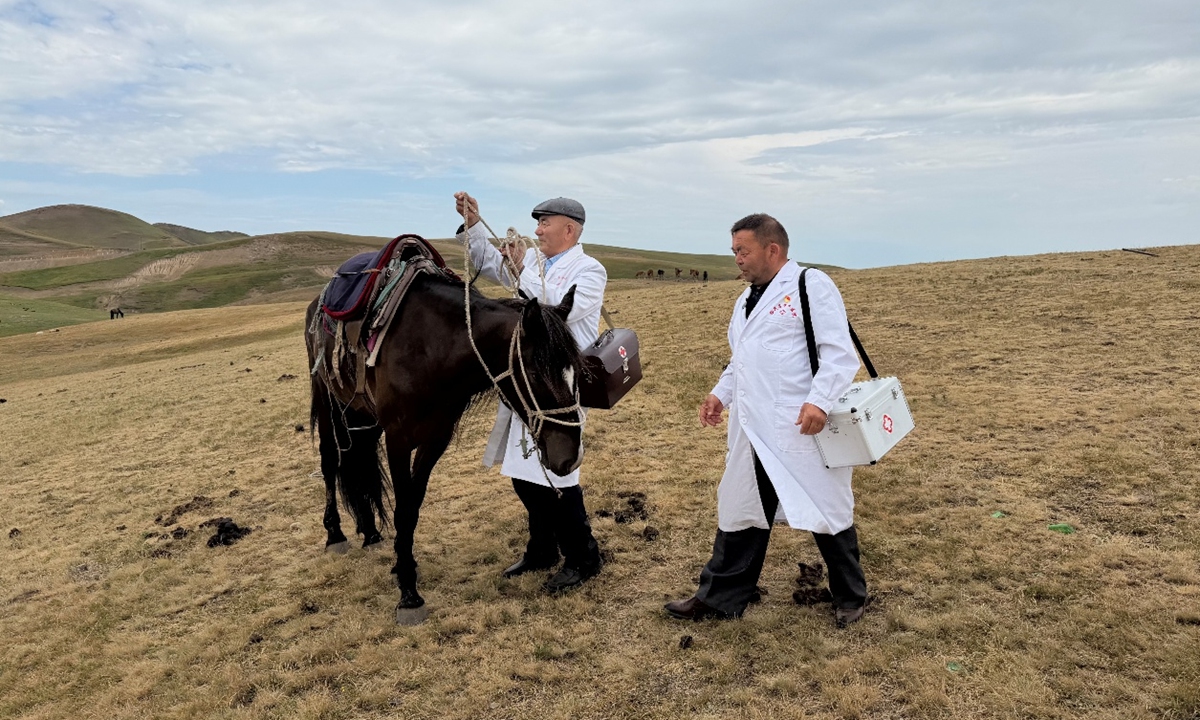
Uhas Sulayman (left) is pictured with his disciple Erjan Kukan at a summer pasture in the Barlik Mountain in Jiyek Town, Yumin County, Northwest China's Xinjiang Uygur Autonomous Region, in June 2026. Photo: Chen Zishuai/GT
Uhas' more than half-century presence across the grasslands embodies the simplest fulfillment of the Party's mission in border regions. His lifelong habit of carrying a medical bag stems from the original aspiration he held as a CPC member.
Uhas joined the CPC in 1993. He told the Global Times that his original aspiration for joining was simply to serve the people better and make full use of his abilities. "After joining the Party, I held myself to a higher, stricter standard, and could better play my role helping people in the pastoral areas. Aside from treating illnesses, I could also offer more help if they had difficulties in daily life."
"As a Party member and doctor at the frontier," Uhas said, "the most important quality is a heart dedicated to serving the people. The state has recognized my years of work in the pastoral areas and given me this highest honor. From now on, I will hold true to that original aspiration and keep going."
Wherever the herders go, Uhas follows
Uhas said he originally came to the pastoral areas following the Party and state policy of setting up medical points there, with the goal of ensuring that people in remote grazing areas could see a doctor.
Starting from Yumin County and driving for about an hour, the Global Times reporter arrived at Akeqiao Grassland. This is the summer pasture for local herders - lush with vegetation, with flocks of sheep and cattle scattered across the rolling hills. Yet even though this is the closest pasture to the county seat, for herders with little access to medical care, it is still a long way to go. Decades ago, without mobile rural doctors, anyone falling ill faced a grueling horseback ride, which would take several hours to reach a village or county clinic. When winter arrived, herders moved hundreds of kilometers to winter pastures in the Barlik Mountain, making medical help even further out of reach. Against these harsh odds, Uhas stepped up to safeguard the health of the herders.
In 1969, at just 10 years old, Uhas became a doctor in Baixie Village, Altayemule Township. From that day forward, he committed his life to saving lives and selflessly serving the public. After graduating from a health school in Tacheng in 1975, he could have taken a comfortable post in a well-equipped urban hospital. Instead, he volunteered for frontline medical work in the rugged Barlik Mountains pastoral zone - where he stayed for 40 years.
The grasslands stretch hundreds of square kilometers, with nomadic herders scattered widely as they follow seasonal water and grass sources. Slender and lean, Uhas rode horseback year-round with his medical bag slung over his shoulder, crisscrossing every corner of the steppe. He endured temperatures as low as -40 C in the brutal winter, and swarms of biting insects through summer, crossing countless rocky mountain trails and rushing mountain streams. Day in and day out, he made house calls and held free mobile clinics for nomadic families.
"I wouldn't be alive today without Uhas," Muchelibek Rehembai, a local herder, told the Global Times. He recalled suffering a ruptured appendix more than 40 years ago; Uhas spotted the emergency and administered urgent treatment, pulling him back from the brink of death.
Stories of Uhas' lifesaving work fill Yumin County. His most harrowing mission unfolded in the winter of 1987. Heavy snow blocked all roads across the grassland, and a herder woman named Alega went into labor. Uhas trekked more than 5 kilometers through raging snowstorms to reach her. The labor lasted over 20 hours, and when the baby was finally born, it made no sound - amniotic fluid blocked its airway. Uhas knelt down and cleared the infant's throat by suctioning out the fluid with his own mouth, until the newborn let out a loud cry.
Over his decades in medicine, Uhas has treated more than 100,000 patients, saved thousands in critical condition and delivered over 3,200 babies. For this, local herders affectionately call him the "umbilical cord dad."
Many herders told the Global Times that medical resources were scarce back then, and Uhas often covered patients' medication costs out of his own pocket.
Liang Jianjun, former Party branch secretary of the county's pastoral hospital, shared with the Global Times: Uhas devoted nearly every waking hour to the grasslands. "No matter where the herders migrate for grazing, he travels with them."
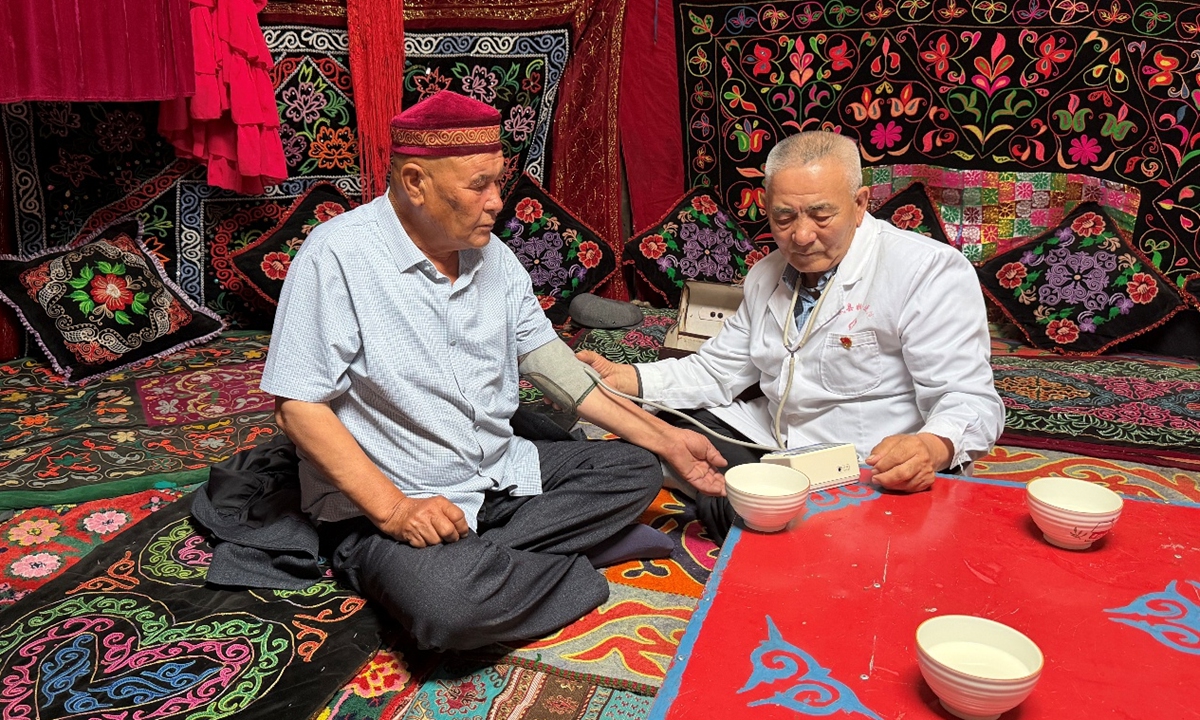
Uhas Sulayman (right) provides a herder with a free medical consultation at a summer pasture in the Barlik Mountain in Jiyek Town, Yumin County in June 2026. Photo: Chen Zishuai/GT
'He is a true grassroots cadre'
During several days of interviews, the Global Times reporters noticed one habitual gesture of Uhas: whenever he sat quietly, he would gently pat his legs. It was a lifelong ailment left behind by more than 40 years of horseback medical visits through wind, snow and harsh conditions.
For over four decades, carrying a medicine box on horseback, he traveled to every corner of the Barlik Mountains, Mayile Mountains and the Kulustay Grassland.
His apprentice, Erjan Kukan, told the Global Times that when he first met Uhas in 2004, "He looked like a very ordinary person. But as I got to know him, I realized how remarkable he truly was. Mention any place in the pastoral area, and he can tell you where it is, who lives there and everything about that location."
One winter in 2011, Erjan accompanied Uhas on horseback to visit an elderly patient with hypertension. A fierce snowstorm caused the horse to slip, and Uhas injured his foot in the fall. "I told him we hadn't gone very far and suggested we turn back to the clinic," Erjan recalled. "But Uhas refused. He said, 'No. The patient is an elderly person with high blood pressure - we have to go.'"
"He sleeps very lightly," Erjan added. "Day or night, in wind or rain, whenever someone comes looking for him, he sets off immediately. Sometimes, at daybreak, as soon as the dogs bark, he knows a patient has arrived."
Adila Maimaiti Ahong, Party Secretary and Director of the Jiayilema community in Halabula Town, Yumin County, told reporters that she had heard Uhas' name since childhood. After working with him, she came to see him as "someone who always puts the interests of the people before his own - a true grassroots cadre."
'Since when does a CPC member retire?'
After retiring in 2015, Uhas started to enjoy a peaceful retirement, but it wasn't after long that he realized he couldn't sit idle and do nothing while people needed him. He picked up his medicine box once again and established the Uhas health service room, where he has provided free medical consultations in the community at least three days a week. Over the past decade, he has treated more than 65,000 patients, transforming his once-mobile clinic into a permanent service center.
In August 2021, Uhas voluntarily converted the courtyard of his own home into a public educational center dedicated to ethnic unity, patriotism and Party education. He receives visiting Party members, officials and members of the public from across the country free of charge, personally recounting the dramatic improvements in healthcare on China's frontier and sharing heartwarming stories of ethnic solidarity. The Global Times reporter visiting the site saw a flagpole standing in the center of the courtyard, where the bright red national flag fluttered in the wind.
The courtyard's guestbook is filled with heartfelt messages from visitors nationwide: "Learn from Grandpa Uhas!" "Learn from this veteran Party member!" "Become someone who contributes to society!"
Inside Uhas' home, the reporter saw an old medical bag that had become badly worn from decades of use. Over the years, he has worn out four such medicine boxes. Today, he carries a brand-new one as he continues his journey of serving the people.
Uhas' medical career also reflects the broader transformation of life for local herders. In Aktiekeqie village, the Global Times reporter found wide, well-paved roads connecting rows of neatly built houses. The village is equipped with a clinic, a cultural activity center and other public facilities. Village doctors conduct regular follow-up visits, and patients with chronic illnesses have easy access to medical care.
Even so, the Party and the government have not withdrawn medical stations from the pastoral areas. Doctors continue to be stationed at remote grazing sites so that herders living high in the mountains can receive convenient healthcare. Uhas understands that lasting improvements in rural healthcare cannot depend on a single individual. What is needed is a medical team that will remain in the community. Over the years, he has mentored many young healthcare workers. Nearly all grassroots medical personnel in Yumin county have received his guidance and training.
Inspired by Uhas' lifelong work, more than 20 doctors and nurses from Yumin county's pastoral hospital now spend the year traveling through the grazing areas, delivering medicines, conducting medical rounds and providing free clinics - helping ensure that healthcare reaches even the most remote farming and herding communities.
As the Communist Party of China celebrated its 105th anniversary this year, Uhas reflected with emotion on the changes brought about in the new era:
"Thanks to the Party's good policies and sound leadership, our motherland has become stronger and has grown into one of the world's leading countries. People's lives have also become better and better. I wish our country continued prosperity and an even brighter future."
RELATED ARTICLES