The price tag of strategic miscalculations by major powers is always astronomical: Global Times editorial
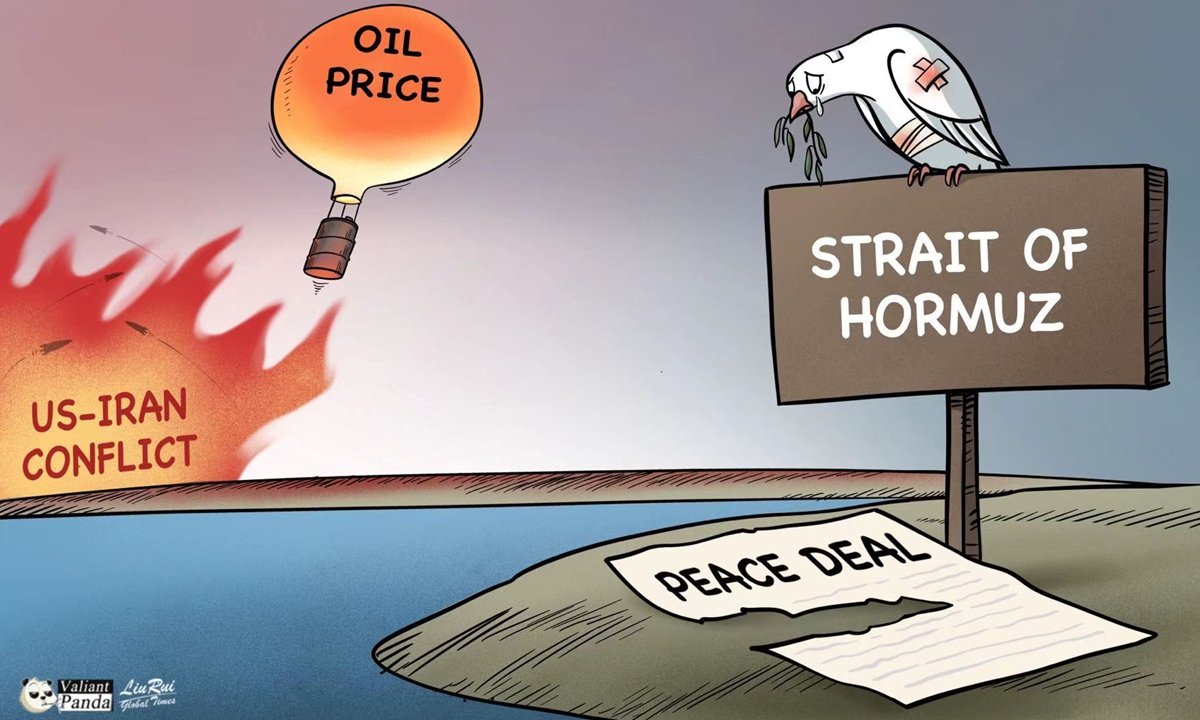
Illustration: Liu Rui/GT
The renewed US-Iran conflict means that the entire world risks being drawn into a prolonged process of "bleeding out." The price tag of strategic miscalculations by major powers is always astronomical. Hopefully, the US and Iran can resume negotiations as soon as possible and apply the rationality needed to "stop the bloodletting" and put the brakes on the conflict.
Less than a month after the signing of a Memorandum of Understanding (MoU) between the US and Iran, tensions between the two sides have once again escalated. In the early hours of July 14, Iran time, the US military launched "a third night of strikes" against Iran, while Iran retaliated by targeting US military bases in regional countries. Global oil prices surged in response, dark clouds once again gathered over the Strait of Hormuz, and the already fragile nerves of global supply chains were dealt another heavy blow. The renewed outbreak of hostilities between the US and Iran is in the interests of neither side involved in the conflict, and it also means that the entire world risks being drawn into a prolonged process of "bleeding out."
The signing of the MoU was hard-won, and it clearly proposes that the US and Iran "declare the immediate and permanent termination of military operations on all fronts" and "refrain from the threat or use of force against each other." The two sides also pledge to respect each other's sovereignty and territorial integrity and refrain from interfering in each other's internal affairs. These provisions embody the spirit of equality, align with the purposes of the UN Charter, and are consistent with basic norms governing international relations. The international community had widely hoped that the document would help stabilize the situation around the Strait of Hormuz and establish a channel for sustained dialogue. However, the US and Iran have interpreted the MoU differently, with both sides accusing the other of "undermining the agreement." The US even openly described the MoU as merely a "test" and said that "it doesn't mean much," a stance that ultimately triggered a new round of confrontation.
The price tag of strategic miscalculations by major powers is always astronomical. In this conflict, no side can afford to indulge in the illusion of an easy "swift victory." History has repeatedly shown that military means are never the solution. Responding to violence with violence only deepens hatred and confrontation, trapping all parties in an endless vicious cycle. It took the US 20 years to withdraw from Afghanistan, while the consequences of its involvement in the Iraq war continue to linger eight years later. The escalating military confrontation is creating multiple risks for the US and Iran, the broader Middle East, and the entire world.
The direct consequence of a return to full-scale hostility between the US and Iran would be to deepen the wounds of the global economy. The Strait of Hormuz handles around 20 percent of the world's oil and gas shipments, making it a lifeline for international trade and energy security. As international oil prices recorded their biggest single-day increase in recent years, costs across global supply chains rose in tandem, casting another shadow over the already fragile global economic recovery. On July 8, the International Monetary Fund (IMF) released an update to its World Economic Outlook, projecting that the global economy would grow by 3 percent in 2026, 0.1 percentage point lower than its April forecast. The IMF cited the impact of the conflict in the Middle East as the main reason for the downgrade.
The most immediate and devastating toll of the US-Israel-Iran conflict is its staggering humanitarian cost. According to Iran's Fars News Agency on June 22, 3,519 people have been killed in the recent hostilities involving the US, Israel, and Iran. Data released by Lebanon's Ministry of Public Health on July 7 showed that Israeli attacks on Lebanon have killed 4,320 people since March 2. Any renewed military confrontation between the US and Iran would further amplify the spillover effects of the conflict, making the prospects for peace even dimmer.
The most concerning issue at the moment is not the difficulty in reaching a consensus through negotiations, but rather the complete closure of communication between both sides. The situation has reached a critical juncture between war and peace. At such a moment, all parties must demonstrate the utmost sincerity, remain committed to a political solution, and ensure that the momentum toward a ceasefire and negotiations is not reversed. The US urgently needs to abandon its hegemonic mind-set, acknowledge Iran's legitimate security concerns, and halt military strikes. Iran, for its part, should continue exercising strategic restraint, avoid actions that could escalate tensions, and preserve the necessary space for the resumption of bilateral talks.
China has repeatedly made its position clear at the UN Security Council and through bilateral diplomatic channels. It has successively proposed the five-point initiative with Pakistan and the four-point proposal on promoting peace and stability in the Middle East. The underlying principle has remained consistent: military means cannot resolve disputes; sovereignty equality, dialogue and diplomacy are the only viable paths to resolving conflicts. The US and Iran should resume follow-up negotiations as soon as possible and work toward a comprehensive agreement that is acceptable to both parties, welcomed by regional countries, and supported by the international community. Restoring the security and freedom of navigation through the Strait of Hormuz at the earliest opportunity serves the interests of all parties. Shipping issues should be handled properly in order to address the concerns of the international community. Any unilateral blockade, military intervention, or forced imposition of transit fees would constitute a serious violation of the UN Charter and the fundamental principles of international law, representing a step backward in history.
In recent weeks, countries including Qatar and Pakistan have continued to play mediating roles, reflecting the strong desire and broad consensus for peace across both the region and the wider international community. The world cannot afford any more bloodshed. What the international community expects is a return to dialogue, not another military gamble. Hopefully, the US, Iran, and all relevant regional parties will apply the rationality needed to "stop the bloodletting" and put the brakes on the conflict.
RELATED ARTICLES