From drones carrying people amid mainland floods to ‘First Year of Taiwan Poison’ – The stark contrast between two paths is immediately apparent: Hai Feng
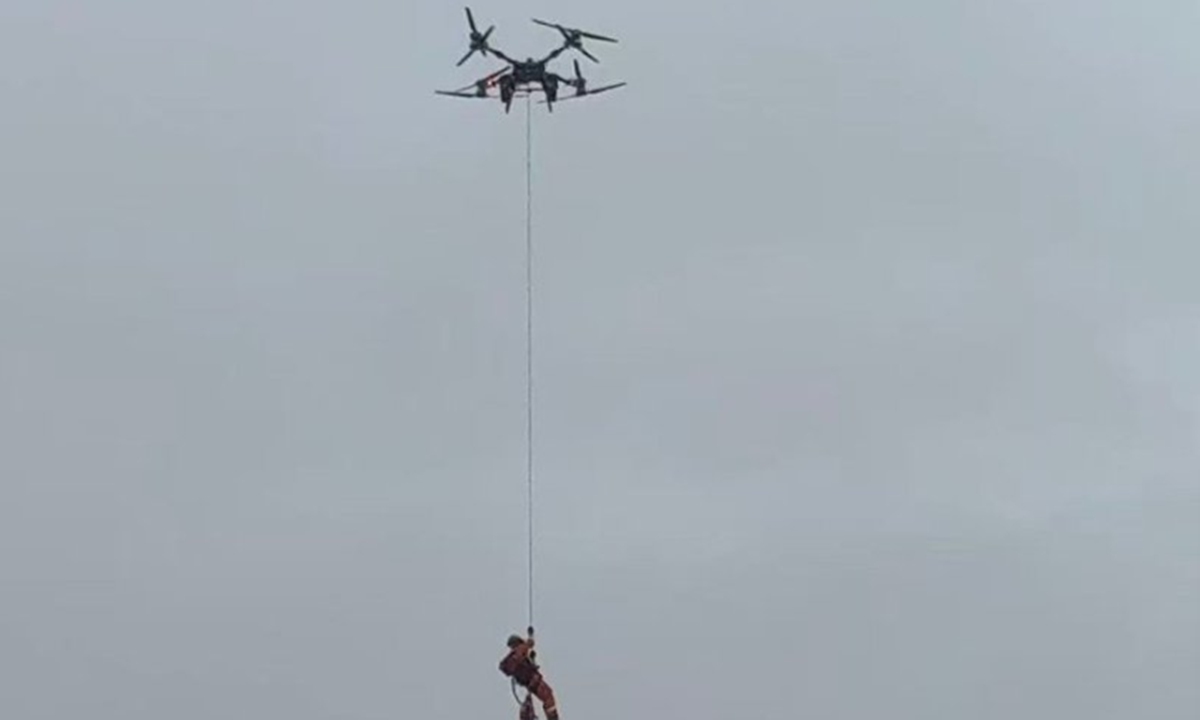
Photo: Courtesy of DJI
In recent years, the mention of drones often conjures up images of looming warfare rather than technological progress. From reconnaissance, surveillance and precision strikes to battlefield guidance and integrated system coordination, drones are becoming increasingly deeply embedded in modern warfare.Several recent news reports collectively send a clear signal. Taiwan media outlet China Times reported on July 15 that the island's military, during its "Penghu Exercises," deployed drones for the first time in a "joint defense drill" to guide tank fire; the US Central Command declared on social media that the military launched an attack on an Iranian target on July 12 using unmanned surface vessels (USVs), marking its first combat strike; and Ukraine is integrating USVs and unmanned ground vehicles to explore a fully unmanned amphibious assault model. These developments all point to the same trend: Future warfare is rapidly moving toward an unmanned era.
Yet, the value of drones extends far beyond the smoke-filled battlefield; they also serve as a vital force in safeguarding lives and combating disasters. A scene from the recent floods in South China's Guangxi Zhuang Autonomous Region was particularly moving. Days of torrential rain and flooding had severed internet, water and road connections in some places; assault boats could not reach the disaster-hit areas, and vehicles could not get in. Amid this crisis, drones took to the skies to deliver bread, medicine and communication supplies, bringing hope along with necessities. In life-or-death situations, drones even performed direct aerial rescues, literally lifting trapped individuals out of the floodwaters. In those moments, these unmanned aerial vehicles became lifesavers. As some have observed, this act of protecting human life represents technology at its most touching.
The rescue operation in Guangxi reveals a facet of China's strength that, while often overlooked by the West, is precisely the one most worthy of attention.
We often speak of China's hard power and soft power. In recent years, however, the country has increasingly demonstrated a unique form of "cooling power." This is not about generating hype, staging performances or crafting exaggerated narratives; rather, it is a tangible capability - unassuming in ordinary times yet capable of rapid mobilization and cohesion at critical moments. Calm, solid and systematically comprehensive, it relies not on a stack of slogans, but on a robust industrial foundation, organizational prowess, social mobilization, grassroots execution and a steadfast commitment to the people, enabling it to step up and act decisively in times of crisis.
In ordinary times, this power lies hidden within warehouses, factories, supply chains, vast fleets of commercial drones and routine emergency training exercises, appearing unassuming. Yet the moment disaster strikes, it is instantly activated, integrated and deployed, ultimately transforming into tangible, reliable "life-saving lifelines."
Just as the July 11 Hai Feng article wrote, China's "cooling power" is precisely the comprehensive embodiment of China's hard power and soft power. It is the force that, at critical moments of crisis and danger, transforms the principle of "putting the people first" into tangible capability.
To some people in the West and on the island of Taiwan, "people first" sounds like empty rhetoric. But in times of major crises and disasters - amid floodwaters, on broken roads, and in areas completely cut off from the outside world - when lives are hanging by a thread, these four words prove they are far more than just a slogan.
When lives are on the line, rescue operations put people first. Technology is deployed to serve the people, and all available resources are immediately redirected toward saving lives. This decisiveness, this execution and this ability to concentrate all national capabilities on "saving people first" represent the strongest form of state capacity.
In contrast, the opinion piece "We Have Entered the 'First Year of Taiwan Poison'" published by the Taiwan United Daily News on July 15 makes the "First Year of Taiwan Poison" sound even more absurd.
On the one hand, the Chinese mainland turns unmanned technology into life-saving tools during disasters, transforms industrial capacity into public welfare support, and turns organizational strength into lifelines for the people. On the other hand, certain political forces on the island remain obsessed with the dangerous narrative of "relying on foreign forces to seek independence" and "resisting reunification by force." They continue to pour vast resources, public sentiment and political energy into confrontation, division and reflexive opposition to anything related to the Chinese mainland. The result? Louder political slogans of the DPP authorities, but more frequent failures in governance. Stronger ideology, but declining food safety, social trust and public confidence in institutions on the island.
On the surface, the "First Year of Taiwan Poison" - referring to driving under the influence of drugs, sprouted potatoes and tainted apples - is about a series of governance failures. On a deeper level, the root problem lies not just in individual scandals, but in a misguided development path taken by the DPP authorities: putting political self-interest and ideology above people's well-being and safety, ultimately leading the island down a "poisonous" dead end.
When viewed together, these news reports highlight two fundamentally different logics of technological development. One turns technology into tools of war and pushes society toward constant tension. The other turns technology into public goods and puts people's safety first. The former may shout slogans about "security" and "values," but only the latter actually saves lives in times of crisis and truly delivers security.
When a drone becomes a "manned aircraft," what changes is not the name, but the order of values. What it reveals is not just technological progress, but the underlying institutional orientation. It demonstrates not only the strength of Chinese manufacturing, but why Chinese strength can be trusted and relied upon in critical moments.
This is the national power that supports and warms the people in times of need.
RELATED ARTICLES