Photo: Courtesy of Huashan Hospital affiliated with Fudan University
A Shanghai hospital has performed China's first commercial brain-computer interface (BCI) surgery following the market approval of a domestically developed implantable system designed to compensate for hand-movement function, according to Beijing News reports on Wednesday.
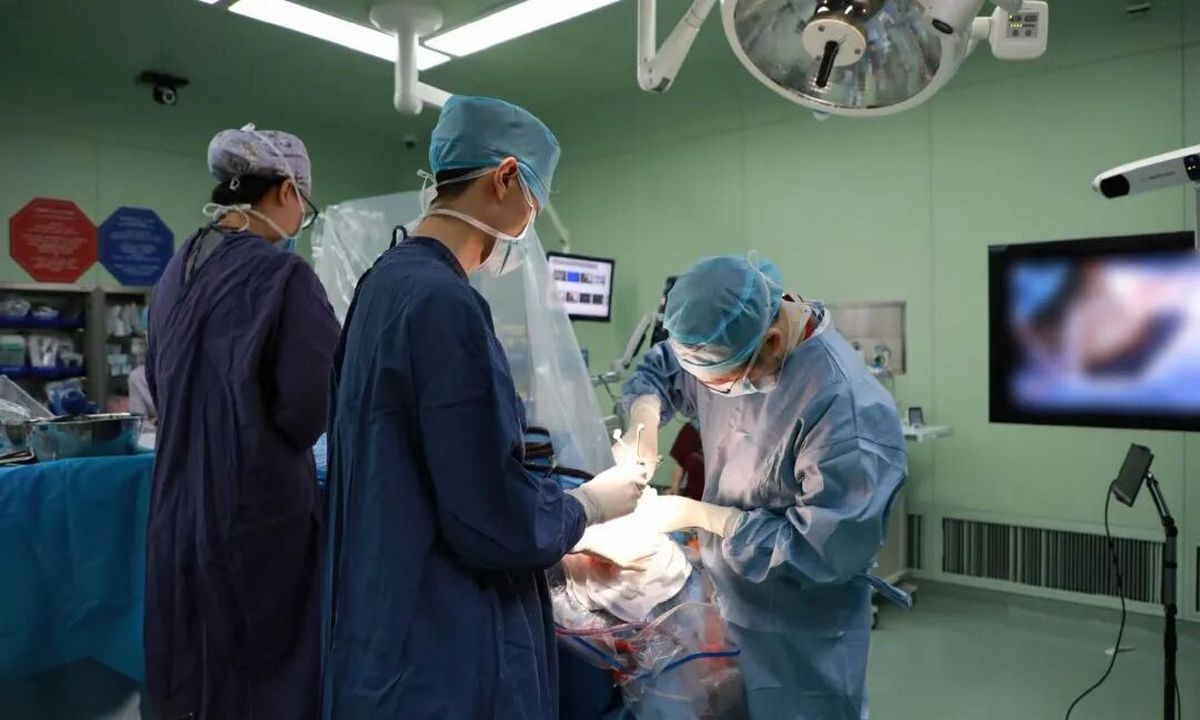
The surgery using the implantable hand motor function compensation system known as "NEO," developed by Neuracle Technology (Shanghai) Co, was completed at Huashan Hospital affiliated to Fudan University on July 13.
The surgery marks a milestone for China's rapidly advancing brain science sector and for a technology that could help patients with severe paralysis regain basic hand function through thought-controlled movement.
Intraoperative testing showed that the epidural brain signals collected by the NEO system were stable and of good quality, and the patient's postoperative vital signs remained stable, the Beijing News reported.
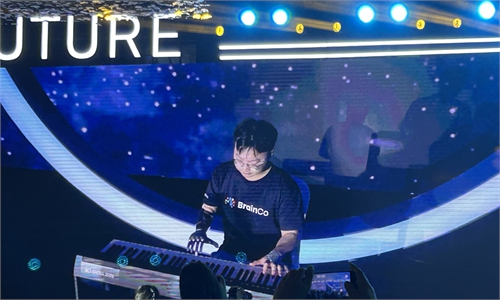
The NEO system, which received China's Class III medical device registration certificate on March 13, is the world's first approved implantable BCI product, according to the company. It is designed for patients with quadriplegia caused by cervical spinal cord injuries, enabling them to control hand movement through minimally invasive implantation.
Experts said the surgery represents an important shift from experimental research toward broader clinical application. However, they cautioned that the technology is still in its early stages and requires intensive rehabilitation before meaningful results can be achieved.
Mao Ying, president of Huashan Hospital, said the hospital has launched the world's first clinical cohort study on BCIs. Based on assessments of 32 patients and a six-month neurological rehabilitation evaluation, the research team has observed encouraging results, he said.
"Looking ahead, as the technology matures and the industrial chain develops, BCI devices may expand from high-cervical spinal cord injury to more scenarios, such as lower-limb recovery and language restoration," Mao said in a previous interview, the Beijing News reported.
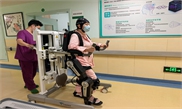
In the current study, patients are required to undergo six hours of rehabilitation training a day for more than one month before significant improvements can be seen, according to Mao.
Lü Baoliang, a professor at Shanghai Jiao Tong University, told the Global Times on Wednesday that the surgery marks a major step toward the technology's transition from clinical trials to routine medical care. It also signals China's competitiveness in a global race that includes Elon Musk's Neuralink, Synchron, and Precision Neuroscience.
On April 28, the Huashan Hospital completed its medical insurance pricing filing, and has since moved forward with device admission, patient screening and preoperative assessment, paving the way for the first commercial implantation, the hospital said on its official WeChat account.
It is estimated that there are more than 3.7 million people living with spinal cord injuries in China, with around 90,000 new cases each year. Roughly 70 percent of the patients are under the age of 50 when injured, underscoring the long-term rehabilitation needs that BCI technology may help address, according to the Beijing News.
Multiple Chinese authorities, including the Ministry of Industry and Information Technology and the National Development and Reform Commission, have issued guidelines calling for key technological breakthroughs in the industry by 2027, alongside the establishment of advanced technology, industry and standards systems, the Xinhua News Agency reported. They also outline an array of key tasks, including the advancement of basic hardware and software research, and achieving significant progress in the development of BCI chips.
Several regions, including Beijing, Shanghai and East China's Shandong Province, have introduced detailed policies to support BCI innovation.
Some institutions predicted that by 2027, China's BCI market will reach 5.58 billion yuan ($818.46 million), with an average annual growth of 20 percent. Industry observers also believe the sector is poised to enter a phase of steady growth, with medical rehabilitation serving as the primary driver while applications gradually expand into broader fields, the People's Daily reported.
Lü said the sector is expected to enter a period of steady growth, with medical rehabilitation likely to remain the main driver before expanding into additional application areas.
RELATED ARTICLES