China's first domestically made smart deep-sea cable-laying vessel enters service in Shanghai
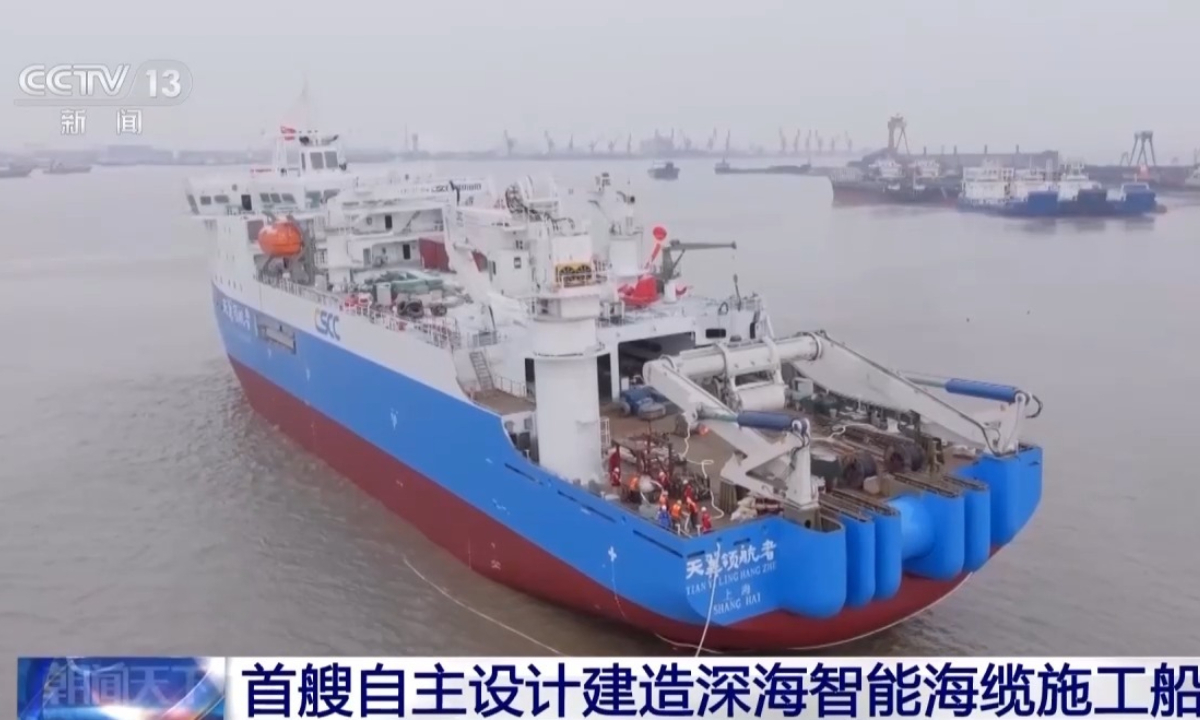
China's first domestically designed and built deep-sea intelligent cable-laying vessel, the Tianyi Linghangzhe, enters service in Shanghai on July 15, 2026. Photo: Screenshot of CCTV News
China's first domestically designed and built deep-sea intelligent cable-laying vessel, Tianyi Linghangzhe, was commissioned in Shanghai on Wednesday and launched a full-system trial voyage for subsea cable-laying, a major step in strengthening the infrastructure underpinning the growth of computing power and artificial intelligence (AI), state broadcaster CCTV News reported on Thursday.
Boasting global submarine cable laying, maintenance and overhauling, the ship measures 116 meters in length, 24 meters in width and 12 meters in depth, with a full-load displacement of 18,000 tons. Its dedicated cable tank features a world-leading maximum load capacity of 8,000 tons for undersea communication optical cables.
Built with BeiDou and Global Positioning System (GPS) dual satellite-positioning signals, the vessel is fitted with a state-of-the-art intelligent positioning system. A suite of high-precision sensors tracking wind speed, geographic position and marine conditions enables it to detect subtle changes in ocean currents, wind and waves in real time, allowing steady and reliable operations even under Sea State 5 conditions.
Outfitted with a specialized 5.5-meter subsea cable burial system, the ship can execute cable burial operations at depths of up to 1,000 meters, setting a new national record for China's deep-sea submarine cable construction, according to the report.
Submarine cables have become one of the most critical yet less visible foundations of the digital economy. The International Telecommunication Union (ITU) said submarine cables form the backbone of global communications, carrying about 99 percent of the world’s Internet traffic and supporting services including financial transactions, cloud computing and government communications.
Undersea communication cables feed high-speed subsea transmission that connects global computing hubs, acting as indispensable core infrastructure for AI computing systems.
These subsea cables deliver low-latency, eco-efficient computing support for AI applications. They also incorporate underwater data centers into China's national computing resource pool, enabling an innovative hybrid deployment model that combines land-based AI model training with subsea computational inference, the CCTV News report said.
China's marine engineering equipment and high-end shipbuilding sectors have seen accelerated industrial transformation and upgrading in recent years. The country has developed a large-scale, fully integrated marine engineering equipment industrial system with a coordinated whole-industry-chain development ecosystem.
Official data showed that China's new marine engineering order value rose 36.4 percent year-on-year in the first quarter of 2026, securing the country's leading position in the global marine engineering market. High-end vessels and advanced marine engineering equipment have emerged as the major drivers behind the robust order growth.
The launch of Tianyi Linghangzhe comes as China continues to expand its computing infrastructure. By the end of 2025, China had built a total of 42 national-level intelligent computing clusters, with intelligent computing capacity reaching 1.59 million PFLOPS (FP16), according to data released by the National Data Administration. The rapid expansion of computing resources has provided infrastructure support for the development of AI applications and the digital economy.
In June, the Ministry of Industry and Information Technology released a three-year plan to accelerate the integration of AI with the information and communications sector, setting targets for more autonomous networks, wider low-latency computing-power coverage and expanded AI applications by 2028.
China has also been accelerating the construction of the "East Data, West Computing" project, which aims to optimize the allocation of computing resources by guiding demand from eastern regions to computing hubs in the west. The project is considered a major infrastructure initiative supporting the development of the digital economy and emerging technologies, including AI, according to official statements.
Global Times
RELATED ARTICLES