Illustration: Chen Xia/GT
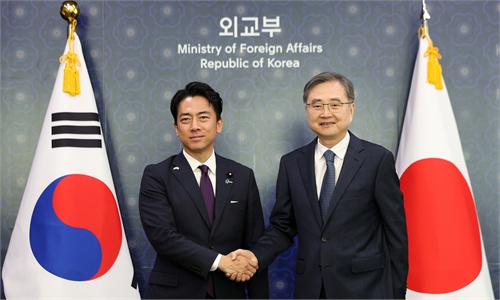
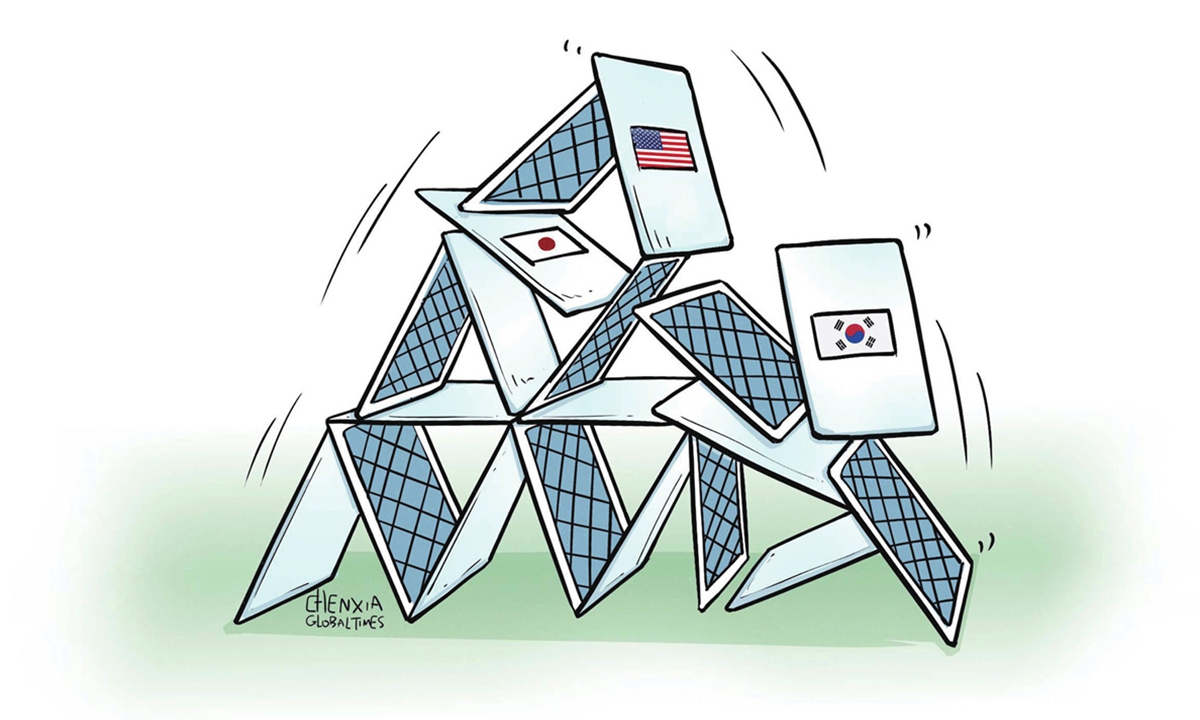
Recently, the foreign ministers of the US, Japan and South Korea signed an agreement to cooperate on the deployment of small modular reactors (SMRs, also known as emergent class of nuclear fission reactors) in third countries on the sidelines of the NATO summit in Ankara, Turkey. An agreement that should have focused on energy transition, industrial heating and civilian electricity supply was instead signed at a summit steeped in military and security implications.This once again shows that the US, Japan and South Korea are applying a Cold War mentality to SMR issues. They are attempting to build an exclusive small circle and turn normal energy and technological cooperation into a new tool for "technological geopolitics."
According to information released by the three countries, a coordinated trilateral approach positions American, Japanese and South Korean firms to provide partners in the region with more competitive alternatives to meet their growing energy demands and to uphold the highest standards of nuclear safety and nonproliferation as new reactor technology increasingly comes online.
Ordinary industrial cooperation is not a problem. The issue lies in the fact that participating countries have imbued it with strong geopolitical overtones right from the start.
South Korean media openly describe it as a "strategic alliance" aimed at countering China and Russia, suggesting that the three countries envision developing a standard for SMR technology through synergy between the US' design techniques, Japan's supply chain and South Korea's building capabilities.
On the US side, the focus seems less on helping these countries secure stable and affordable clean energy and more on preventing them from adopting energy solutions offered by China and Russia. Since the US, Japan and South Korea struggle to compete on price alone, they are attempting to use security rhetoric, alliance systems and regulatory barriers to influence market choices.
The South Korean government has repeatedly stated its opposition to bloc confrontation and emphasized "pragmatic diplomacy," yet it actively seeks the benefits of bloc confrontation on the SMR issue. This contradiction - opposing bloc confrontation in words while joining it in action - reflects an opportunistic mind-set.
This raises a key question: What do countries actually need - energy solutions that meet their national conditions and are affordable, or energy options that serve US geopolitical strategy?
The US has long faced delays in nuclear power construction, with weaknesses in its supply chain and nuclear fuel capabilities. Japan continues to struggle with energy structure and public acceptance issues following the Fukushima nuclear accident. For countries with their own unresolved problems, dictating energy paths for others clearly lacks persuasiveness.
South Korea, in particular, should not hold overly high expectations for this memorandum. Seoul hopes to enhance its nuclear industry capabilities by participating in the US-led SMR supply chain and to accumulate leverage for gaining uranium enrichment and fuel processing rights. But would the US really easily hand over critical nuclear capabilities to South Korea?
What Washington needs is Seoul's manufacturing and construction capabilities, but it is unlikely to nurture a competitor capable of independent design, fuel mastery and autonomous exports.
By promoting trilateral cooperation, the US aims to leverage South Korea's supply chain and integrate it into an American-dominated system of technology, fuel and export licensing - preventing South Korea from "going solo" in the international market. Once the US controls design certification, nuclear fuel and export permits, South Korea will likely remain merely a "high-level manufacturer" and "engineering contractor," rather than a true equal rule-maker.
In this scenario, SMRs risk being transformed from an energy transition solution into a tool for forming cliques, controlling supply chains, and creating long-term dependence. South Korea should not be naive about this. Whether in the Asia-Pacific region or elsewhere, what countries truly need are safe, reliable, affordable and sustainably financed energy solutions that allow autonomous choice - not being forced to pick sides between different camps.
The author is director and professor of the Center for Korean Peninsula Studies at the Shanghai University of International Business and Economics. opinion@globaltimes.com.cn
RELATED ARTICLES