‘We are still very much concerned about the remilitarization of Japan’: South Korean expert
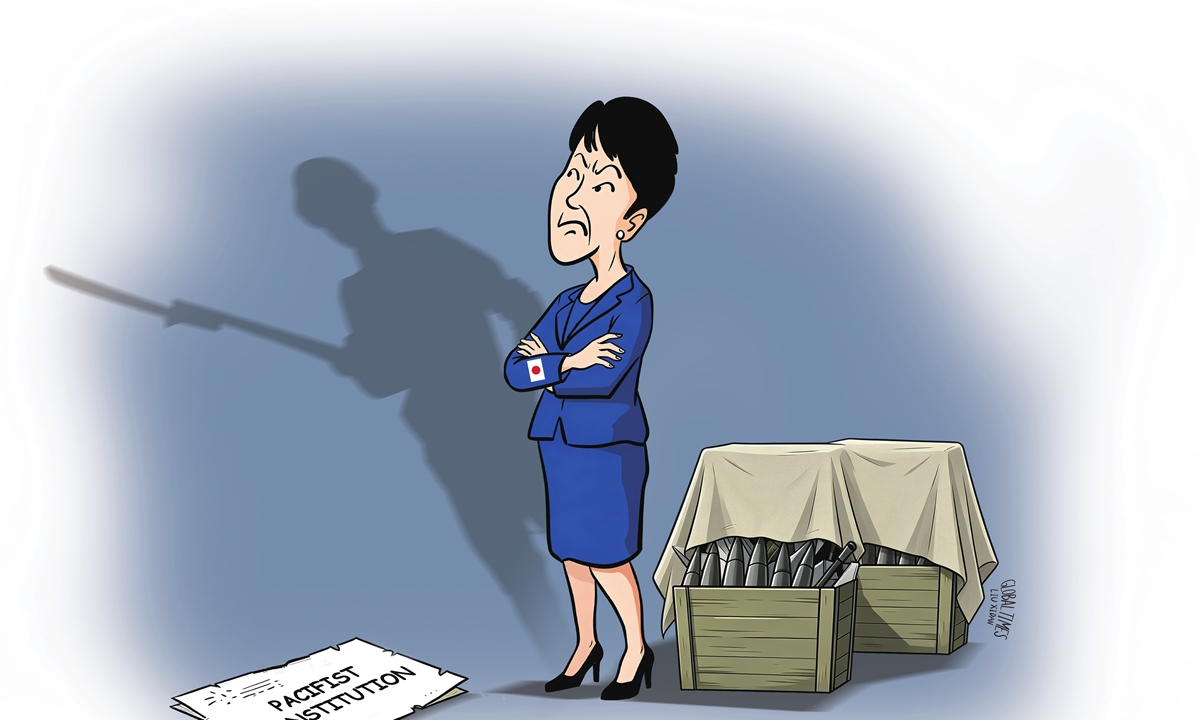
Illustration: Liu Xidan/GT
Editor's Note:Japan's aggressive military buildup has sparked mounting alarm and strong opposition from neighboring countries due to its notorious history of militarist atrocities. In this interview, Moon Chung-in (Moon), who served as former president Moon Jae-in's special adviser on national security and foreign affairs, shares his views with Global Times (GT) reporter Su Yaxuan. Moon said that historical issues remain a key factor shaping South Korea's approach toward security cooperation with Japan, emphasizing that Japan's pursuit of closer ties with neighboring countries should be accompanied by a sincere reflection on its wartime history.
GT: You noted in your previous interview that South Korea should not adopt a confrontational approach toward China. However, in reality, when Seoul develops its relations with the US and Japan, some agendas are inevitably aimed at countering China. What is your assessment of this contradictory situation?
Moon: Washington and Tokyo want Seoul to join trilateral military exercises and training, but we have been much more cautious in doing so. There is one important sign. President Lee Jae-myung took a prudent stance on concluding the Acquisition and Cross-Servicing Agreements with Japan and said "It is difficult to accept at this moment, considering [South Korea's] public sentiment."
President Lee thinks that it is still too premature to sign that military logistics cooperation between the two countries. South Korean people have a collective memory of the historical past, and the South Korean government needs to pay attention to public sentiment.
South Korea has a very strong alliance with the US, but it also wants to continue and promote a strategic cooperative partnership with China.
If you look at a series of actions and policies, there have been reservations on the part of the Lee administration in strengthening US-Japan-South Korea cooperation. I would say that this sends a clear signal to China. Also, on the Taiwan question, Lee has made it very clear: We support the one-China principle and behave in accordance with that principle.
GT: Recently, Japan-South Korea relations appear to have somewhat improved. However, public sentiment in South Korea continues to be resistant. If Japan fails to take meaningful action on historical issues, can the relationship between the two countries truly improve?
Moon: I doubt it. Historical issues will continue to hinder the fuller improvement of relations between the two countries. In the past, that was one of the main reasons why Japan-South Korea relations worsened. But the Lee administration has taken a different approach by pursuing a two-track approach. Economic and security cooperation will go ahead, but historical issues cannot be easily resolved by the leaders themselves, because they require persuasion from South Korean people, as South Koreans have a collective memory of the historical past.
We will continue to raise historical issues as part of diplomatic negotiations. Thus, enhancing cooperation in security and economic issues, while maintaining tension in history issues, will be troublesome. Although the Lee administration will try to minimize impacts of historical issues on security and economic relations, these issues will from time-to-time cause problems for bilateral relations.
South Korea opposes Japanese remilitarization through the amendment of its peace constitution because of the memory of Japan's brutal militarism in the 1930s.
GT: In recent years, Japan's accelerated militarization, including raising its defense budget and easing restrictions on weapons exports, is extremely concerning for the region. What risks do you think Japan's continued militarization poses to Asia?
Moon: In 1931, Japan began its invasion of China starting with Manchuria and launched a series of wars after that. Therefore, Japanese aggression through its militarism left neighboring countries with deep scars and fear. Japan is a mature democracy, but we are still very much concerned about the remilitarization of Japan.
If Japan amends Article 9 of its constitution and abolishes the Self-Defense Forces, it will become a normal state with a regular army. Japan will give up its traditional exclusive defense-oriented policy. Japan can engage in military actions going beyond its national boundaries. This is much more concerning for us.
There is also an American factor. The US wants Japan to play a greater role in defending the so-called Indo-Pacific region against China. Japanese conservatives have been utilizing this kind of American demand to amend the constitution and seek the normalization of the Japanese state.
I do not oppose Japan going normal. It is a sort of natural process. But there is one condition. That is the cleaning of the stained history of aggression and domination as well as subsequent apologies and actions thereof that can remove fears of neighboring countries and people.
But the problem is that Japan has been somewhat hesitant in addressing its historical past, while at the same time wanting to pursue remilitarization. That is what we are very worried about.
GT: Amid growing challenges facing the UN system and multilateralism, what kind of approach is needed to address global common challenges and improve global governance?
Moon: Yes, the UN is in crisis. We should work together and restore the power and functions of the UN. It will be good for the world, especially smaller countries.
Multilateralism is in severe crisis. The World Trade Organization (WTO) is in trouble, and the Paris Agreement is also in trouble. But if those multilateral agreements collapse, there will be no way to solve global common problems.
The US used to serve as a creator and sustainer of the UN and other multilateral cooperative schemes. But now the US does not want to play a leading role in steering these multilateral efforts. We should think about a multilateral order without American involvement.
In this regard, the Global Governance Initiative (GGI) proposed by China is very timely and desirable. It aims to increase the voice of the Global South in UN, IMF and WTO reforms under the core principles of sovereign equality, the rule of international law, multilateralism, a people-centered approach and action-oriented results.
Therefore, I strongly support the GGI. It can contribute to opening the new horizon of global governance. It is the surest way to shape the shared future of common destiny through the logic of win-win.
RELATED ARTICLES