LV reportedly files lawsuit against small store in Ningbo amid growing IP controversy
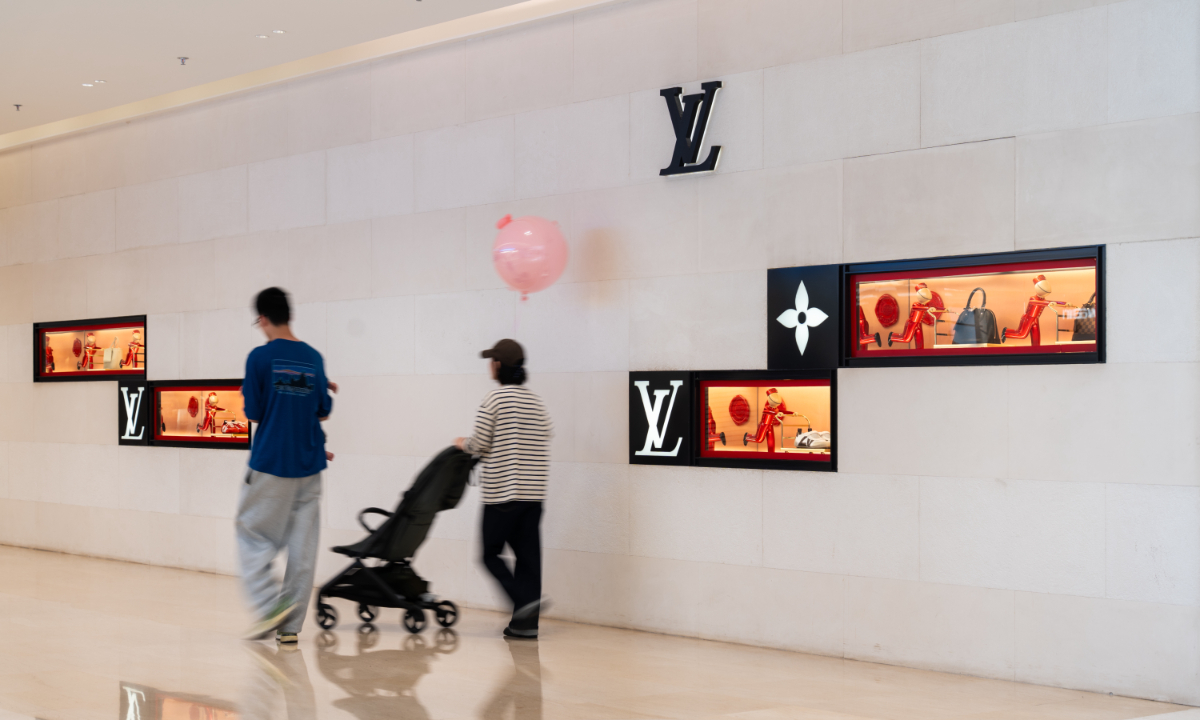
A Louis Vuitton store at a shopping mall in Ningbo, East China's Zhejiang Province, on April 26, 2026. Photo: VCG
Louis Vuitton (LV) has filed a lawsuit against a small-sized daily necessities store in Ningbo, East China's Zhejiang Province, for alleged intellectual property (IP) infringement, according to local media report.
This became one of the latest IP lawsuits involving LV and Chinese companies, including tea chain Molly Tea, which have sparked heated debate among Chinese netizens, with some criticizing the French luxury brand for attempting to monopolize traditional Chinese patterns.
Public judicial records showed that in the past five years, LV has filed 1,691 trademark rights protection lawsuits in China, with 56 new cases in the first half of 2026 alone.
The defendants cover a wide range of industries, including catering, cultural and creative products, home textiles, daily necessities, property management, internet technology, and more - from well-known chain brands to small street food vendors.
According to the Ningbo Evening News, LV recently filed a lawsuit against Ningbo Haishu Shiqi Yuanya Daily Necessities Store and Ningbo Textile City Co for alleged IP infringement.
Ningbo Haishu Shiqi Yuanya Daily Necessities Store is registered as an individual industrial and commercial household. It was established in 2018 with a registered capital of 50,000 yuan ($7,387). Its business scope includes wholesale and retail of daily necessities, according to statistics on Qichacha, a Chinese corporate database platform.
Ningbo Textile City is a large commodities market with over 4,000 merchants, more than 1,000 of which are engaged in daily necessities retail. The involved daily necessities store is one of the merchants in the city.
Jiang Weiliang, chairman of Ningbo Textile City Co, the operator of the commodities market, confirmed "the case is currently underway, so many details cannot be disclosed," as quoted by the Ningbo Evening News.
"The primary defendant is Ningbo Haishu Shiqi Yuanya Daily Necessities Store, while Ningbo Textile City is named as a joint defendant," said Jiang.
According to Qichacha, the IP infringement case was originally scheduled for a hearing on Monday. Jiang revealed that the court session has been postponed, with no new date confirmed yet.
LV's IP lawsuits against Chinese companies have gained widespread attention recently.
On Thursday, the Beijing Intellectual Property Court held a public hearing on an LV-related trademark administrative dispute. The plaintiff is LV, the defendant is the China National Intellectual Property Administration, and Huang Minyao participated as a third party.
Earlier this month, the trademark infringement lawsuit filed by LV against Chinese tea chain Molly Tea has continued to generate heated debate on Chinese social media.
A growing number of Chinese netizens criticized LV for attempting to monopolize traditional Chinese patterns that form part of the country's shared cultural heritage.
Amid the controversy, on Thursday, the hashtag "no queues at multiple LV stores" trended on social media platform Sina Weibo.
Some media reports revealed that after recent IP lawsuits, several LV's popular bag models are experiencing a noticeable price drop in the resale market in China.
For example, the official retail price of Carryall small handbag is 23,000 yuan, but the second-hand brand-new version is now listed at 19,000 yuan on Dewu APP — a drop of about 4,000 yuan. On second-hand luxury platform ZZER, the same model in 9.5/10 condition has fallen to around 12,000 yuan, nearly half the original retail price.
Global Times
RELATED ARTICLES