Pew survey: China surpasses US in global favorability – What does this mean?: Hai Feng
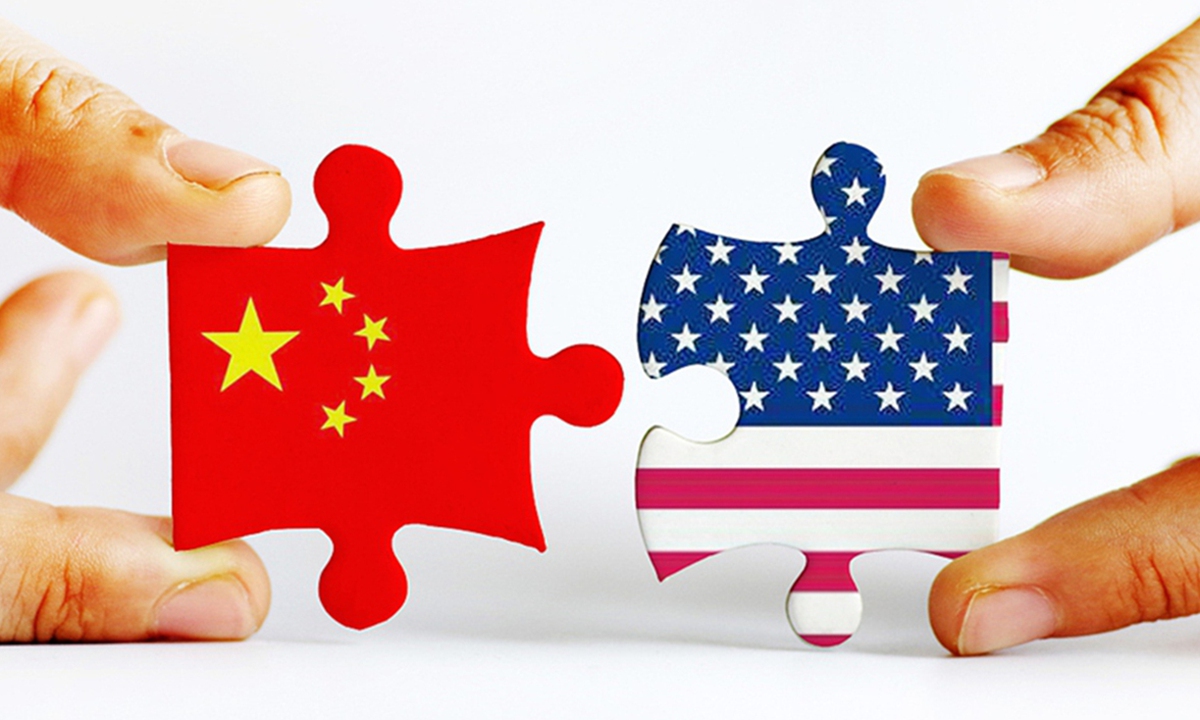
China US Photo: VCG
On July 16, Singapore's Lianhe Zaobao published an article titled "Pew survey: China surpasses US in global favorability rankings." The latest Pew survey indicates that China is now viewed more favorably than the US in many countries, marking the first time this has happened since at least 2023. Shifts in public opinion can even be observed among America's allies.
The poll becomes far more thought-provoking when paired with Francis Fukuyama's recent comments. During an interview in June, the scholar famous for advancing "The End of History" thesis argued that the US will enter a long-term decline and eventually give way to a country like China. As the US marks its 250th anniversary, it must consider two questions: Is the US heading toward a decline? And what does the future hold for China-US relations?
The US: waning yet unfallen, still a global hegemon
A recent analysis published by The Economist, a British news outlet, claimed that economically, militarily and technologically America is richer, stronger and cleverer than ever. Based on market exchange rates in 2025, the US remains by far the world's largest economy; the US dollar is the world's primary reserve currency; the US military boasts unmatched global power projection capabilities; and the US continues to lead in cutting-edge technology fields such as artificial intelligence.
However, the US is also showing clear signs of relative decline. Manufacturing output and the share of physical goods in exports continue to shrink; its military deterrence can no longer cover the entire globe; and the number of top US universities ranked globally is decreasing. US President Donald Trump has repeatedly stated publicly that the US is no longer a great nation, but rather a nation in decline.
More crucially, American society has long been mired in deep partisan polarization. Gallup polls show that for nearly two decades, the majority of Americans have consistently believed the country is heading in the wrong direction, with the wealth gap being the most serious issue - "the wealthiest 1 percent has taken 50 percent of all national wealth." Combined with this year's Pew survey, which reflects a decline in US soft power and a drop in US international standing, this is sufficient proof that the US today is a classic example of a hegemonic power in decline.
The 'Thucydides Trap' no longer binds the modern world
During their meeting in Beijing this May, Chinese and US leaders once again brought up the idea of transcending "Thucydides Trap." The so-called "Thucydides Trap" refers to the historical dilemma in which an established great power, fearing the rise of an emerging power, ultimately descends into full-scale confrontation. To avoid falling into this trap, China and the US reached a consensus on building a constructive relationship of strategic stability.
It is undeniable that China's decades of steady development and consistent rise in overall national strength have sparked strategic anxiety in the US - the root cause behind repeated hype over the so-called "Thucydides Trap." Among these factors, the Taiwan question is widely seen as the variable most likely to spark risks and global unrest, capable of becoming the trigger that sets off the "Thucydides Trap."
However, is this really the case?
In his book Destined For War: Can America and China Escape Thucydides's Trap? Graham Allison clearly points out that the "Thucydides Trap" is not a historical inevitability. Despite differences in systems, development paths and national conditions, China and the US have no choice but to coexist, which is both a necessity and an imperative. At the Summer Davos Forum in June 2026, Allison reiterated that the two nations are so inextricably entangled that each requires a level of cooperation with the other to ensure its own survival.
This is because China and the US are not Athens and Sparta from over 2,000 years ago, nor is today's world in the isolated state of early human civilization; the globe has long been integrated, and cultural exchange is an irreversible mainstream trend. Both China and the US understand that they cannot isolate one another, much less remake each other, and that neither side can bear the cost of all-out confrontation. The consensus reached at the China-US leaders' meeting to build a constructive relationship of strategic stability is precisely a powerful breakthrough against the fatalism of conflict between major powers, and it is also the correct answer to escaping the "Thucydides Trap."
Stability in the Taiwan Straits is the prerequisite for stability between China and the US. As the Taiwan question constitutes a pivotal issue where a single misstep could shake the entirety of bilateral ties, both sides are aware that separatist forces advocating "Taiwan independence" stand as their common foe.
"The vast Pacific Ocean is big enough to accommodate both China and the US." The US side has repeatedly sent cautious signals indicating it has no desire for direct conflict with China over the Taiwan Straits, preserving vital leeway for the two countries to stabilize risks and manage differences.
Chinese and American civilizations each hold unique merits; respecting each other's splendor is the right path forward
Civilization is rich and diverse precisely because of its variety. Although Chinese and American civilizations span different historical periods and have followed vastly different paths of development, they are both important treasures of human civilization. Chinese civilization, with its unbroken 5,000-year history, has upheld the core values of benevolence and friendliness toward neighboring countries, as well as a vision of a harmonious world. It has never harbored an expansionist gene that dictates "a strong country will inevitably seek hegemony," and has consistently engaged with the world through exchange, mutual learning, harmony, and coexistence.
The US' 250-year journey of modern development has shaped a distinctive form of modern industrial civilization, deeply engaging in and driving modern global industrial revolutions and scientific and technological progress. Zheng Yongnian, a scholar of international relations, believes that both China and the US are civilizational states. The US embodies Western civilization, while China stands for Eastern civilization. Experience shows these two civilizations are by no means mutually exclusive; instead, they are capable of integration.
The "Chinese Dream" embodies the pursuit of national rejuvenation, while the "American Dream" represents the people's aspiration for a better life. These two development visions are not opposed to one another nor mutually exclusive. China's path to modernization and the US' development trajectory have explored diverse possibilities for the advancement of human civilization. Faced with the defining question of our era - "Can China and the US overcome the 'Thucydides Trap' and create a new paradigm of major-country relations?" - China has consistently responded with a rational, stable, and open stance: Competition among major powers does not equate to confrontation, and shifts in the global landscape do not imply an inevitable destiny of conflict; China and the US can certainly forge a new path of peaceful coexistence and constructive interaction.
On the occasion of the 250th anniversary of the US' founding, China, through its vivid practices and confident stance, has helped the world begin to understand that zero-sum games are not the optimal solution, that the rise of a great power does not necessarily lead to hegemony, and that a clash of civilizations is not an inevitable fate; rather, the new future lies in each civilization cherishing its own beauty while coexisting in harmony.
The Pew survey highlights a broader shift in global perceptions of China and the US, one that is also likely to shape the dynamics across the Taiwan Straits. In today's world, change unfolds by the day. Only by embracing shifts with a positive mindset can we adapt to evolving circumstances and break new ground.
The author is a commentator on international affairs. opinion@globaltimes.com.cn
RELATED ARTICLES