Tokyo’s policies harbor hidden danger of turning S.China Sea into a ‘sea of war’: Japanese historian
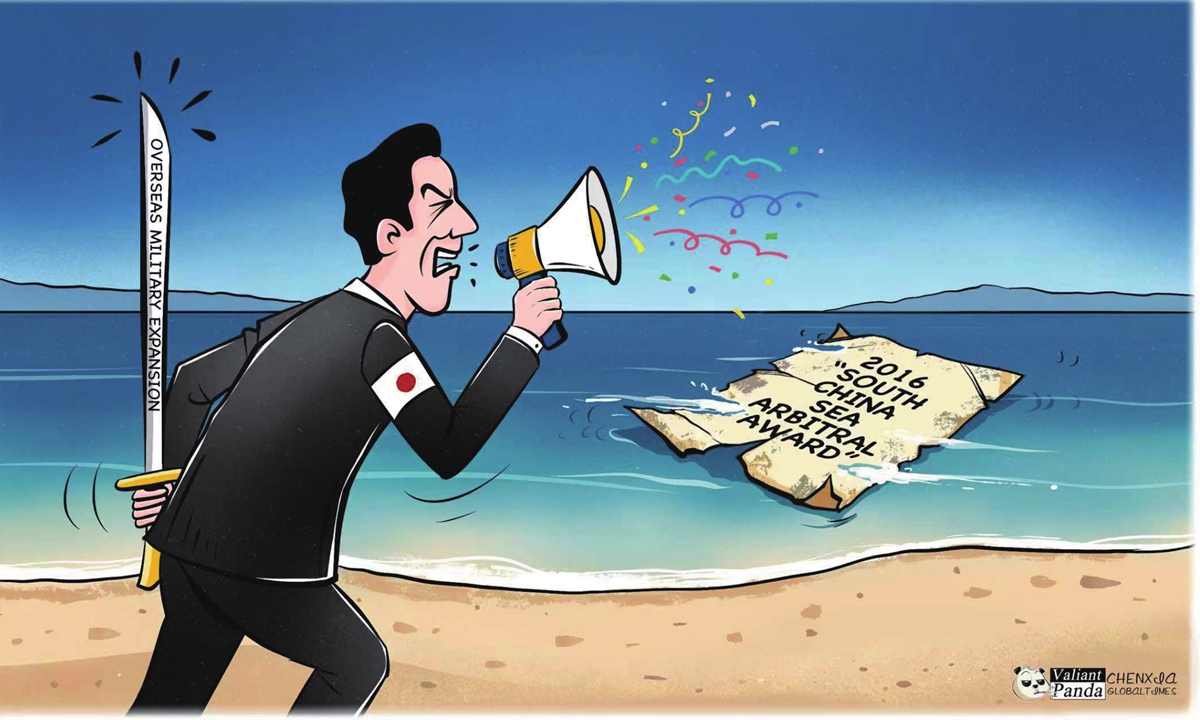
Illustration: Liu Rui/GT
Editor's Note:
On the occasion of the 10th anniversary of the "South China Sea arbitration award," Japan, along with some countries outside the region, has attempted to seize the opportunity to hype up the "China threat" narrative and wantonly intervene in South China Sea affairs, continuously stirring up regional tensions. Against this backdrop, Atsushi Koketsu (Koketsu), a professor emeritus at Yamaguchi University in Japan, discussed the true motives and dangers behind Japan's interference in the South China Sea affairs, among other topics, with Global Times (GT) reporter Xing Xiaojing.
GT: Japan is not a party to the South China Sea dispute, yet it keeps claiming to be a "legitimate stakeholder" who uses the South China Sea. What drives Japan to ignore its historical guilt regarding the South China Sea in WWII and force its way into South China Sea affairs?
Koketsu: During WWII, while launching its war of aggression against China, Japan illegally occupied islands in the South China Sea in order to prepare for war against the US, and also establish hegemony over vast waters, including the South China Sea. After the war, Japan deliberately covered up these historical facts and never felt the need to apologize for its actions.
Consequently, this dark chapter of history has been largely forgotten by the majority of the Japanese public. Post-WWII Japan, which proudly branded itself as a peace-loving nation, should have apologized for its history of aggression and taken concrete actions to ensure it would never repeat its past mistakes, but it did neither.
China's territorial sovereignty and maritime rights and interests in the South China Sea possess solid legal foundations. The "South China Sea arbitration award" was essentially a product of US manipulation behind the Philippines. Now, with a pro-US administration back in power in Manila, it has dragged this "ruling" out again to use it as a political tool to contain China. Seeking regional hegemony in East Asia, Japan views the Philippines as a military quasi-ally and wants to turn it into a beachhead for pressuring China.
Japan's intention to position the Philippines as a forward outpost to contain China has become increasingly glaring. However, this plot faces immense difficulties due to domestic and international criticism. Far from reflecting on its past history of aggression, Japan's current actions make it seem as though it is trying to rebuild the so-called Greater East Asia Co-Prosperity Sphere, which clearly exposes the militaristic nature of its policies.
GT: What risks does Japan's interference in the South China Sea issues carry?
Koketsu: Japan's persistent offensive posture toward China is highly dangerous. In recent years, Japan has consistently strengthened its security assistance and defense cooperation with the Philippines, attempting to use the country as a springboard to extend its own "remilitarization" layout into the South China Sea. Such behavior by Japan effectively introduces a "military-first" logic into Asia, which will only continuously escalate the risk of regional military conflicts.
The South China Sea should fundamentally be a "sea of peace." However, Japan is rapidly expanding its defense budget, beefing up the equipment of its Self-Defense Forces, and labeling China's moves as its "greatest strategic challenge." The policies currently pushed by the Japanese government harbor the massive hidden danger of turning this body of water into a "sea of war."
GT: Amid the easing of China-US relations, what potential damage will Japan's national interests suffer from its push for continuously hiking defense spending and reinforcing the Japan-US alliance?
Koketsu: There is a Japanese proverb, "having the ladder pulled out from under you," which perfectly describes the current predicament of the Japanese government. Japan is now left hanging in a dilemma. It blindly follows US instructions to frantically expand its military and treat China as the enemy. Meanwhile, faced with the reality of the easing of China-US relations, the logical foundation of Japan's security policy is being severely tested.
The immense underlying danger is that if a conflict breaks out, the US will likely stay out of it, only verbally directing Japan to charge forward. If Japan continues down its current path, all the sacrifices and losses will ultimately be borne by Japan alone, even though Tokyo mistakenly believes that strengthening the Japan-US alliance secures a US "security guarantee." The Japanese government needs to re-examine the starting point of its security policy to avoid making a false binary choice between "pleasing the US" and "stabilizing relations with China." Otherwise, the warning of "having the ladder pulled out" will become a reality.
As the strategic consensus between Chinese and US leaders continues to deepen, Japan's security path of blindly clinging to the US and confronting China not only severely damages peace and stability in the South China Sea, but will also plunge Japan into strategic isolation and force it to pay a massive developmental price.
GT: Some Japanese politicians and media outlets deny the existence of "neo-militarism" in Japan. What is your take on this?
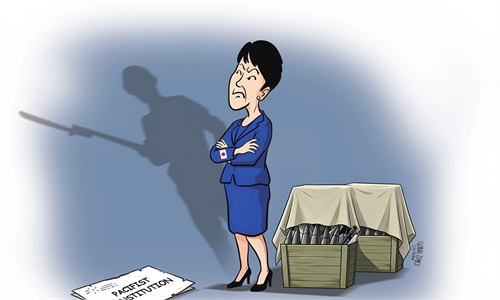
Koketsu: When talking about "neo-militarism," some conservative forces argue that the term "lacks evidence." However, I believe that characterizing Japan's current state as "neo-militarism" is by no means baseless. Sanae Takaichi's governing philosophy and methods are heavily tinged with militarism. She rejects the path of peaceful consultation and advocates relying on military force to advance foreign policy. A diplomatic model that relies on military pressure to force its way is, in itself, the embodiment of a militaristic mindset. The core of the problem is that Takaichi is completely oblivious to why her policies are viewed as militaristic.
Viewing Japan's current situation as "neo-militarism" is an entirely justified critique, and many peace-loving Japanese people share this sentiment. However, the current Japanese public sphere, political arena, academia and cultural circles are continuously drifting to the right. When faced with the label of "neo-militarism," they only react with instinctive rejection and refuse to reflect, falling into a truly tragic state.
RELATED ARTICLES