IN-DEPTH / IN-DEPTH
How rice, herbs and books help reshape a village in Taklimakan Desert
Sand dunes turned to oasis
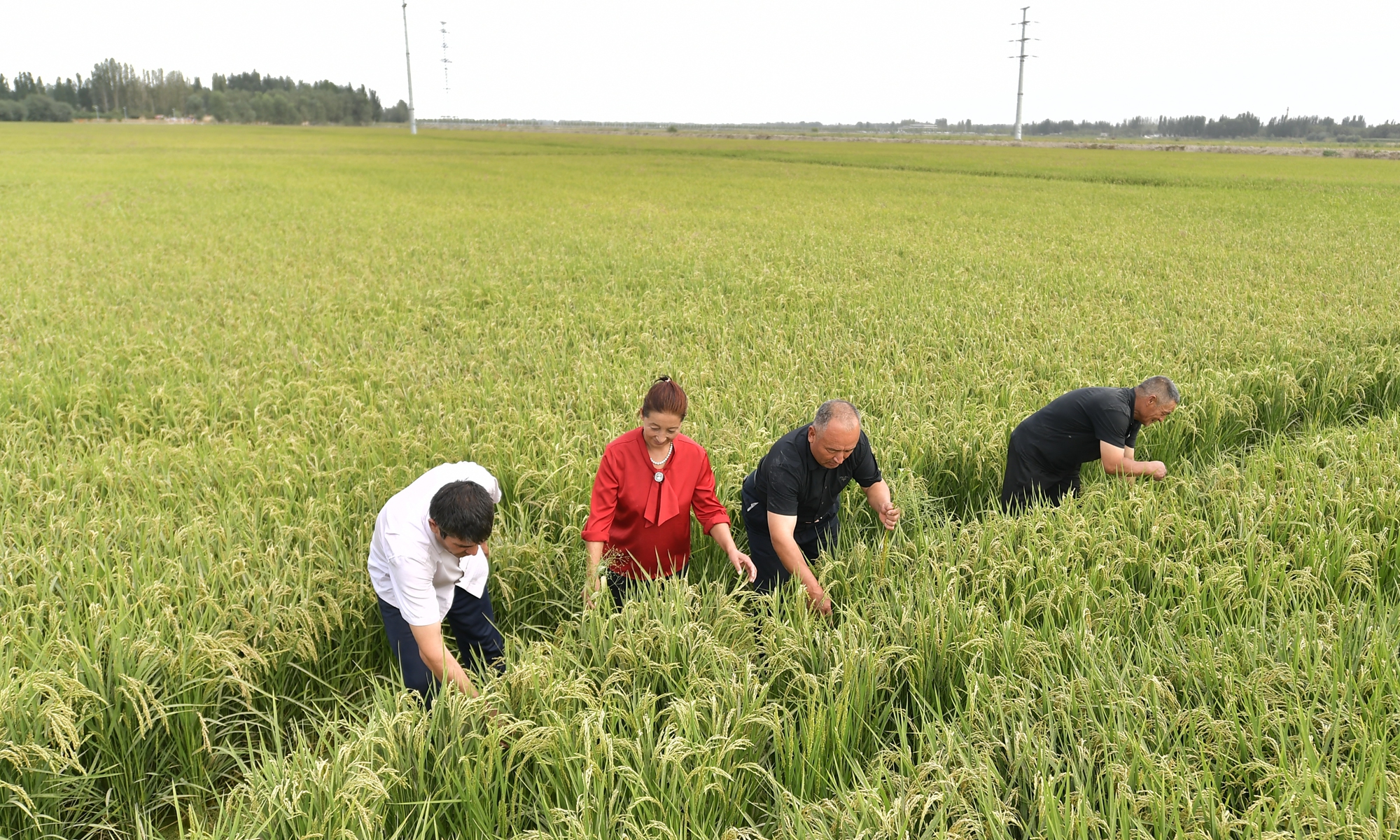
Villagers weed a paddy field and check the growth of rice in Hotan, Northwest China's Xinjiang Uygur Autonomous Region. Photo: VCG
In the height of summer, on the southern edge of the Taklimakan Desert, Northwest China's Xinjiang Uygur Autonomous Region, the wind carries heat. But in Daoxiang Village in Hotan County, that harshness gives way to a gentler landscape. Rice paddies stretch for miles, and their green seedlings rise in neat rows along irrigation channels. This village, once known as "the last sand dune," has turned into a lush oasis, upending any image of desert life.
At the village's specialized health and wellness post, called the Heart-Calming Courtyard, the Global Times reporters witnessed an ordinary yet telling scene.
Under a sprawling grape arbor, with the faint scent of herbs in the air, villagers gathered around doctors and a township official on his routine visit. At first, we thought it was a training session, but the villagers were earnestly asking about college application strategies for their children - how to fill out the preference forms, which majors to choose.
Seeing the intense interest, the official immediately called for extra teachers to hold a special consultation session. Villagers told the Global Times that they trust the assistance officials and doctors, and they wanted their children to choose the right path, so that someday they could give back to their community and their hometown.
Just four years ago, few could have imagined such stability and prosperity for the village. Once hemmed in by shifting sand dunes and plagued by severely saline land, the village scraped by on tiny, unproductive farm plots with almost no room for growth. Since 2021, Beijing has poured more than 77 million yuan ($11.3 million) into the village, upgrading farmland, infrastructure and industries. The desert still looms, but the village's fate has fundamentally changed.
A desert village reborn
The former name "Ayagedun" - literally "the last sand dune" - captured the village's former plight: poverty, remoteness and neglect.
Though the Karakash River ran nearby, providing natural irrigation, the farmland was fragmented, the soil saline and the waterworks decrepit. Rice yields hovered around 300 kilograms per mu (0.07 hectares). Farmers had the water and the land but couldn't escape poverty for many years.
With sustained support from Beijing's aid program, the village systematically reshaped its farmland. Workers leveled fields, improved saline soil, and overhauled irrigation networks to merge scattered plots into large-scale, high-standard farmland, creating sprawling rice oases on the desert's edge. The results have been striking: rice output has doubled to 600 kilograms per mu.
Capitalizing on its distinctive desert rice landscape, the village developed rural tourism and promoted a "one household, one specialty" model.
Families turned their courtyards into guesthouses or craft workshops. For instance, local resident Aireti Rouzimaimaiti leased his 42 mu of land to the village cooperative for unified cultivation and converted his traditional Uyghur residence into a boutique homestay.
Retaining local features including grape trellises and old Nang ovens while adding modern facilities such as natural gas pipelines and sewage systems, the homestay earned him 200,000 yuan last year.
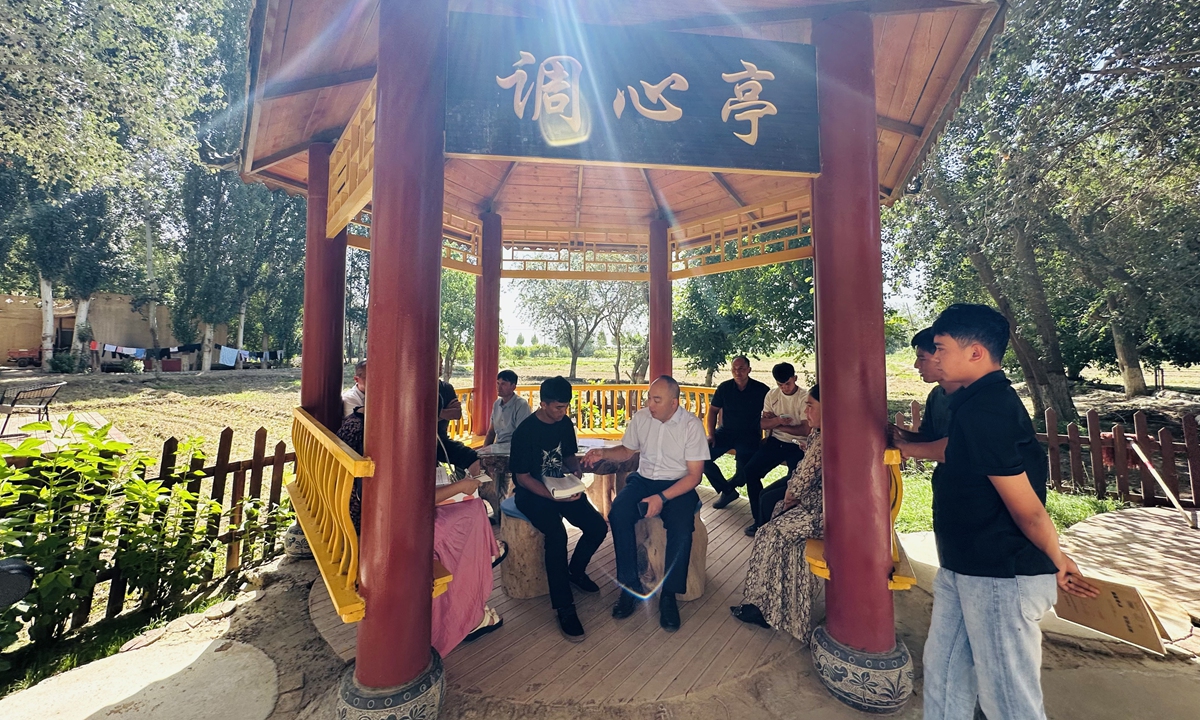
Villagers gather around township officials and counselors to discuss college application strategies for local students at the Heart-Calming Courtyard in Daoxiang Village, Hotan County, on June 26, 2026. Photo: Lin Xiaoyi/GT
Aireti recalled that back in the day, whenever sandstorms hit, every household would shut their doors and windows tight. Today, this once barren sand village has turned into a popular online check-in spot. Tourists wander around taking photos, elderly locals sit and play chess, and the wind rustles through tree leaves. The harsh stinging of sand hitting people's faces is long gone."I once thought tourism was only something big cities could benefit from. Now we earn money right at our doorsteps. Tourists come here from all over the country, and chatting with them lets us learn about faraway places across the nation," he said.
According to Xinjiang Daily, in just a few years, the village collective's annual revenue swelled to 1.12 million yuan, while per capita net income jumped from 9,800 yuan to more than 14,600 yuan. More villagers have shed their old reliance on handouts and are now taking the initiative to start businesses, boost earnings and chart their own paths forward.
Where trust takes root
While thriving rice farming has secured villagers' homes and livelihoods, local wellness and cultural programs have enriched their spiritual lives.
Officially opened in May 2025, the Heart-Calming Courtyard combines traditional Chinese medicine with local ethnic healing practices. It offers a full range of therapies, including cupping, foot massage and sand treatment, alongside a special Uyghur herbal tea, bringing traditional healing culture to life for rural residents.
More than a treatment center, it serves as a community hub for villagers. It regularly provides free health checkups and wellness education for older residents. Today, villagers are comfortable sharing their everyday concerns here and seeking advice on a wide range of issues.
The township official, who had been helping students with their college application choices, told the Global Times that villagers' willingness to voluntarily share their family concerns and proactively seek help is the strongest affirmation of, and trust in, the work being done at the grassroots level.
Adjacent to the courtyard stands Daoxiang Academy, home to over 3,000 books. Writing paper, ink brushes and craft supplies for children are always laid out on reading tables.
Li Yan, the academy's commentator, noted that spending free time reading, practicing calligraphy and making crafts with their children has become a daily routine for local families.
"Regular weekend parent-child reading sessions and evening traditional culture lectures run year-round. Meanwhile, our village has rolled out a writing program for local residents, encouraging them to document the transformations of their daily lives through writing. These literary activities fill the quiet desert village with the lingering scent of books, a gentle counterpoint to the rustle of ripening farm crops," she told the Global Times.
Li came from Southwest China's Yunnan Province, drawn to Daoxiang Village by work. But she stayed because something here took hold of her.
She has watched, season after season, as this patch of sand that, once so barren it barely deserved a name, turned into a living, breathing place that draws visitors from afar.
Standing at the edge of the paddies, Li said that she wants to spend her youth putting down roots right here alongside the village. "I want to be here to witness, year after year, the resilient life that keeps emerging through the sand."
RELATED ARTICLES