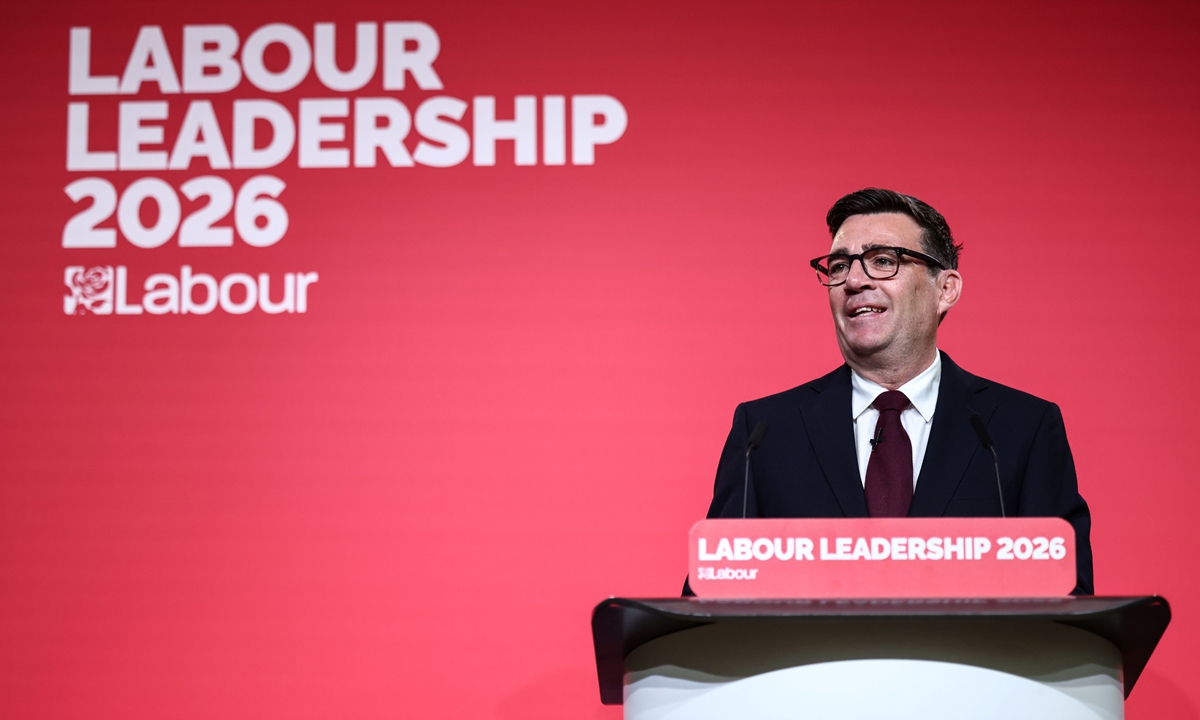
Andy Burnham speaks after being confirmed as the Labour Party's new leader and the UK's next prime minister in central London, UK, on July 17, 2026. Photo: VCG
According to British media reports, Andy Burnham was installed on Friday as the leader of Britain's Labour Party and he is expected to formally succeed Keir Starmer as the UK prime minister on Monday.However, he is inheriting the mess left by his predecessor. From a sluggish economy to deep political divisions, the UK, a decade after Brexit, remains deeply mired in difficulties. How much can Burnham improve the situation using his proven governance experience? Can he maintain a pragmatic and stable policy toward China? These are issues worth watching closely.
Burnham's pragmatic approach is rooted first and foremost in his nine years as mayor of Greater Manchester. During his tenure, he actively sought foreign investment to revive the local economy and did not shy away from economic and trade engagement with China. As recently as April this year, he met with the Chinese Consul General Tang Rui in Manchester and stressed that "Greater Manchester attaches great importance to developing relations with China."
This pragmatic style is broadly in line with the Labour government's overall approach toward China, which regards China as a "systemic competitor" while emphasizing a stable, consistent and engaged China policy.
At the same time, Britain's current economic situation is far from ideal. According to IMF forecasts, the British economy is expected to grow by only around 1 percent in 2026. Meanwhile, the UK's public finances are losing around 330 billion pounds ($442 billion) a year due to weak economic growth, population aging and ill health, according to Reuters.
Whatever reform measures Burnham hopes to introduce, he will likely first confront the issue of "money," because without growth, other ambitions will be difficult to realize.
Economic realities will therefore continue to remind the new prime minister of the necessity of cooperation with China. After all, driven by commercial interests, the Chinese market remains a necessity that British businesses cannot afford to abandon.
Of course, Burnham's potential limitations in China policy must also be recognized. The first challenge comes from the pressure within the Labour Party and domestic political competition. Starmer's resignation was directly triggered by a crisis of confidence within the party following Labour's poor performance in local elections in May. The Labour Party is clearly not united on China policy, and any move perceived as "overly pro-China" could trigger internal backlash. Burnham will need to form an "inclusive" cabinet and accommodate various factions within Labour that supported him.
Another source of pressure comes from the Western bloc, particularly the US. After Brexit, the UK promoted the vision of "Global Britain," claiming it could engage more freely with countries around the world. Yet in reality, a UK outside the EU has seen its standing decline in the eyes of both the US and other countries. The country has therefore had to strengthen ties with the Western alliance, particularly by further consolidating its relationship with the US, highlighting its strategic dilemma. As long as the UK remains closely aligned with the US through NATO, the Five Eyes alliance and AUKUS, it will be difficult for UK to significantly diverge from the US approach toward China. This leaves the UK in a difficult position. Once Washington demands that allies align on issues such as technology restrictions and investment screening toward China, how much room for maneuver will this new British prime minister actually have?
Burnham does possess unique advantages. His pragmatic reputation gained through successful local governance, the overwhelming support he currently enjoys within the Labour Party, and even the "ice-breaking" progress in China-UK relations made by Starmer's government this year all provide him with certain capabilities and conditions to manage bilateral ties.
However, these factors are not enough to help him overcome UK's existing structural constraints, whether domestic or external. For the UK, there is no "perfect China policy" that can simultaneously satisfy economic interests, security needs and value-based considerations.
The new prime minister is more likely to continue Starmer's pragmatic approach based on practical considerations, seeking a balance between cooperation and competition rather than moving beyond the Labour government's existing framework on China policy. What he can do may simply be to make the UK's China policy less chaotic in an era of uncertainty. And that, in itself, would already be a pragmatic achievement.
The author is a professor of the School of International Relations at Beijing Foreign Studies University. opinion@globaltimes.com.cn
RELATED ARTICLES