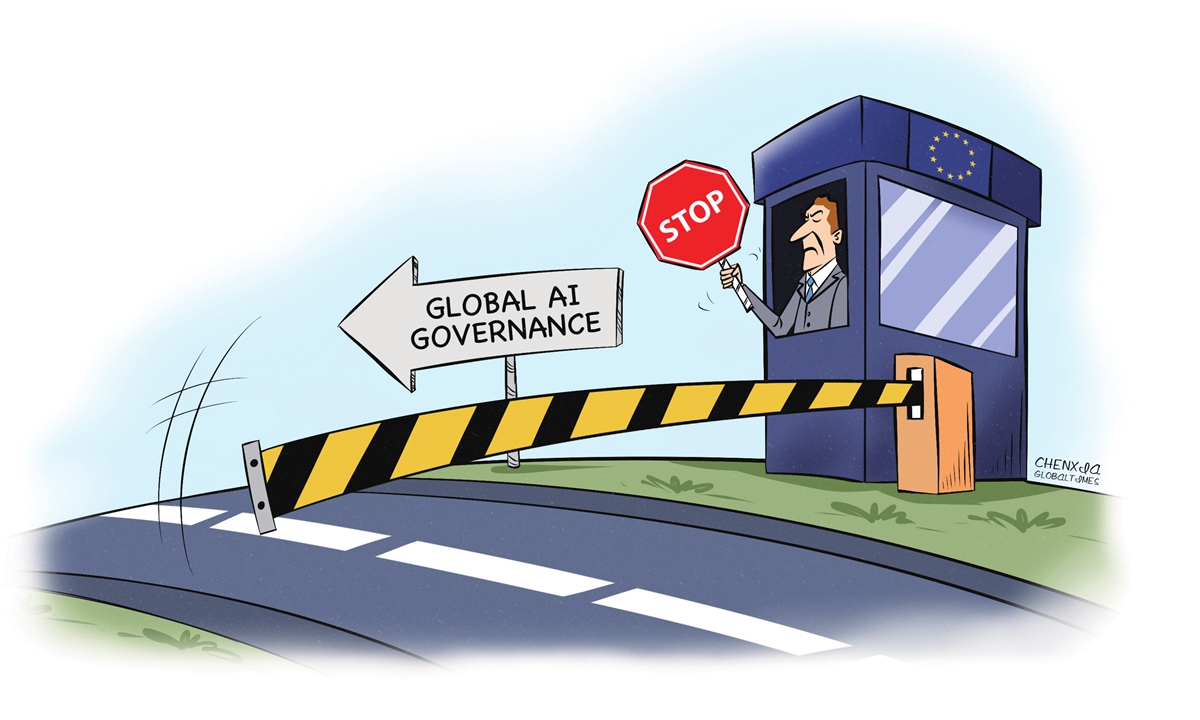
Illustration: Chen Xia/GT
A delegation from the European Parliament's Committee on Foreign Affairs is currently visiting China, with a stop in Shanghai that has drawn particular attention. There, the delegation plans to hold talks with local tech companies on "technology sovereignty and competition" and "global AI rules." These discussions coincide with the recent World Artificial Intelligence Conference in Shanghai, where global AI governance and rule-making were central themes.
That the EU delegation has placed these issues at the heart of its dialogue with China underscores Brussels' ambition to position itself as a key architect of global AI rules - a role it has long aspired to play.
The EU has made valuable contributions to digital governance, particularly in AI ethics and data protection. Its "human-centric" approach to AI development carries genuine merit. With its regulatory capacity and market heft, the EU could play a constructive role in fostering multilateral consensus and bridging the digital divide.
Yet, regrettably, the bloc's recent actions in AI governance have increasingly diverged from its professed commitment to global cooperation, revealing a protectionist and exclusionary undercurrent.
The most telling example is the EU's Artificial Intelligence Act - the world's first comprehensive law regulating AI.
Built on a "risk-based" tiered framework, it imposes everything from fines to bans on AI applications. On paper, the rules apply equally to all market players. In practice, however, the law's teeth - fines of up to 7 percent of global annual turnover - combined with its labyrinthine compliance procedures and certification standards, have erected a formidable technological and capital barrier.
What is framed as a matter of "safety" and "ethics" has, in effect, morphed into a powerful market-access weapon - a phenomenon often described as the "Brussels Effect," whereby the EU unilaterally projects its standards onto global markets, granting itself a disproportionate competitive edge.
Worryingly, Brussels has not stopped there. In early 2026, a draft EU proposal called for the mandatory phase-out of "high-risk suppliers" in 18 critical sectors, covering both hardware and AI models. Though unnamed, the measure is widely seen as targeting Chinese tech giants like Huawei and ZTE.
Meanwhile, the EU's enforcement standards in areas such as data compliance have become increasingly ambiguous, which objectively creates room for selective enforcement targeting enterprises from specific countries. Furthermore, the participation of China's research institutions in key EU research projects like Horizon Europe has been subject to varying degrees of restrictions, highlighting a tendency to erect barriers across the board.
The EU's AI rules, if used for containment rather than genuine collaboration, will undermine global AI governance and cooperation. True global rules require equal consultation among all major tech powers (China, US, EU) in multilateral forums such as the UN, rather than being imposed unilaterally.
Moreover, this wall-building strategy may ultimately hurt the EU itself.
Brussels already trails both the US and China in foundational AI models, computing power and venture capital investment. Its primary edge lies in regulation and ethics.
If it turns that edge into an exclusionary tool, it may shield domestic players in the short term - but in the long run, it will leave its AI industry sheltered from global competition and cut off from the cross-border data flows, open-source collaboration and diverse application scenarios that drive real innovation.
In trying to fence itself in, the EU risks losing not only access to China's vast market and R&D partnerships but also its moral high ground as a global rule-setter.
China actively shapes global AI governance by hosting forums such as the Shanghai Conference. Beijing seeks cooperative AI development and security with all, including the EU, based on mutual respect and benefit. We urge Europe to abandon lecturing and protectionism in favor of genuine dialogue and multilateralism. Otherwise, its "rules" will isolate it.
RELATED ARTICLES