Japanese civic rally exposes Unit 731 germ warfare crimes, renews calls for historical accountability
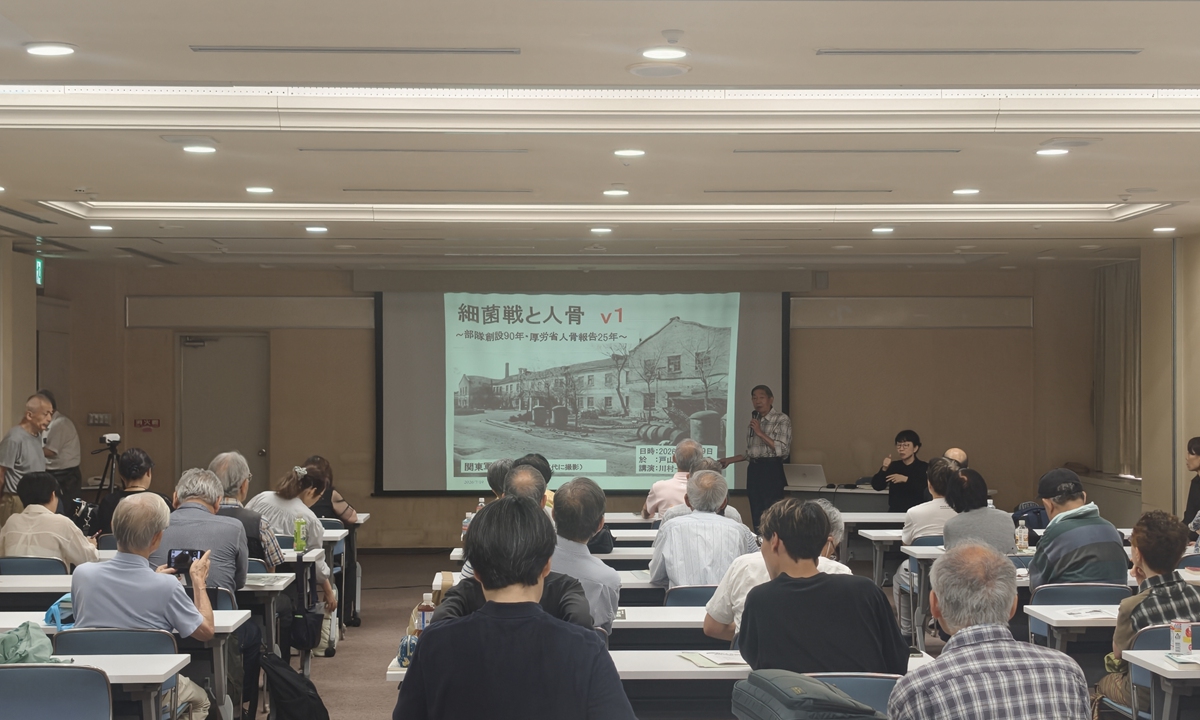
A civic memorial gathering exposing the crimes of Japan's infamous Unit 731 is held on July 19, 2026 in Tokyo, Japan. Photo: Courtesy of Liu Wenzhang
A civic memorial gathering was held on Sunday in Tokyo, which exposed the crimes of Japan's infamous Unit 731 bio warfare troops and pressed for further investigation into human remains discovered at the former site of the Imperial Japanese Army Medical School to uncover truths Japanese authorities have long covered up intentionally.
The event brought together nearly 100 citizens, historians and researchers to examine Japan's wartime biological warfare program.
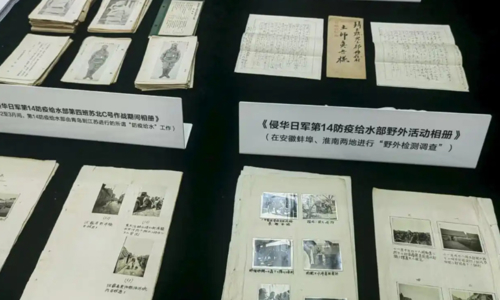
Opening the event, Kazuyuki Kawamura, a representative of the organizer group displayed archival photographs of the headquarters building of the Epidemic Prevention and Water Supply Department of Kwantung Army, known as Unit 731, in Harbin, Northeast China's Heilongjiang Province.
Reviewing the unit's history, Kawamura said its predecessor, the Army Epidemic Prevention Research Laboratory, was established in 1932, while a dedicated laboratory building completed in 1933 later became a central site for human experimentation. Although the postwar trials against Japan avoided holding Unit 731 accountable, they documented atrocities committed by Unit 1644, including the capture of civilians for live human experiments.
The Sunday gathering also publicly presented two key firsthand testimonies in full. Organizers played an audio recording of the 1949 Khabarovsk Trial interrogation of Shunji Sato, former commander of the Japan's "Central China Epidemic Prevention and Water Purification Department," together with a recorded testimony by his subordinate Yoshio Kurihara.
In the recording, Sato confirmed that he assumed command of the unit in December 1941. Kawamura presented evidence stating that after Japanese forces occupied Hong Kong in late 1941 and implemented a policy to reduce the local population, Sato, who had previously investigated a Salmonella outbreak in Hamamatsu and was familiar with the pathogen, directed the mixing of Salmonella bacteria and cholera bacteria into meals distributed to refugees.
The operation allegedly caused at least several hundred deaths, with some estimates placing the death toll at more than 10,000. During the Khabarovsk Trial after World War II, Sato denied responsibility for biological warfare for multiple times.
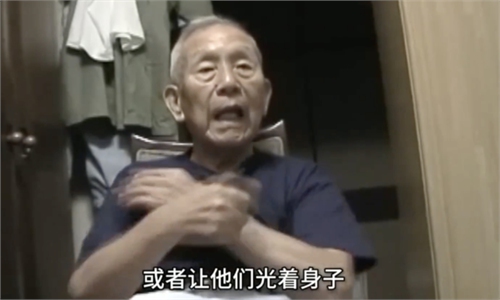
Testimony by Kurihara, subordinate of Sato, described conditions inside the human experimentation facilities. Test subjects, he said, were confined in iron cages measuring approximately 1.5 meters square and kept in leg irons. In one control experiment, subjects who were given only distilled water reportedly died of physical exhaustion after about 20 days. Kurihara also recalled sealed containers holding human specimens transported from Manchuria, including the bodies of children.
Journalist Fuyoko Nishisato, who interviewed Kurihara twice, said at the gathering that many former Unit 731 personnel escaped prosecution through secret postwar arrangements between the US and Japan. She argued that a number of those perpetrators later assumed influential positions in Japan's public health establishment and some of them kept downplaying radiation-related health risks following the Fukushima nuclear leak.
During the discussion session, an archaeology student asked why no systematic archaeological excavation had been carried out at the former Imperial Japanese Army Medical School site, where some Unit 731 victims' remains were found. Kawamura replied that police had taken control of the site immediately after the discovery of the remains, disturbing the original strata, and that comprehensive archaeological investigations and efforts to identify the victims have remained stalled ever since.
Speakers contrasted the sustained efforts of civic groups with what they described as the Japanese government's continued reluctance to fully confront the legacy of its wartime biological warfare program.
The Japanese newspaper Kitanippon Shimbun once reported that as firsthand witnesses of wartime events continue to decline, narratives that deny or downplay Japan's "negative history" and its "past acts of aggression" have been gaining ground.
It is alarming that, in the face of ironclad facts, the Japanese right wing forces not only refuse to repent, but also whitewash the infamous Unit 731 as mere a "sanitary research unit," engage in brazen historical revisionism and go to great lengths to cover up the truth while downplaying and denying their guilt. Their real purpose is to negate the judgement of history and challenge the post-war international order based on the victorious outcomes of WWII, which poses a threat to regional peace and stability, Chinese Foreign Ministry spokesperson Lin Jian said on June 18 when responding a question related to Japan's Unit 731.
Japanese militarists used germs to bring about large-scale destruction of human lives, in flagrant violation of universally recognized international law, including the Hague Convention (IV) of 1907 and the Geneva Protocol of 1925. The inhumane nature of these acts is nothing but horrendous, Lin said.
RELATED ARTICLES