New historical evidence of Japanese Army’s Unit 731 bacterial warfare released in China
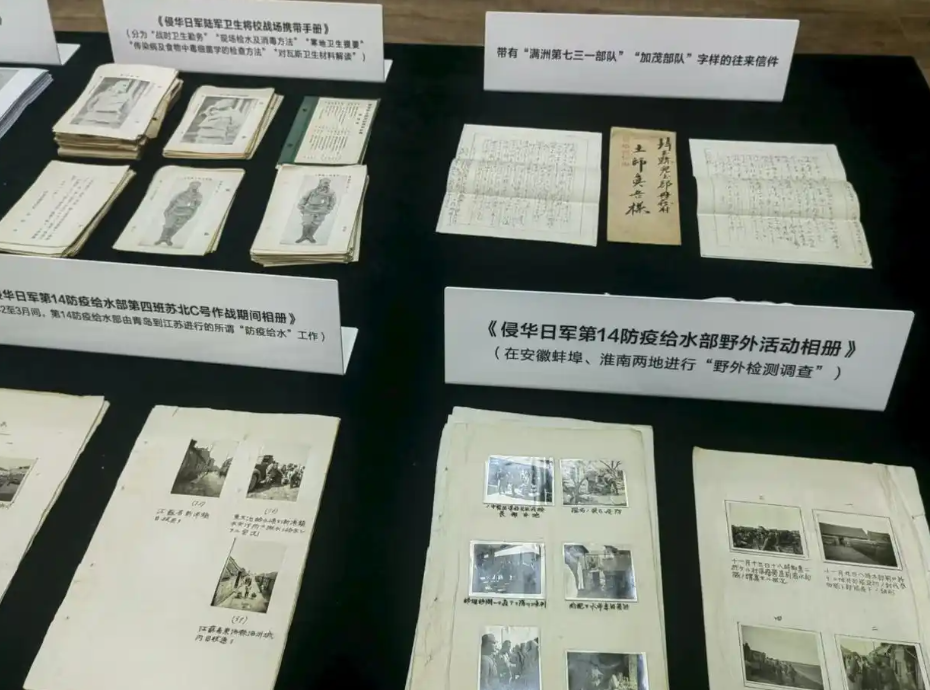
Some of the new historical evidences released at the press conference Photo: People's Daily
Some newly uncovered historical evidences of the Japanese Army's bacterial warfare and human experiments in China during World War II were released to the public for the first time on Friday at a press conference held by the Exhibition Hall of Evidences of Crime Committed by Unit 731 of the Japanese Imperial Army in Harbin, Northeast China's Heilongjiang Province.
The evidences consist of 3,010 pages of documents, 194 minutes of video, 312 photographs, 12 postcards and eight letters, according to a press release sent to the Global Times on Friday.
Meanwhile, an illustrated guide to the cultural relics showing the evidence of atrocities by Japanese army's bacterial warfare was also released at the press conference, enriching the chain of evidence of Unit 731's crimes and providing strong evidence for exposing the atrocities committed by Japanese militarism.
The guide book, launched in five languages, includes evidences of Unit 731's crimes that the exhibition hall has uncovered over the decades through archaeological excavations, investigative collection, cross-border evidence gathering, and artifact acquisition, enriching the chain of evidence of Unit 731's crimes and providing strong evidence for exposing the atrocities committed by Japanese militarism, the hall told the Global Times.
Unit 731 was a top-secret biological and chemical warfare research base established in Harbin as the nerve center for Japanese biological warfare in China and Southeast Asia during WWII.
At least 3,000 people were used for human experiments by the unit, and more than 300,000 people in China were killed by Japan's biological weapons, Xinhua News Agency reported.
Friday marks the 80th anniversary of Japan's unconditional surrender in World War II and the 40th anniversary of the establishment of the exhibition hall.
The newly released evidences include personnel records, daily life, pathological dissections, photo albums, operation manuals, and more. Most of these materials are being made public for the first time and carry immense historical value, further solidifying the chain of evidence of the Japanese Army's bacteriological warfare crimes in China, according to the press release.
The first part of the materials is criminal evidence collected from official sources in Japan, including a personal status report of the Japanese Unit 731. This archive primarily records the movements of Unit 731 personnel in China and the Soviet Union after Japan's surrender. From the perspective of Japanese documents, it presents the investigation, punishment, and trial process conducted by the Soviet Union to Unit 731 members. A total of 43 individuals were tried and sentenced, with prison terms ranging from three to 25 years - information of this kind has been discovered for the first time. Through systematic collation and study, it will effectively enhance the objectivity and accuracy of research on the Unit 731.
The second part consists of oral testimonies from Unit 731 members, collected during the exhibition hall's cross-border evidence-gathering interviews in Japan. It reconstructs the daily operations of Unit 731, its personnel composition, the destruction of evidence, and other historical details, such as detainees being taken to observe dissection rooms and their skulls being severed, further revealing the crimes of human experimentation by Unit 731 from an oral history perspective.
The new evidences reveal key historical details about the Japanese Unit 731 in China, including its objective existence, overall structure, troop size, and personnel composition. It also presents the criminal system of Japan's bacteriological warfare units in China, further proving that these units, during their establishment and expansion, were colluded with and supported by the Japanese government, the Japanese headquarters, and the Japanese medical community. This demonstrates that Japan's bacteriological warfare was a premeditated, organized state crime carried out from the top down, according to the hall.
Through these evidences - oral testimonies and videos, written archives, and historical photographs - the atrocities of the Japanese Army's Unit 731 in China are further corroborated and solidified.
The new evidence will be put on display at the hall in Harbin from September 1.
RELATED ARTICLES