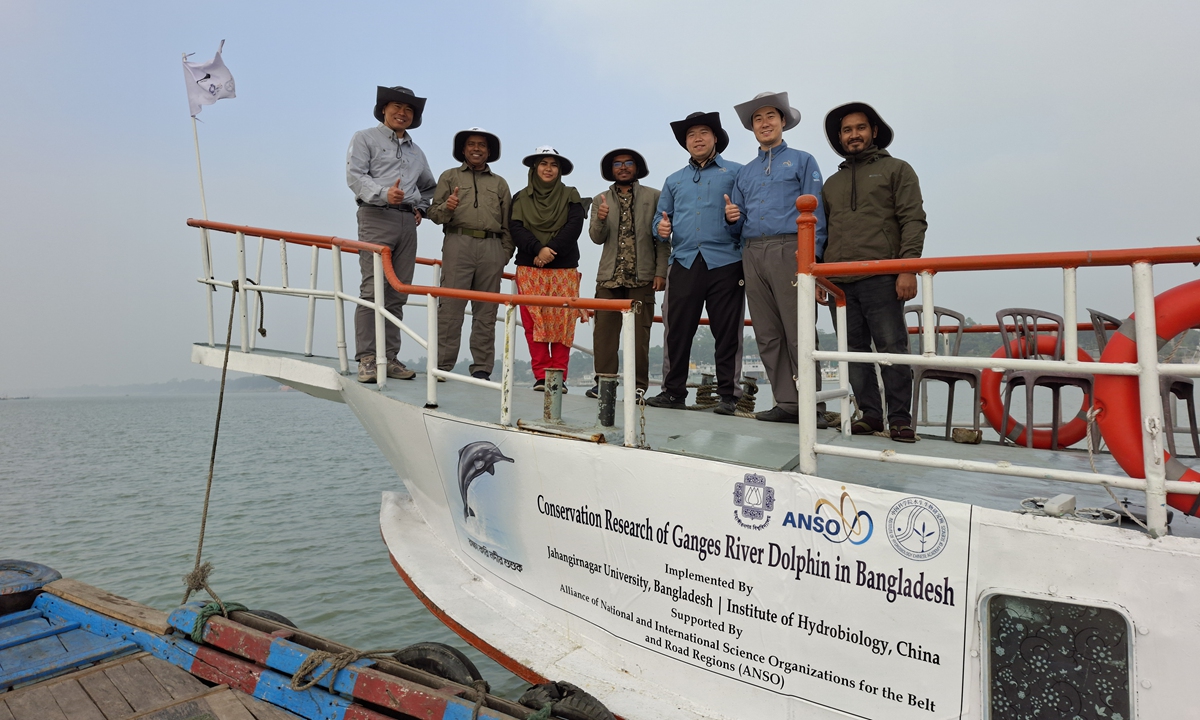
Researchers from Professor Mohammad Abdul Aziz's team at Jahangirnagar University in Bangladesh pose with colleagues from the Institute of Hydrobiology at the Chinese Academy of Sciences at the bow of their vessel. Photo: Courtesy of Institute of Hydrobiology
Editor's Note:
As global challenges grow increasingly interconnected, technological solutions are rarely confined to a single country. Through research collaboration, open sharing of expertise and partnerships with international institutions, Chinese scientists, engineers and enterprises are engaging more deeply with the world, contributing tools and experience to problems that demand collective answers.
The Global Times launches a series of "Tech Seeds, Global Bloom," spotlighting China's achievements in advancing tech for good both domestically and internationally. By following these trajectories, the series invites readers to consider a different measure of progress: Not how advanced technology becomes, but whom it ultimately serves, and how widely its benefits can spread.
This is the sixth installment. The Global Times reporter talked with Chinese researchers from the Institute of Hydrobiology at the Chinese Academy of Sciences. They shared how they cooperated with colleagues in Bangladesh and applied China's self-developed monitoring technologies and China's wisdom in ecological recovery to support Bangladesh in its freshwater dolphin monitoring and research.
Beneath the murky, fast-flowing waters of Bangladesh's Padma and Jamuna rivers lives one of South Asia's most elusive endangered species: the Ganges river dolphin. Functionally blind, they navigate and hunt entirely by echolocation. For decades, their fleeting movements and turbid habitats have stymied every effort to accurately count and protect them.
Now, a new generation of Chinese acoustic technology is changing the field.
A homegrown real-time acoustic monitoring system, nicknamed "tech ears," has operated steadily across key Bangladeshi river stretches for nearly six months since it detected distinct acoustic signatures from more than 146 individual Ganges river dolphins at the beginning of this year, filling a longstanding void in systematic, data-backed population tracking for the species.
"The Ganges river dolphin only surfaces briefly to breathe, before diving back under water in a split second, making it extremely hard to spot them with the naked eye," Hao Yujiang, a professor at the Institute of Hydrobiology at the Chinese Academy of Sciences (CAS), told the Global Times.
In 2024, Hao was invited by the World Bank to attend a conference in Bangladesh on the protection of the Ganges river dolphin. During that event, he learned about the challenges of Ganges river dolphin monitoring and conservation, and major technical bottlenecks hampering local surveys. In response to this problem, Hao shared at the conference China's experience and technologies developed for monitoring Yangtze finless porpoises, including a China-made real-time acoustic monitoring system, dubbed "tech ears."
China's technologies and experience caught the attention of Mohammad Abdul Aziz, a researcher from Jahangirnagar University in Bangladesh. With the support of the Alliance of National and International Science Organizations for the Belt and Road Regions, researchers from the Institute of Hydrobiology and Aziz's team jointly launched a project to apply China's self-developed monitoring technologies to support Bangladesh in their freshwater dolphin monitoring and research.
China-made 'tech ears'
China's dolphin-protection technology is rooted in its own hard-won ecological recovery.
Once facing a continuous population decline, the Yangtze finless porpoise is an endemic freshwater cetacean species of China's "mother river." The population of the Yangtze finless porpoise has increased to 1,426, an increase of 177 compared to the 2022 survey, thanks to a 10-year fishing ban for the Yangtze River that started from January 1, 2021, the Xinhua News Agency reported in January 2026.
Yet river ecosystems in Bangladesh present vastly different and more challenging conditions.
Bangladesh's major rivers largely feature undeveloped shorelines, minimal port infrastructure, and over-loaded shallow-draft ferries and cargo vessels, creating dual pressures on navigation safety and aquatic wildlife protection, acoustic engineer Chen Yuwei from the CAS Institute of Hydrobiology told the Global Times.
Scientific coverage of Ganges river dolphins in the country also remains sparse, according to Chen. Japanese and Indian scholars have conducted extensive acoustic research on Ganges river dolphin populations in Nepal and Indian river stretches, yet systematic surveys within Bangladesh remain scarce, with only small-scale experimental work conducted in the Sundarbans Mangroves. Professor Aziz's team has tracked Ganges river dolphins for years, yet insufficient observation technology stalled consistent research progress, he said.
Global monitoring of freshwater dolphins has depended on acoustic equipment to capture their echolocation signals for a long time. The fundamental principle of acoustic monitoring is that the equipment collects and identifies characteristic acoustic signals emitted by dolphins. Based on the positional relationship between the dolphins and the survey vessel, researchers can distinguish individual dolphins and calculate their population size, Hao explained.
For visually impaired Ganges river dolphins, acoustic sensing is essential to survival - a biological trait that makes acoustic monitoring far more effective than visual surveys, especially in sediment-heavy river waters, Hao said.
However, traditional acoustic monitoring workflows carry critical flaws: field data must be retrieved and manually screened in laboratories after daily surveys, ruling out on-site real-time alerts for dolphin activity. This model demands massive manpower and high expertise from operators, Chen said.
Targeting this, researchers from the institute spent four years developing a complete real-time automatic recognition system for cetacean echolocation signals. After multiple rounds of field tests and peer-reviewed academic validation, the system - co-developed by researchers from the CAS Institute of Hydrobiology, the Wuhan Pindu Technology Co., Ltd. and the Wuhan Baiji Conservation Foundation - boasts the world's highest monitoring efficiency and fastest full-cycle product rollout for small cetaceans such as the Yangtze finless porpoise, resolving a core bottleneck in real-time freshwater dolphin monitoring, according to Chen.
The system features two hydrophone arrays: The dual-hydrophone towed array can be deployed on research vessels to track individual dolphin acoustic trajectories and accurately count populations along waterways; while the four-hydrophone fixed array can be installed underwater at docks or navigation beacons, logging dolphin movements, residence durations and transmitting data with instant alerts around the clock, Chen said.
Compared with similar products developed overseas, the China-developed equipment features a highly integrated all-in-one design and can be deployed underwater right out of the case. The entire system operates at an ultra-low power consumption of merely 6 to 7 watts, and a single 20,000 mAh power bank can sustain nonstop monitoring throughout the day. No overseas product has yet matched this ultra-low power advantage to date, Chen told the Global Times.
Equipped with 26 adjustable built-in recognition parameters, the system also allows operators to rapidly adapt to varying dolphin vocal signatures, river noise levels and aquatic environments. New staff can master operation after just one to two days of training, Chen introduced.
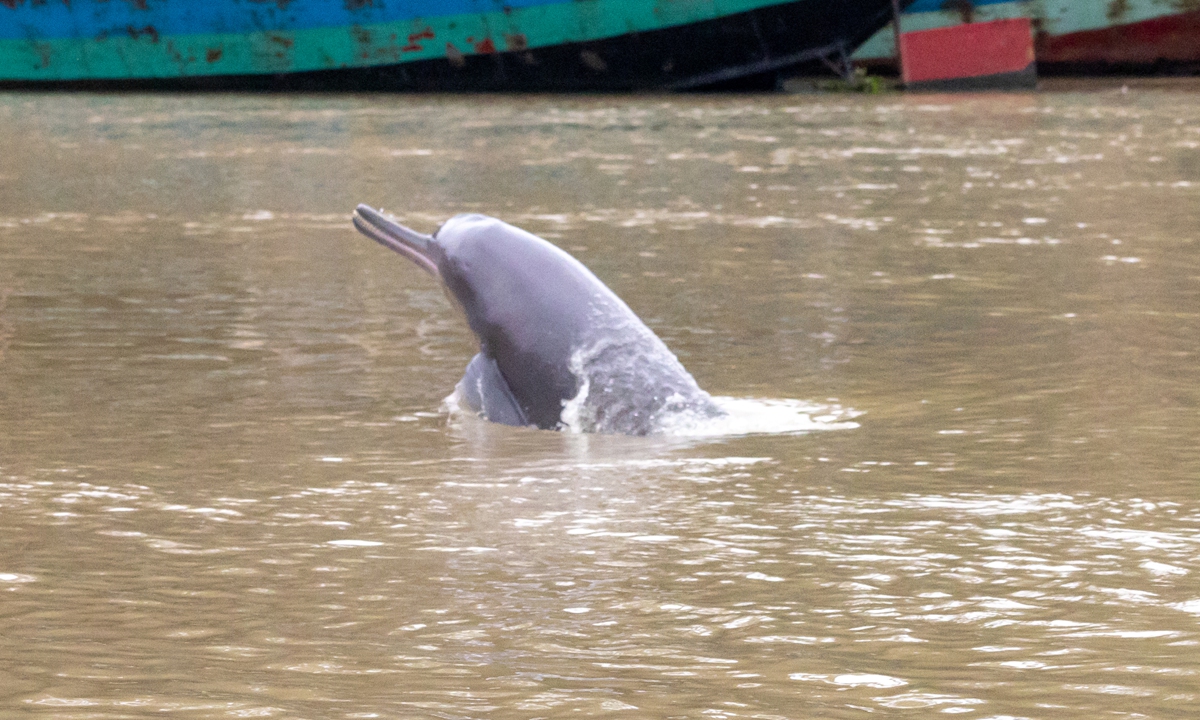
A Ganges river dolphin breaks the surface to breathe. Photo: Courtesy of Ameer Hamza
Boosted confidence
During a days-long survey across the two major rivers in Bangladesh in January, the system helped researchers from both countries detect signals from more than 146 individual Ganges river dolphins and pinpointed multiple critical habitats, including a high-density activity zone around downstream sandbars. Extrapolations based on existing population models suggest the surveyed river stretch is home to over 250 Ganges river dolphins, Hao told the Global Times.
"We first conducted surveys on the Jamuna River. Shortly after our equipment was lowered into the water, it picked up acoustic signals of Ganges river dolphins. We were thrilled, and our Bangladeshi partners were utterly amazed," Hao said.
For the next step, researchers from both sides will cooperate to build standardized datasets to assess dolphin population density, geographic distribution and breeding conditions - metrics critical to long-term species protection, according to Hao.
Chen remembered that at the early stage of cooperation, Bangladeshi researchers harbored doubts about the equipment's performance due to the limited number of published papers on this technology. After the Chinese team fine-tuned the recognition parameters multiple times, the system then achieved stable capture of Ganges river dolphin acoustic signatures. Following each acoustic alert, the survey team could visually spot surfacing dolphins within an average of one minute, greatly boosting the confidence of the joint research team.
For Ameer Hamaza, a graduate student on Professor Aziz's team and an experienced field photographer, the process was a study in incremental progress. Early system alerts sometimes failed to produce visible dolphin sightings, leaving the researchers discouraged. But as calibration improved and acoustic detections consistently aligned with surfacing events, Ameer rushed to the bow each time an alert sounded, excitedly documenting rare footage of the elusive dolphins in their natural habitat.
Since the successful completion of the first phase of cooperation, local researchers are now able to conduct comprehensive river-wide surveys of Ganges river dolphins every two months, filling Bangladesh's long-standing gap in routine acoustic monitoring of the species, according to Chen.
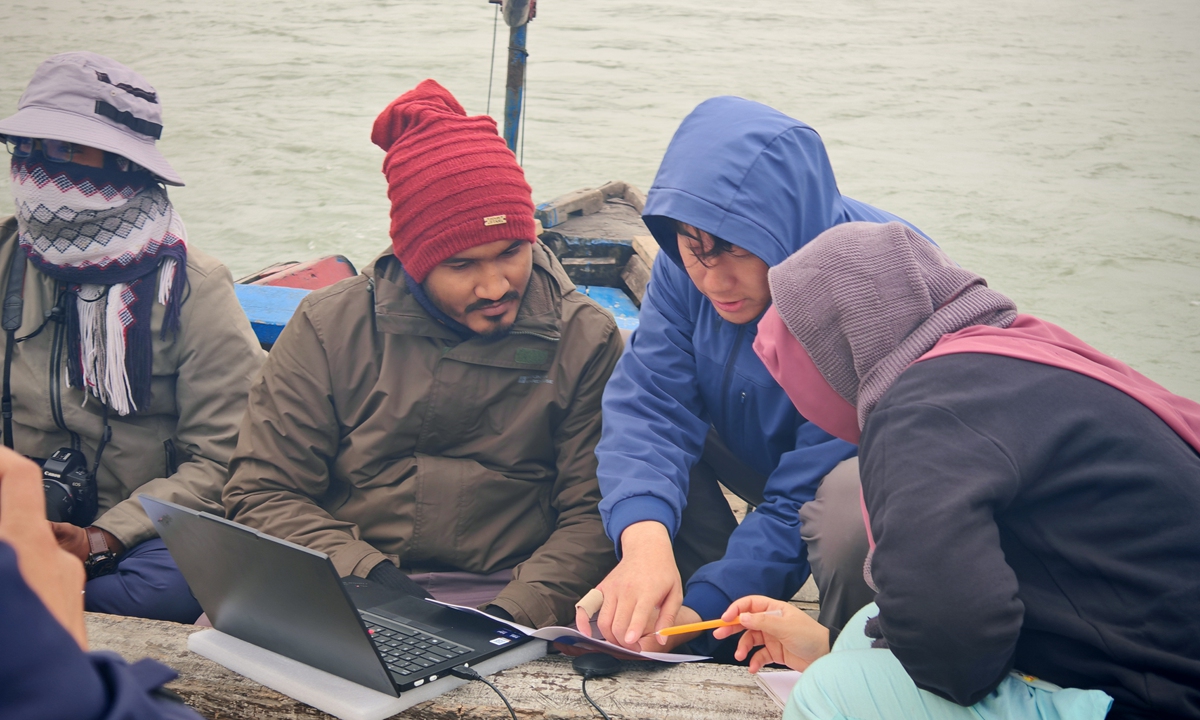
Chinese researchers explain the instrument manual to their Bangladeshi counterparts. Photo: Courtesy of Institute of Hydrobiology
Shared exploration
Bangladesh is the third stop for China to share its technologies and experience in aquatic biodiversity protection with global partners. Before that, the technology had already been deployed in the protection of Irrawaddy dolphins in Myanmar in December 2019 and Irrawaddy dolphins in Cambodia in December 2023, according to Chen.
In June 2025, 19 experts and officials from five Southeast Asian countries - Cambodia, Indonesia, Laos, Myanmar, and Thailand - visited Central China's Hubei and Hunan provinces as well as East China's Jiangsu Province to discuss strategies for protecting endangered freshwater dolphins and establishing an international cooperation framework for cetacean conservation with their Chinese counterparts, according to a report published in June 2025 on the CAS Institute of Hydrobiology website.
China's monitoring technologies and conservation experience for the critically endangered freshwater cetacean, the Yangtze finless porpoise, have been thoroughly studied and adopted by neighboring Southeast Asian countries through in-depth academic and ecological exchanges, Chen said.
Im Rachna, undersecretary of state with Cambodia's Ministry of Agriculture, Forestry and Fisheries, was impressed by China's efforts to rescue the Yangtze finless porpoises and boost its population. "As an environmental conservationist, I know full well that such a population rebound in a short span of time is by no means an easy feat," she was quoted as saying in the report.
"Extraordinary achievement" stems from a systemic, long-term governance approach centered on ecological restoration and sustainable development. Over the past decade, China has developed a scientific strategy for Yangtze River governance, with ecological protection and green development at its core, according to a think tank report released in September 2025 by Xinhua Institute, a think tank affiliated with Xinhua.
Along with the export of China-developed technologies, Chinese researchers said they are also helping the partner countries to shift conservation mindsets, standardize fishing activities and establish scientific management systems.
"We all share one planet, and cherishing and protecting these precious creatures is a shared responsibility for humanity," Hao said.
"The Chinese team not only brought equipment, but also an entirely different way and philosophy of conservation," Aziz said.
"This is not just technology transfer, it is a shared exploration," he was quoted as saying in another report on the CAS website.