Amid US spat, India needs to decide how independent its strategic posture should be
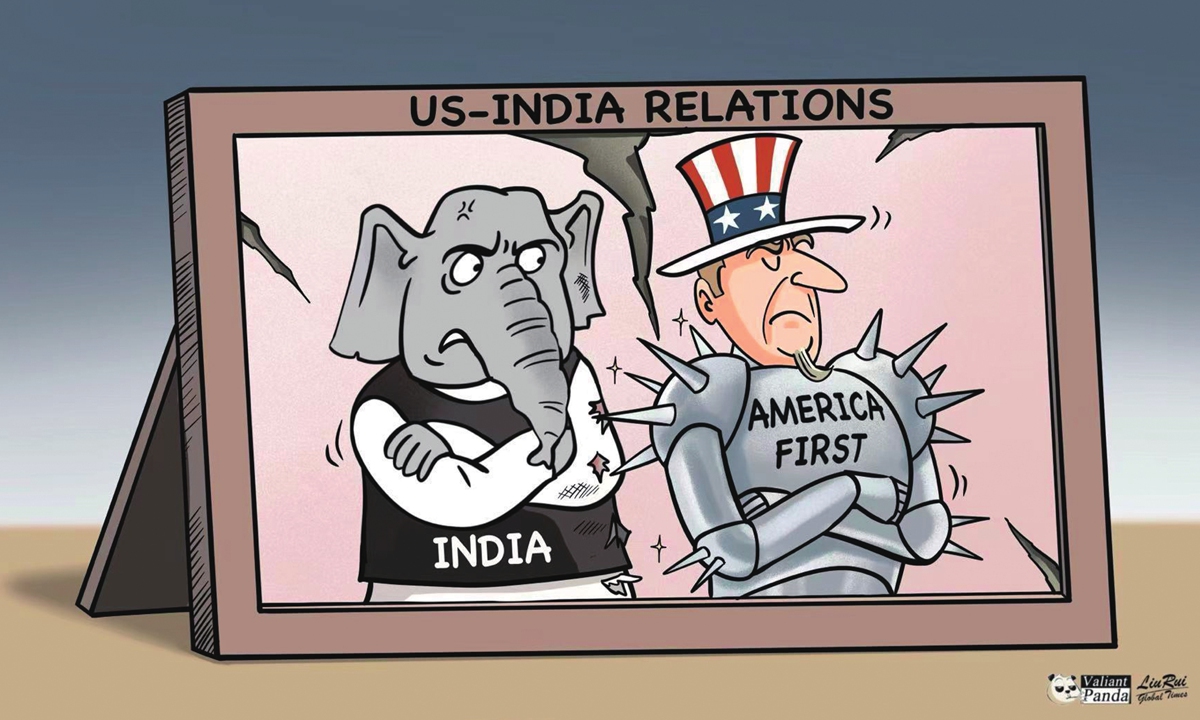
Illustration: Liu Rui/GT
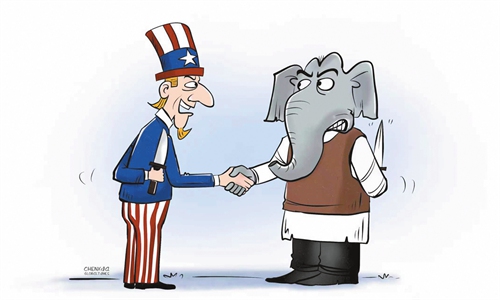
Recently, an Indian scholar highlighted in his opinion piece a telling statement made by US Deputy Secretary of State Christopher Landau at the 2026 Raisina Dialogue: Washington "will not repeat its China mistake" on India. This reflects that "Washington no longer views India's rise as an unqualified strategic asset," according to the scholar.Has hedging against India's full-scale rise become the new baseline of US strategy toward India? Washington appears to be moving away from welcoming a rising India as a benign power toward viewing it as a rising power that requires careful management - and perhaps even necessary restraint.
However, New Delhi seems only now to be realizing that the US is by no means a "benevolent hegemon." As disagreements over trade, visas and geopolitical division of labor remain unresolved, voices within India's strategic circles have begun to call for a fundamental reassessment of relations with Washington.
At present, New Delhi is engaged in a deep debate over whether to recommit to its traditional principle of strategic autonomy and recalibrate its ties with the US.
Writing in India's World, an Indian magazine on foreign policy, Happymon Jacob, an associate professor at Jawaharlal Nehru University, argued that over the past quarter-century, India has over-relied on the US and New Delhi's closeness with Washington has been driven by "anxiety, insecurity, and a fear of isolation." He contended that Washington has no interest in seeing a fully competitive India in technology and industrial development. Consequently, Jacob advocated for a "de-Americanization" of Indian strategic decision-making - a return to a multi-directional balance anchored strictly in India's own national interests, preventing the country from becoming a mere vassal of Western unilateralism.
Yet this perspective is far from a consensus in India. While some acknowledge that India's interests should be taken into account, others argue that relations with the US remain India's "top priority," and that the current phase in India-US relations "need not be a cause for alarm."
At its core, this debate centers on a fundamental question: How independent should India's strategic posture really be?
Driven by growing uncertainty over US policy, India's strategic community increasingly recognizes the danger of relying too much on a single partner. To build genuine resilience, India must accelerate supply chain diversification, deepen partnerships across a broader array of nations and cushion itself against potential external shocks.
At the same time, New Delhi needs to focus inward. Building resilience requires closing gaps in critical minerals, semiconductors and artificial intelligence, thereby developing a robust domestic industrial system capable of withstanding geopolitical pressure.
In fact, this very path of inward-looking resilience building has been systematically pursued by China over the past several decades. Its setbacks and successes thus offer a concrete historical case study for New Delhi to examine as it seeks greater strategic autonomy.
It is vital to build a comprehensive industrial foundation and indigenous technological capability. This remains the most effective defense against external "chokepoint" strategies. Through decades of supply chain development and sustained R&D investment, China built an irreplaceable industrial ecosystem - giving it the leverage to resist strategic coercion or bad-faith maneuvers.
At the same time, genuine strategic autonomy needs to be upheld. In an era of intensifying great-power rivalry, true strategic autonomy means placing core national interests at the center - not serving as a proxy for another power. Only by maintaining this independence can a country avoid being hijacked by third parties and retain the initiative in a complex global landscape.
For New Delhi, standing firm in today's volatile world requires a clear-eyed assessment of its own geopolitical position and national interests. Seeking short-term gains by aligning with one major power against another is a short-sighted strategy that yields only fleeting dividends - a lesson amply demonstrated by the trajectory of Indian diplomacy over recent years.
The author is professor and vice dean of the Institute of International Studies at Fudan University. opinion@globaltimes.com.cn
RELATED ARTICLES