Illustration: Chen Xia/GT
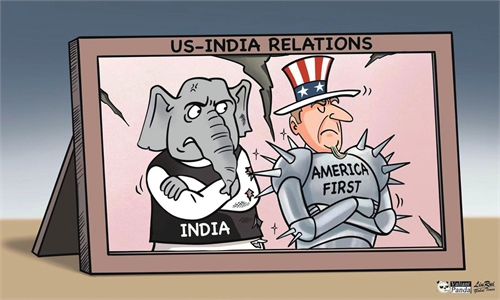
For a long time, US-India relations were hailed as a "defining partnership of the 21st century." Many international observers once asserted that this transoceanic partnership was "unbreakable" and poised to become a core force reshaping the global geopolitical landscape. Yet following the start of US President Donald Trump's second term, this seemingly solid relationship has cooled at a pace that exceeded all expectations. The appearance of harmony has masked underlying rifts, tearing away the previously warm and cordial facade of cooperation.The US first imposed punitive tariffs on Indian exports, and subsequently crossed India's diplomatic red lines on a series of issues, including US-Pakistan relations and the Iran conflict. The strategic trust built over the past few decades is now being eroded at a visible pace.
The current state of US-India relations is the inevitable outcome of the US administration's "America First" transactional diplomacy. For Washington, the "strategic partner" has been little more than a tool to advance its own interests, not an equal partner.
The Trump administration has embedded transactional diplomacy into every detail of its policy toward India. Its protectionist trade policies have disregarded India's development interests. The high tariffs dealt a direct blow to India's exports, causing massive losses to several of India's pillar industries. Even if the two sides eventually reached an agreement to reduce tariffs, India would still be forced to meet onerous conditions.
Perhaps what India finds even more difficult to accept is that Trump has disregarded India's core interests in handling the situation in Iran and the crisis in the Strait of Hormuz. The Trump administration's hardline policy toward Iran has not only driven up India's energy import costs to skyrocket but has also severely damaged New Delhi's reputation as a "net security provider in the Indian Ocean" through incidents such as the attack on the Iranian frigate IRIS Dana and the assault on Indian merchant ships.
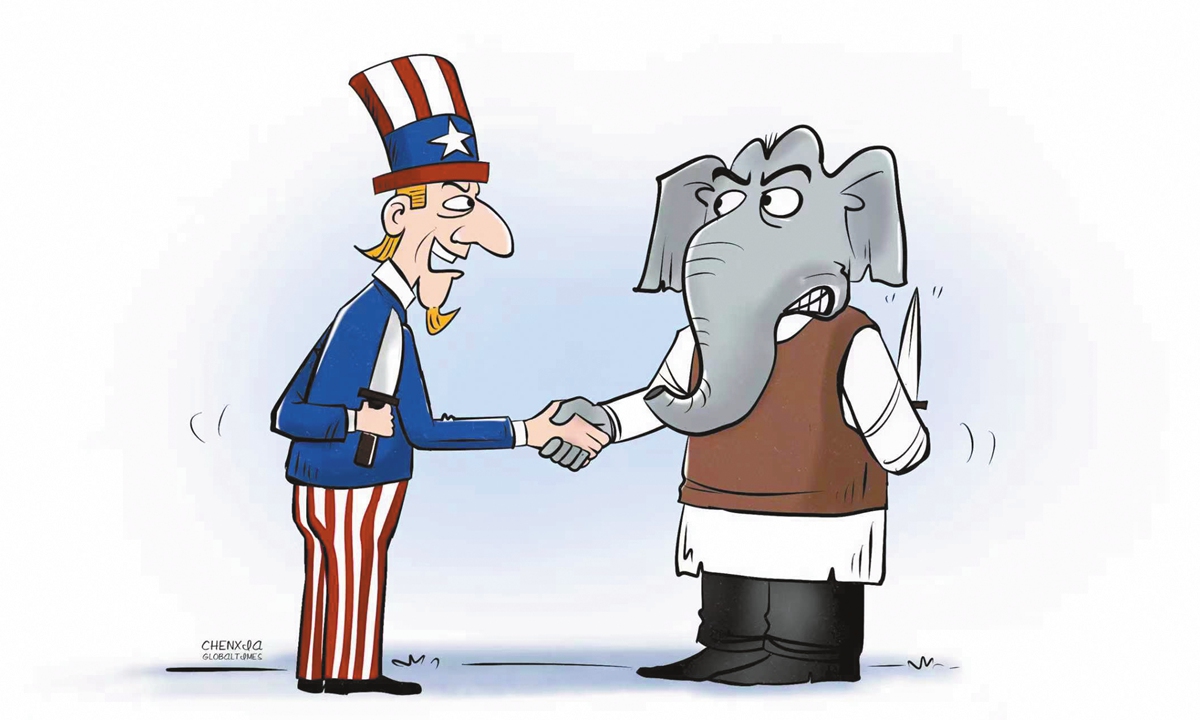
At the same time, the US has bypassed India to proactively strengthen its ties with Pakistan, a move that India views as a "stab in the back." Such actions once again underscore a cold reality: When interests diverge, so-called strategic partners are reduced to pawns that the US can use or discard at will.
It must also be recognized that the deep-rooted foundation of strategic cooperation between the US and India, built up over the past two decades, makes a complete breakdown of bilateral relations highly unlikely. Cooperation in the military and technological fields has already gained significant momentum, making it difficult to bring such engagement to an abrupt end.
However, as strategic trust continues to erode, it remains to be seen whether existing cooperation will slow, whether the US will tighten conditions on core technology sharing, and whether India can achieve its goal of upgrading its defense industry through military procurement.
The widening diplomatic rift, coupled with policy uncertainty for the remainder of Trump's term, has become the new normal in South Asian geopolitics, directly prompting India to recalibrate its diplomatic strategy.
Recently, the Modi administration has accelerated its foreign policy diversification, proactively extending goodwill toward China to improve the bilateral economic, trade, and political climate, and to mitigate the risks posed by US diplomatic uncertainty. Modi himself has frequently visited countries in ASEAN, the South Pacific, and Europe, seeking to reduce India's reliance on US unilateralism by strengthening regional multilateral cooperation. This shift signals a return to pragmatism and rationality in India's foreign policy.
Looking back on the ups and downs in US-India relations, policymakers in New Delhi should draw a sobering lesson: In the chess game of great-power rivalry, pinning excessive hopes for national development on the support of a single major partner will only leave a country stripped of initiative, trapped in the logic where that partner's own interests always come first.
For India, the path that truly serves its long-term interests should never be one of dependence on any single party, but rather one that consistently anchors itself in its core interests and pursues genuine "strategic autonomy." Only by staying independent, maintaining clear-eyed judgment and striking a balance among major powers, can India truly take control of its own destiny in an ever-shifting global landscape.
The author is director of the Research Department at Tsinghua University's National Strategy Institute. opinion@globaltimes.com.cn
RELATED ARTICLES