‘King of self-unloading ships’ delivered in Jiangsu, China, to serve the Simandou Iron Ore Project in West Africa
By Guo Yuandan in Yangzhou and , Published: Jul 21, 2026 11:06 AM

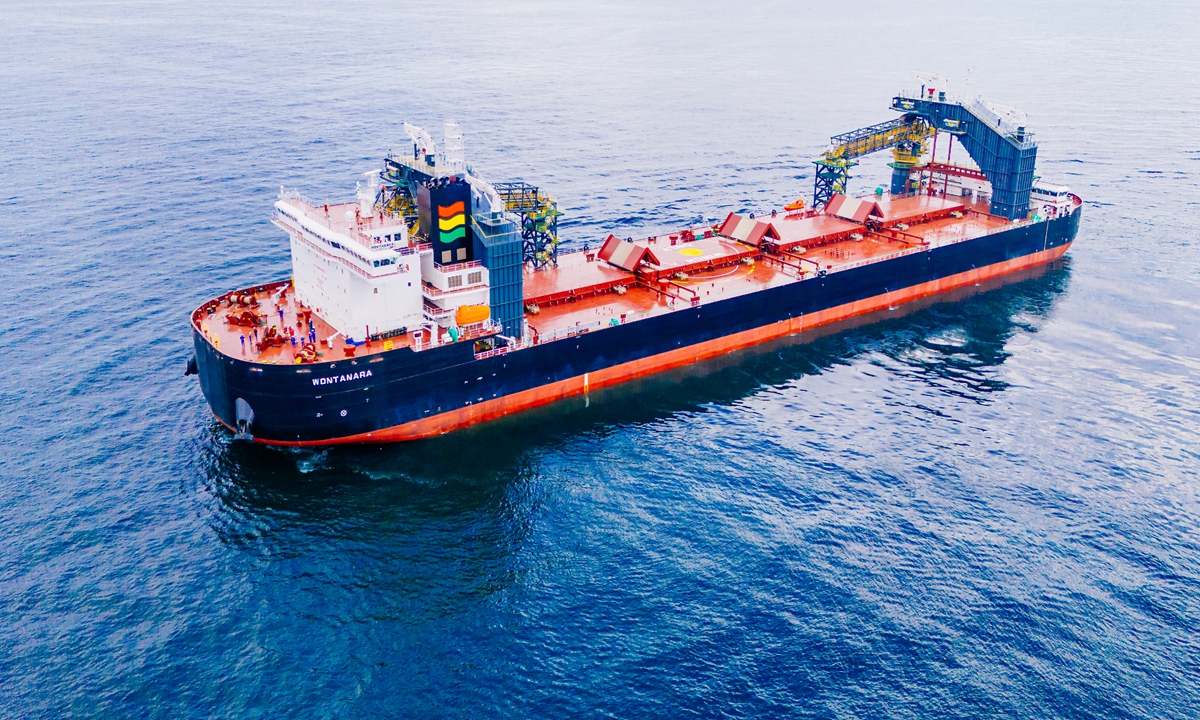
China State Shipbuilding Corporation (CSSC) delivers a 41,800-ton self-unloading bulk carrier custom-built for the landmark Simandou iron ore project off the coast of West Africa's Guinea on July 21, 2026. Photo: Courtesy of the CSSC
China has delivered the world's first 41,800-ton bidirectional sailing self-discharging ship named "WONTANARA" in East China's Jiangsu Province on Tuesday, the Global Times learned. The ship is independently designed and built by a Chinese shipbuilder, and the delivery marks a breakthrough for China in the high-end self-unloading and cargo transfer vessel sector, transitioning from the stage of "following others" to "taking the global lead," industry insiders said.The delivery of the "king of self-unloading ship" embodies the prowess of China's independent innovation and comprehensive whole-chain capabilities in high-end shipbuilding and marine engineering equipment.
This milestone arrives as China - the world's largest shipbuilder - continues to maintain its global lead and attract global orders for large vessels and high-end ship types, despite intensifying competition from South Korean and other players, industry insiders said. It also reflects the broader transformation and upgrading of China's manufacturing industry toward high-end, intelligent, and green development.
As Global Times reporters approached the "steel behemoth" docked at a Yangzhou port in East China's Jiangsu Province on Tuesday, its towering hull loomed impressively against the skyline. Once aboard, visitors are struck by the labyrinth of pipelines and the vessel's complex, meticulously engineered interior. Although enormous in scale, the ship features a highly advanced self-unloading conveyor system that delivers exceptional speed and operational efficiency.
The vessel has set three new world records in one go. It is the world's largest deadweight shallow-water transshipment self-unloading ship, the world's fastest self-unloading ship in terms of discharge speed among specialized vessels, and the world's first self-unloading transshipment ship in its tonnage class with bidirectional sailing capability, the Global Times learned from the shipbuilder.
The vessel was built by a subsidiary of China State Shipbuilding Corporation (CSSC), CSSC Chengxi Shipyard Co, for the multinational mining company Rio Tinto Group. Rio Tinto has placed five orders for the vessel, and Tuesday's delivery marks the first one, while the second and third vessels were launched on May 6 and June 30, respectively, and are expected to be delivered during the first half of next year.
The vessels will be deployed in the waters off Guinea in West Africa to serve the Simandou Iron Ore Project, providing critical support for the stable production and transshipment of iron ore, Zhang Xinlong, general manager of CSSC Chengxi Shipyard Co, told the Global Times.
Rio Tinto said in a post on its WeChat account that "WONTANARA" means "we are together" in Susu language, one of the major languages in West Africa. It added that the specialized vessel can transfer more than 40,000 tons of iron ore per trip from the port to oceangoing bulk carriers anchored offshore, "providing strong support for the project to gradually increase production and achieve full capacity."
The Simandou Iron Ore project is a key project in economic and trade cooperation between China and Guinea, and a significant achievement of the joint construction of the Belt and Road Initiative. Once fully operational, the project will supply massive volumes of high-grade iron ore to the global market each year, Zhang said.
Setting the record
The vessel has an overall length of 215 meters, a molded breadth of 42 meters, a molded depth of 14.5 meters, a design draught of 7.5 meters, and a deadweight tonnage of 41,800 tons. It features a large cargo hold that is approximately 135 meters in length, with a capacity of 29,000 cubic meters.
Industry insiders compared the self-discharging ship to a "super cargo handler" in sea transportation. These ships, installed with built-in cargo discharge systems that allow them to unload independently without port equipment, operate like floating shuttle buses and are capable of efficiently ferrying cargo between shallow-water docks and deep-water anchorages.
"It is particularly suitable for regions and countries with relatively shallow waters or inadequate port facilities, where large ships cannot berth or utilize port machinery for loading and unloading cargo," Zhang said.
One of the prominent features is that the ship achieves a world-record discharge rate of 12,000 tons per hour, a 71 percent increase in efficiency over the previous record of 7,000 tons per hour. That earlier benchmark was set by a Supramax bulk carrier, which was also retrofitted and delivered by CSSC Chengxi in May 2025, the Global Times learned. This marks a significant leap forward for China's shipbuilding industry in the core system integration technology of self-unloading vessels, analysts said.
"Imagine loading 41,800 tons of iron ore into standard train cars, which would require nearly 700 carriages lined up end-to-end, stretching over 7 kilometers, [while taking a prolonged period to unload]. Yet the new self-unloading ship can unload this amount of iron ore at sea in less than 3.5 hours," Zhang said.
Once five vessels of this type operate in coordination, they will be able to fully transfer and load an entire 200,000-ton oceangoing bulk carrier within 24 hours. This dramatically shortens the waiting time for giant ships at anchor, while also significantly boosting the mine's shipment volume and economic returns, according to Zhang.
According to the shipbuilder, this remarkable efficiency is also achieved due to a number of innovative, brand-new, and first-of-their-kind designs, including the adoption of a wide-body shallow-draft design and a dual self-unloading system, which significantly enhances both cargo capacity and discharge efficiency compared to existing shallow-water self-unloading transshipment ships. Also, the ship features bidirectional sailing technology and is equipped with two full navigation bridges, one at each end - similar to China's high-speed trains which are designed with driver cabs at both ends. This also represents a world-first application.
Considering that in major overseas mining projects - particularly at African ports handling bulk commodities such as iron ore and coal - shallow water depths and inadequate port facilities pose challenges, these designs effectively address the long-standing bottleneck in short-distance transshipment from shallow-water terminals to deep-water anchorages, while enabling the vessel to achieve excellent operation economy, the Global Times learned.
The delivery of this new vessel highlights a period when China's shipbuilding industry is showcasing its growing strength in high-end maritime equipment. It also reflects the broader transformation and upgrading of China's manufacturing sector, where strategic emerging industries such as humanoid robots and new energy vehicles are rapidly gaining momentum, analysts pointed out.
In the first quarter of 2026, China's shipbuilding industry maintained its global lead across all major indicators, with shipbuilding completion volume accounting for 57.3 percent of the global share during the period, according to data from the Ministry of Industry and Information Technology.
In line with this trend, CSSC Chengxi's orders have already been scheduled through 2030. And as of now, the company holds more than 120 vessels in the order book, covering a wide range of ship types including container ships, oil tankers, and specialized vessels, according to Zhang.
"China has developed the capability to fully assemble and build a complete spectrum of marine products - from ultra-large LNG carriers to polar icebreaking research vessels and large cruise ships, some of which achieve global firsts. This has laid a solid foundation for Chinese players to seize opportunities in the global shipping industry's green transformation and the new upcycle in the shipbuilding market," Zheng Ping, chief analyst with industry news portal chineseport.cn, told the Global Times on Tuesday.
Analysts added that Chinese shipbuilders innovate in line with evolving market demands, which further enhances their global competitiveness.
For example, as the global shipping industry places greater emphasis on green and environmental protection, Chinese enterprises are accelerating the development and deployment of new energy vessels, including electric ships, methanol-fueled ships, and biofuel-powered ships.
According to Zheng, while South Korea had maintained a lead in high-end shipbuilding in the past, China has already outpaced it in many aspects - backed by complete industry chains, a stable industrial environment, affordable price and a short delivery cycle.
RELATED ARTICLES