IN-DEPTH / IN-DEPTH
Witness plateau miracle on a 100-kilometer road to Xizang’s Medog
A promise across snowy mountains
By , Fan Wei and Pang Yue in Medog Published: Jul 21, 2026 07:05 PM

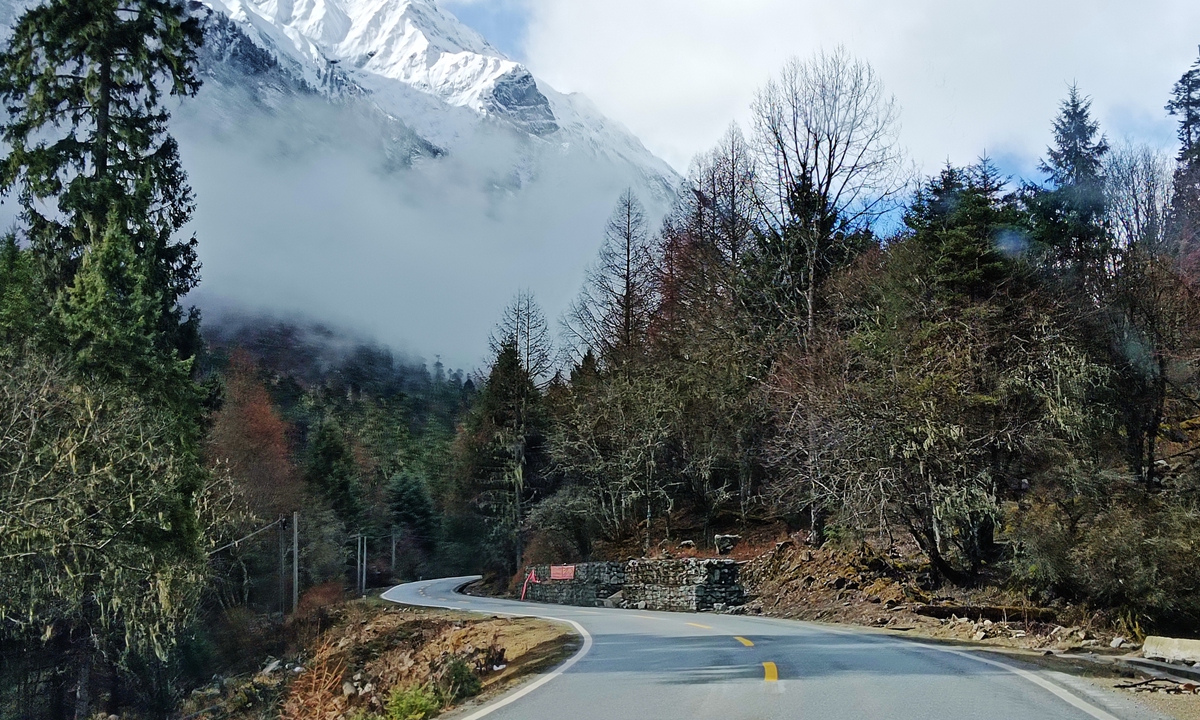
A view of the Zhamog-Medog Highway in Nyingchi, Southwest China's Xizang Autonomous Region Photo: VCG
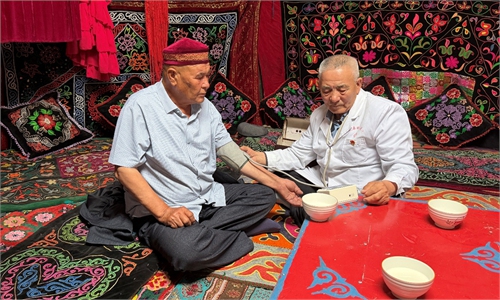
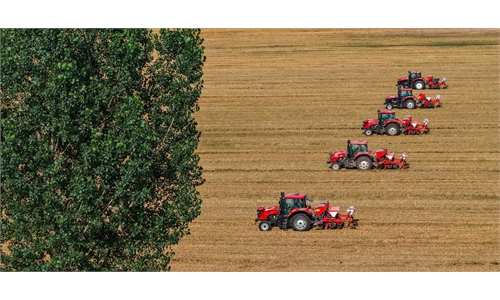
Editor's Note:The year 2026 marks the 105th anniversary of the founding of the Communist Party of China (CPC). For years, some Western media outlets have adhered to a narrowly market-driven framework, interpreting China's governance solely through the lens of short-term economic returns and questioning the country's large-scale public welfare investments in remote, underdeveloped regions. Recently, Global Times reporters traveled to the Gobi Desert, snow-covered plateaus and remote mountain regions to document three livelihood projects that may appear financially unviable: subsidized slow trains serving farmers across the vast Taklamakan Desert in Northwest China's Xinjiang Uygur Autonomous Region; a high-altitude highway linking the valleys of Medog in Southwest China's Xizang Autonomous Region; and school retention programs that keep children in classrooms in the Daliang Mountains of Southwest China's Sichuan Province.
Behind these outlays that defy profit-and-loss logic lies a distinctly Chinese philosophy of governance: wherever the people are, the state's protection follows. Through the human warmth of these seemingly unprofitable endeavors, one glimpses the enduring commitment of the Party to stay rooted among the people and to build social cohesion through inclusive welfare.
American stand-up comedian Lee Camp spent three weeks in Southwest China's Xizang Autonomous Region in 2025. This place is often smeared by some Western media, however, for him, it was spectacular.
"I can't even remember how many tunnels and bridges I went through, or how many dams I saw," Lee Camp told the Global Times. "There were so many major infrastructure projects. It was incredible. I was shocked."
Why did China's Xizang leave such a deep impression on this American, known for his sharp tongue? Recently, as Global Times reporters drove along the road to Medog - a county mainly inhabited by Monpa and other ethnic minority groups, located deep in a valley in the Himalayas and known as "the last county without roads in China" until late 2013 - the mountains and rivers tamed by Chinese infrastructure workers gave the answer.
In Medog, melting snow and fast rivers cut deep canyons thousands of meters below. To build roads here, people had to bore through mountains and build bridges over dangerous waters. These huge projects were not just about roads and bridges. They were about connecting more than 10,000 residents living in this "hidden realm on the plateau" with the rest of the world and ensuring they don't get left behind.
No one left behind
As modern roads reached Medog, life here slowly changed. Today, in many ways living conditions in the county are no different from those in inland counties. But the area is still surrounded by virgin forests.
"After being bitten by mosquitoes here, you have to squeeze out the swelling blood blister right away, otherwise it may become infected, and you may even end up with a hole in your skin," said Zhaxi Qupei, the Party chief of Gelin village in Medog, while guiding reporters along a forest trail.
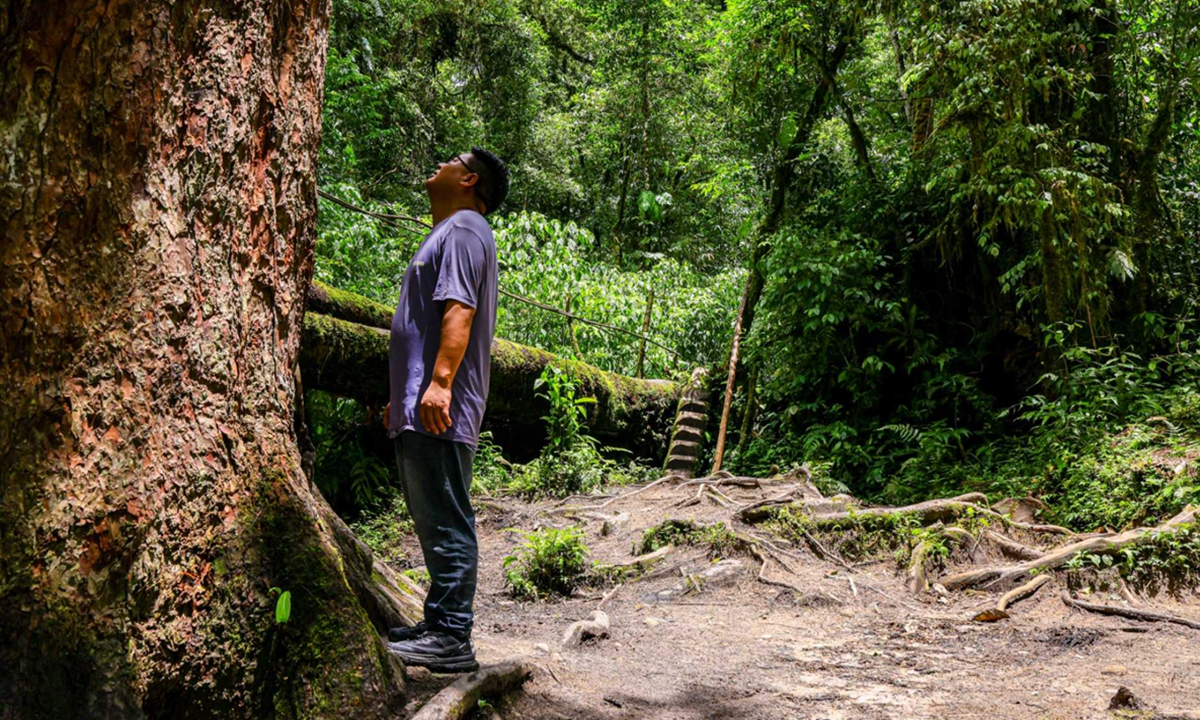
Zhaxi Qupei, the Party chief of Gelin village in Medog, looks up at a 76.2-meter-tall Bhutan pine in the tropical rainforest on July 1, 2026. Photo: Fan Wei/GT
Zhaxi Qupei is not yet 30, but he knows the rainforest very well like an experienced "Monpa hunter."When he was in primary school, Gelin village still had no road access. To get to school in Baibung Township down the mountain, he had to climb through the virgin forest. The straight-line distance was less than seven kilometers, but the round trip took nearly four hours. Even so, he said he was lucky as the road to Medog was opened before he went to college.
However, his elders had a much harder life. Since childhood, they had to act as "porters," carrying daily supplies through the forest for nearly 10 days to and from Pad Township in Milin City, more than 80 kilometers away.
For people in cities, with online shopping and food delivery, it is almost impossible to imagine such hardship. When Global Times reporters tried to follow the old porter's route with Zhaxi Qupei, they found that the forest is not easy for outsiders. The space under the tall trees feels tight and heavy. The mountain path is steep, and landslides and mud make every step dangerous.
In this environment, being a porter was once the fate of many people in Gelin village. Learning how to survive in the forest was something they had to do from childhood.
Dengba Zhaba, the village's former Party chief, told the Global Times that even horses were unwilling to travel this route, but people had to.
"Basic things like salt and sugar had to be bought in Pad Township," he said. "As the trip was so hard, everyone had to carry back nearly 50 kilograms of goods each time."
To improve transport in Medog, road builders had to work in very difficult conditions. Cao Ming, a technical expert who took part in the construction of the Medog road, shared with the Global Times that local villagers welcomed them warmly when they heard they had come to build the road.
They offered their best meat and dishes. One dish left a deep impression on him: sour meat.
"At first I thought it was a special local taste," Cao said. "Later I learned that, because there was no road, people usually did not have refrigerators. Medog is also hot and humid, so meat spoiled quickly. That is why local people got used to eating sour meat."
Under those conditions, it was hard to imagine significant development in the county.
Zhao Shuai, a civil servant in Ganden Township in Medog, came from Central China's Henan Province after university and chose to settle in this remote area. His experience gave him a deep understanding of the saying: "If you want to get rich, build roads first."
In his view, transport is the first condition for development. "Before the road was opened, cement that cost just over 300 yuan ($44) per ton in inland provinces could sell for 20,000 yuan in Medog," Zhao said. "Under these conditions, how could Medog develop?"
Spare no expense
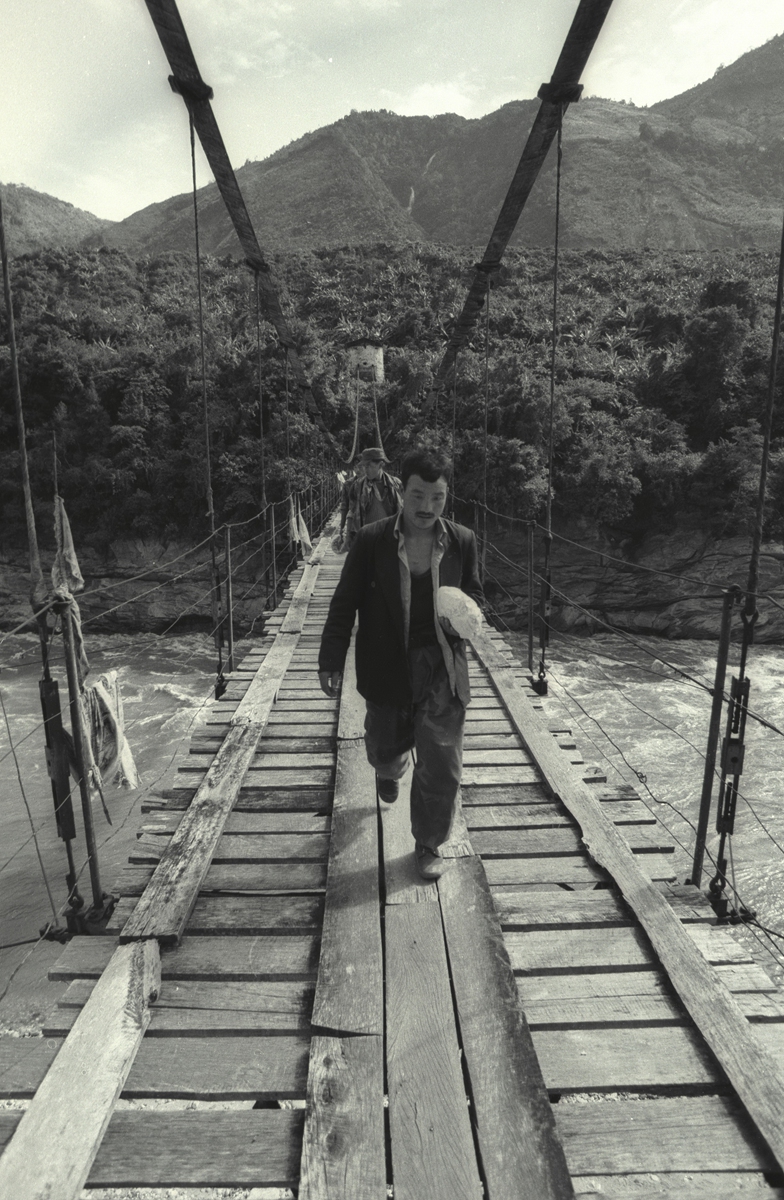
The file photo displays a suspension bridge inside the Yarlung Zangbo Grand Canyon in Nyingchi taken on November 8, 1998. Photo: VCG
Today, Medog's old title - "the last county in China to gain road access" - has become a kind of "signboard" that attracts tourists.At the monument marking the opening of the Medog Highway, near the Galongla Tunnel, an inscription records the long history of road building in Medog. The highway to Medog was rebuilt four times - in 1965, 1974, 1980 and 1990 - but none of these efforts led to lasting road access. It was not until 2013, when the Zhamog-Medog Highway opened, that Medog finally achieved the dream of road access.
In 2021, another highway connecting Medog was fully opened, reducing the time to drive in and out of Medog from 12 hours to about 4 hours. This brought the county into a faster period of rural development.
"Medog is often called a museum of geological disasters in China, and that is not an exaggeration," said Cao.
Spreading out a road design drawing he had made, Cao pointed out to the reporters the many challenges involved in building roads in Medog: a road stretching between just 30 to 50 kilometers had a vertical elevation difference of nearly 3,000 meters; it passed through snow mountain passes and steep canyon cliffs at altitudes of more than 4,000 meters; along the route, maximum snow accumulation exceeded 12 meters, and snow avalanches affected stretches of road longer than 30 kilometers; some sections received more than 3,000 millimeters of rainfall, with over 200 rainy days a year, while earthquakes, mudslides, landslides and other geological disasters occurred frequently.
To cope with these natural barriers, China's most advanced engineering technologies have also converged in Medog, crossing snow-covered mountains that remain frozen year-round. From double-shield full-face hard rock tunnel boring machines that carve tunnels through high-altitude, high-cold regions, making mountains bow their heads, to steel cable bridges that span deep canyons, linking one cliff wall to another and forcing rivers to yield, and to a series of man-made culverts that combat frequent mudslides - these structures form a "protective shell" that channels flash floods and debris safely away.
On the road to Medog, Global Times reporters saw how China's infrastructure builders displayed boundless wisdom and made tremendous sacrifices in transforming this "isolated plateau island."
"Roads to Medog are also like a museum of China's engineering technology," Cao said.
There are very few places in China like Medog, where such a rich and advanced range of engineering resources has been mobilized to build a highway. Even now that the road has been opened to traffic, China continues to invest advanced technologies in road improvement and geological disaster prevention.
Public information shows that the total investment in the approximately 117-kilometer Zhamog-Medog Highway exceeded 1.6 billion yuan, with an average cost of more than 13 million yuan per kilometer. Cao compared this with inland areas: "In plain inland regions, building one kilometer of road to the same standard would probably cost only about 7 million yuan."
"In order to help the people of Medog leave behind the trouble of being an 'isolated island,' the country truly spared no expense," he said.
Today, all administrative villages under the eight towns of Medog have been connected by road. Meanwhile, Medog's third road to the outside world is currently undergoing upgrading and reconstruction. The opening of the third highway, part of National Highway 219, will elevate Medog from simple accessibility to full connectivity in all directions.
Creating miracles
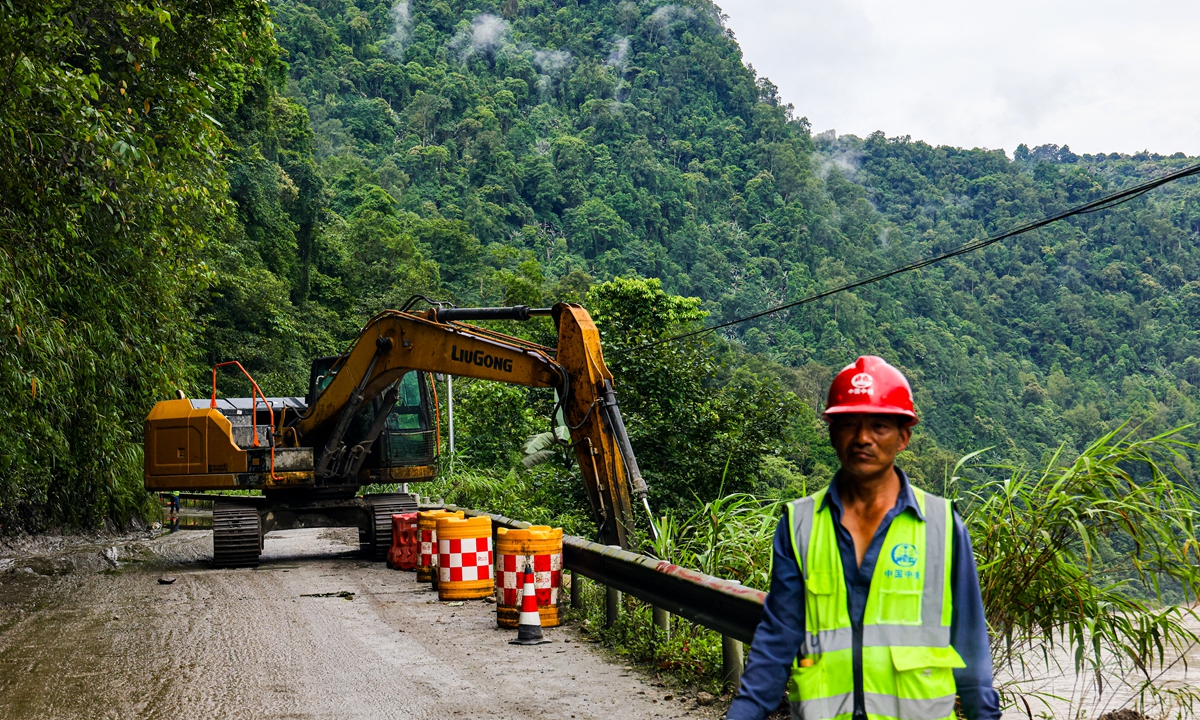
A road maintenance worker stands on the highway in Medog on June 30, 2026. Photo: Fan Wei/GT
During the visit, Global Times reporters also saw a photo exhibition in the commercial street of Medog's county center marking the 105th anniversary of the founding of the Communist Party of China (CPC).Images showing life before the highway opened drew many tourists to stop and look, which stood in sharp contrast to the busy and prosperous scene around them.
On the last display board, an inscription lays bare the original intention behind the exhibition: in just 20 years, Medog changed from a place where supplies were carried by porters and pack animals to a place where vehicles now travel freely. It has also changed from an isolated area to one lit by household lights. Behind this change is the long-term goal of generations of CPC members: to help people live better lives, as well as the Party's promise that no ethnic group should be left behind.
"In Xizang, there is so much to appreciate and take in. Chinese efforts to connect remote areas are extremely impressive." When the Global Times reporters told Lee Camp about their trip to Medog, he also shared his observations in his country. "It doesn't seem the US has a broad approach to infrastructure. Some cities repair theirs and many do not. There are around 41,000 structurally deficient bridges in the US right now. The Francis Scott Key Bridge in my hometown of Baltimore catastrophically collapsed in a fully preventable accident a few years ago and no one fixed the problem."
"The Chinese government thinks more about whether something benefits society and whether it can make people's daily lives more convenient." What Lee saw and heard in China gave him much to think about. "China is willing to devote a great deal of effort, time and budget to large-scale infrastructure construction, all with the goal of benefiting the people in the long run. Whether it makes money is not important."
RELATED ARTICLES