Access to Chinese open-source AI significantly shortens our startups' path from idea to product: Uzbek tech delegate at WAIC 2026
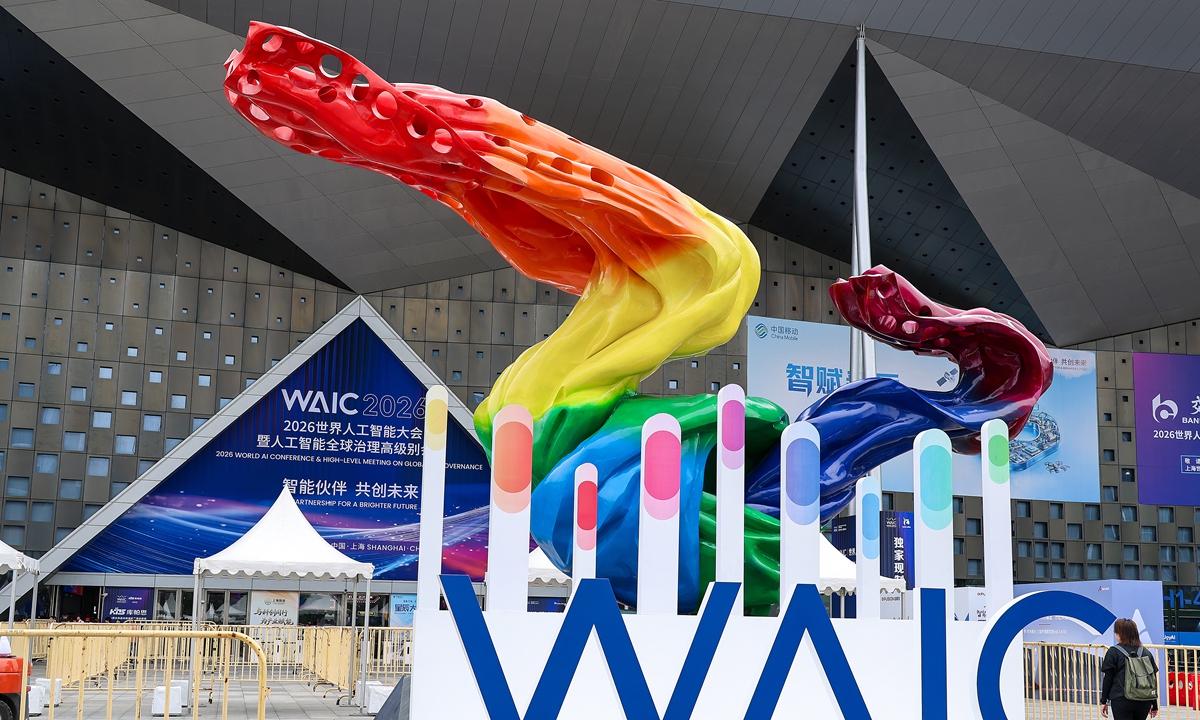
This photo shows the street installation for 2026 World Artificial Intelligence Conference in Shanghai, which is set to open on July 17, 2026, bringing together more than 1,100 companies and over 3,000 exhibits. Photo: VCG
Editor's Note:As artificial intelligence (AI) rapidly transforms global industries, Chinese and foreign leaders and tech pioneers in the past few days gathered at the 2026 World Artificial Intelligence Conference (WAIC) in Shanghai to forge new avenues of international cooperation. Among them was Azamat Karamatov (Karamatov), CEO of IT Park Uzbekistan, an eyewitness and key driver of Central Asia's surging digital transition.
In an exclusive interview with the Global Times (GT), Karamatov discussed Uzbekistan's ambition to become a regional AI hub, its growing data infrastructure and how Chinese technology empowers local startups. Highlighting the historic Silk Road connection, Karamatov noted: "China is one of Uzbekistan's closest strategic partners, and we are keen to be part of the next wave of AI innovation - not only as observers, but as active partners."
GT: What has impressed you most about China's AI ecosystem and the global conversations at the WAIC 2026?
Karamatov: What has impressed me most is AI's fast shift from research to real-world applications. I was interested in the advances in robotics, embodied AI and industrial AI, where innovation is transforming the way businesses operate and industries develop. China has become a global leader in AI, and WAIC provides an outstanding platform to build stronger connections not only between businesses, but also between countries. We seek to strengthen China-Uzbekistan ties while exploring new opportunities for collaboration.
China is one of Uzbekistan's closest strategic partners, and we are keen to be part of the next wave of AI innovation - not only as observers, but as active partners. Today, China is Uzbekistan's largest trading partner. At IT Park Uzbekistan, we aim to complement these strong economic ties by deepening cooperation between our technology ecosystems, and fostering joint innovation, investment and talent development. That is why this year's theme, "Intelligent Partners, Co-create the Future," resonates so strongly with us.
GT: What does the landscape of Uzbekistan's AI industry look like? What role do China and its tech companies play in it?
Karamatov: Uzbekistan is emerging as the world's fastest-growing startup ecosystem. With two unicorns and our National AI Strategy 2030, we are building a strong AI ecosystem.
Uzbekistan is also investing heavily in AI infrastructure. We are building large-scale data centers with more than 500 MW of planned capacity, and competitive electricity prices starting from $0.05 per kWh.
China has built world-class AI capabilities, and Uzbekistan aims to serve as a regional platform for AI engineering, digital services and R&D, connecting Chinese companies with talent and opportunities across Central Asia.
GT: Many developing nations face constraints in computing power, data infrastructure and R&D funding. Do you believe China's AI approach can help bridge this AI divide? What specific areas do you see as the most promising for IT Park Uzbekistan to leverage?
Karamatov: Absolutely. One of China's biggest strengths is that it is building the entire AI ecosystem. This approach can help many countries accelerate AI adoption. We already see strong examples like DeepSeek and Alibaba Cloud. AI is transforming manufacturing, healthcare, logistics and smart cities. These are valuable examples for us.
For IT Park, the biggest opportunities are open-source AI, cloud infrastructure and industry AI solutions. Our goal is to build the infrastructure that helps companies not only use AI, but also develop and scale AI solutions.
GT: Which Chinese AI models are widely used by companies in Uzbekistan? How do you assess the role of China's open AI innovation ecosystem in driving global technological innovation?
Karamatov: We are seeing strong and growing interest in Chinese open-source models such as DeepSeek and Z.ai. Developers are using them for software development, multilingual applications, AI assistants and enterprise solutions.
For Uzbekistan, this presents a major opportunity. IT Park Uzbekistan supports more than 1,000 startups, and access to world-class open models allows them to focus on solving business problems and building solutions efficiently. This significantly shortens the path from idea to product and helps our startups compete internationally.
Looking ahead, we want to collaborate with Chinese AI companies to fine-tune models for the Uzbek language, develop industry-specific solutions for Central Asia, and establish joint R&D initiatives in Uzbekistan.
RELATED ARTICLES