China’s dynamic growth refutes ‘China Shock 2.0’ rhetoric, injecting positive momentum for the global economy
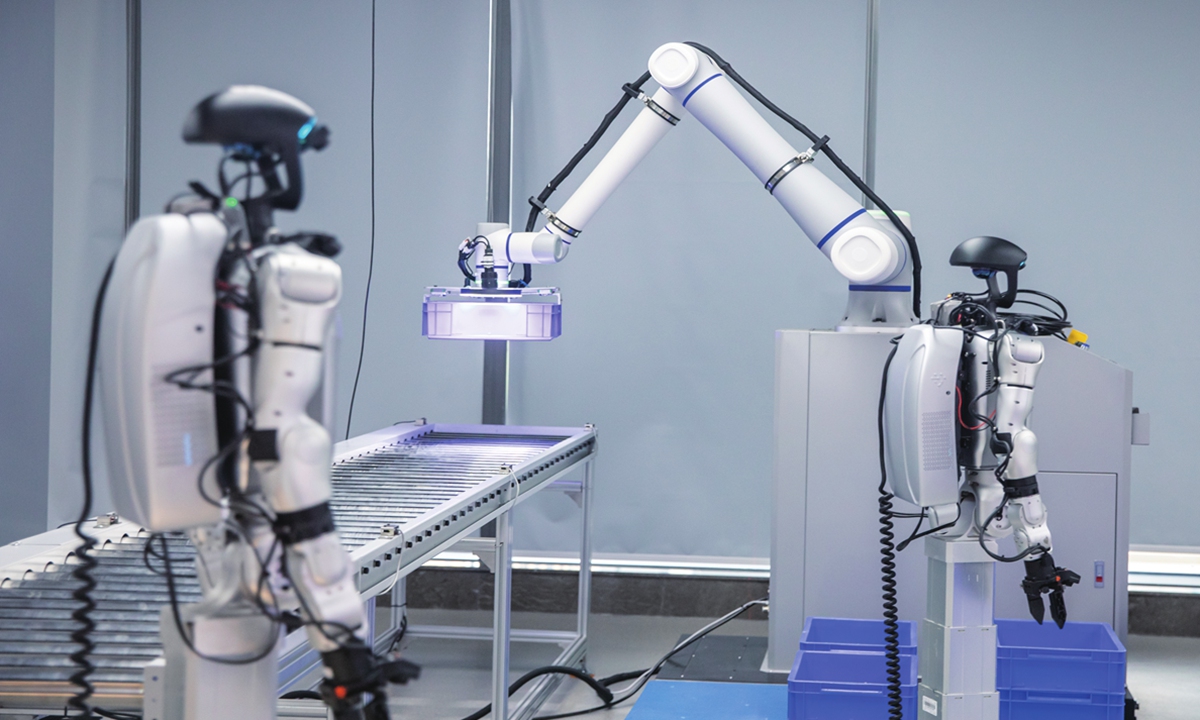
A robot trains for logistics and warehouse operations at an embodied AI demonstration center in Hangzhou, East China's Zhejiang Province, on June 11, 2026. Photo: VCG
China's GDP grew by 4.7 percent year-on-year in the first half, demonstrating the Chinese economy's strong resilience amid geopolitical tensions, inflation, and uncertainty in international markets. This resilience has been achieved through industrial upgrading, technological innovation, robust manufacturing capabilities, and stable trade performance.
Global institutions continue to place high confidence in the Chinese economy. The IMF's World Economic Outlook update, which was released on July 8 projected China's growth at 4.6 percent for 2026, which is 0.2 percentage points higher than its April forecast. It meanwhile lowered its global growth forecast to 3 percent this year, down from an average of 3.5 percent between 2024 and 2025.
Some Western media outlets and politicians have recently been hyping the so-called China Shock 2.0 narrative. However, the latest GDP data clearly refutes this claim. Far from creating shocks, China's technological and green transformation is generating far more opportunities than challenges for the world. At the same time, China's strong export performance demonstrates that global demand for Chinese products, technologies, and solutions continues to rise, precisely because its advanced technology, clean energy products, and modern industrial equipment are more affordable, reliable, and accessible.
China's stable and dynamic economy benefits not only its own citizens but also numerous developing countries that have fostered strong connectivity with China in such sectors as trade, investment, economic cooperation, and various developmental projects. As the world's second-largest economy, China plays a pivotal role in the global economic system. I firmly believe that China's consistent focus on innovation, the integration of artificial intelligence (AI) into everyday life, high-quality development, green transformation, and greater openness will provide strong positive momentum for the global economy.
At a time when the global economy faces numerous uncertainties, China's steadfast commitment to long-term development and international cooperation will continue to make a meaningful contribution to global economic stability and shared prosperity.
This success is deeply rooted in China's unique economic model. Looking back at its remarkable journey, China's economic model tells a compelling story of resilience, sustainable development, and continuous progress. This model has enabled China to achieve remarkable accomplishments, including significant poverty reduction, world-class infrastructure development, modernization, and robust industrial growth. Through long-term strategic planning, visionary leadership, and consistent policy reforms, China has transformed itself into a global economic powerhouse. And this development path also offers valuable lessons and practical experiences for other developing countries striving for sustainable and inclusive economic growth.

Khalid Taimur Akram Photo: Courtesy of Khalid Taimur Akram
China's high-tech contributions
China is making rapid strides in artificial intelligence (AI), electric vehicles (EVs), renewable energy, smart technologies, digital technologies, and advanced manufacturing. These breakthroughs are creating significant opportunities for developing countries. By learning from China's experience, they can adapt successful models and accelerate their own development.
In this context, Pakistan, as China's all-weather strategic cooperative partner, stands to gain immensely from Chinese expertise. Through technology transfer, joint research and development, investment, industrial partnerships, and skills training programs, such collaboration will enhance productivity, upgrade physical and digital infrastructure, modernize industries, and better prepare the youth for future employment opportunities.
As China advances in innovation and high-quality development, I expect bilateral cooperation between China and Pakistan to expand beyond traditional infrastructure into high-potential emerging sectors such as AI, digital technology, renewable energy, modern agriculture, healthcare, education, and advanced manufacturing. These areas will generate new employment opportunities, boost productivity, and support Pakistan's long-term economic modernization.
Beyond bilateral benefits, both countries can work together to promote fair trade, regional connectivity, and sustainable development through deeper economic partnerships. By fostering investment, technology transfer, industrial cooperation, and people-to-people exchanges, China and Pakistan can contribute to building a more balanced and inclusive global economic order. Their partnership serves as a powerful example of how developing countries can achieve mutual benefit and shared prosperity through solidarity and collaboration.
In the broader context, China's technological ascent plays a vital role in strengthening South-South cooperation. Rather than relying solely on traditional sources, China actively promotes collaboration among countries and encourages collective progress. When countries work together in key areas such as innovation, education, clean energy, smart manufacturing, and digital transformation, they can bridge technological gaps and achieve more sustainable and inclusive growth. China's willingness to share its experiences and cooperate with partner countries lays a strong foundation for long-term mutual development.
Khalid Taimur Akram is the executive director of the Pakistan Research Center for a Community with Shared Future.
RELATED ARTICLES