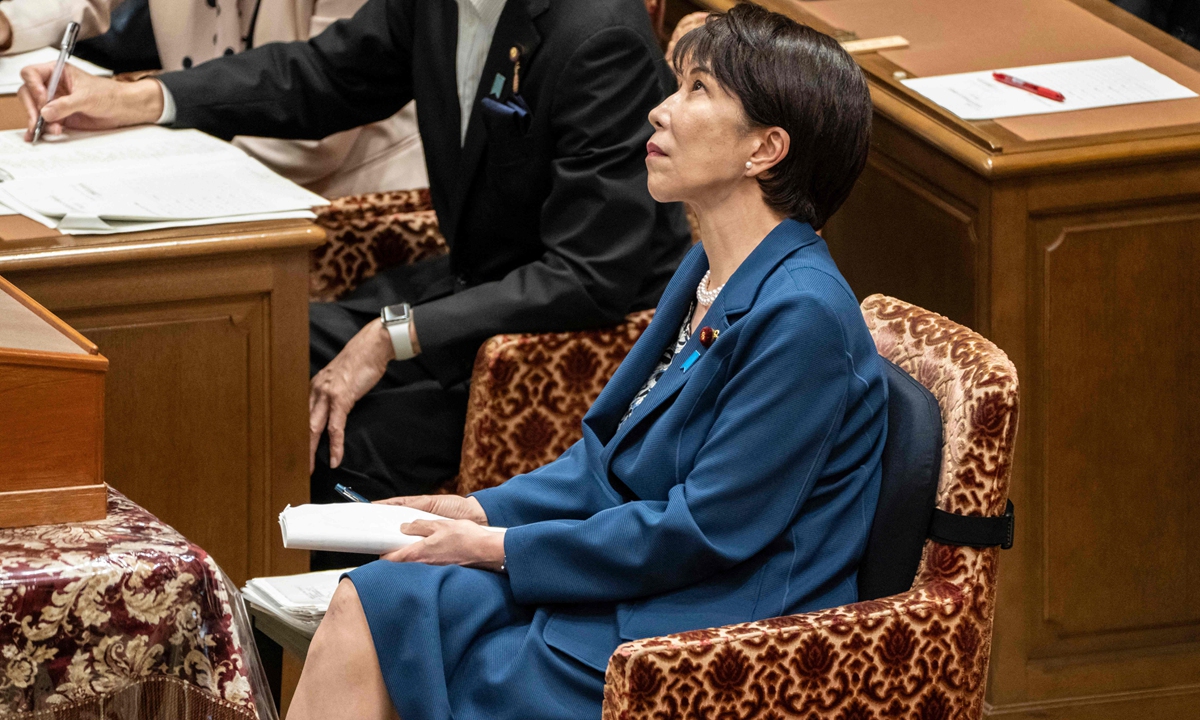
Japanese Prime Minister Sanae Takaichi attends the Joint Meeting of the Committees of Both Houses on Fundamental National Policies at the Diet in Tokyo on July 15, 2026. Photo: VCG
Sanae Takaichi's public support is in freefall - a political Waterloo. As Japan's first female prime minister, she entered office with soaring expectations and a bold, hardline conservative agenda. Now, her power is shaking.The latest polls are telling. According to reports, support for Takaichi's government decreased to 53 percent from 60 percent in June in an Asahi newspaper poll, while broadcaster ANN found her popularity fell over 10 points to 49.2 percent. A separate Mainichi newspaper survey saw a similar-sized drop to 41 percent.
From a rock-solid 70 percent plus when she took office to the 41 percent today - this isn't a gentle change. It's a political meltdown.
The cracks started showing with the deeply controversial revision of the Imperial House Law, which keeps women off the throne. "A popular princess drives support for having a female Japanese Emperor. But the country's first female prime minister opposes it," writes NPR. Critics commented that it was tone-deaf, rushed, and out of step with both public sentiment and the Imperial family's preferences.
Then came the internal power struggle. Tensions between Takaichi and LDP heavyweight Taro Aso - once a close ally of Takaichi - have been mounting, leaving her power base shaking. Moreover, the Japanese media revealed that her election team produced and distributed AI-generated smear videos targeting political rivals. Takaichi has not yet responded directly, which has only made things worse.
Takaichi's diplomacy hasn't helped either. Her overly flattering and sycophantic behavior on the diplomatic stage has left many Japanese feeling embarrassed.
But the real killer is the economy. Japan's wholesale prices jumped 7.1 percent year-on-year in June, the sharpest rise in more than three years. The Japanese yen recently dropped to 163.24 per US dollar, marking its weakest level since 1986. A weaker yen is driving up food and energy import costs, squeezing household budgets. And Japan recorded over 5,300 corporate bankruptcies in the first half of 2026, the highest in 12 years.
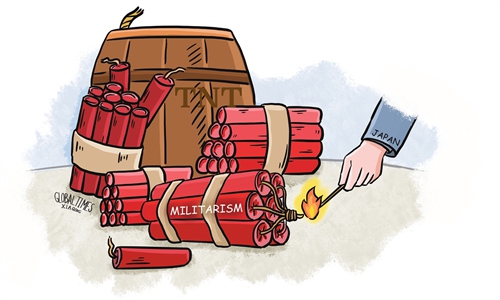
Takaichi failed to deliver on tax-cut promises, doubled down on expansionary spending, ballooned the debt and watched the yen weaken dramatically without effective measures. When voters' biggest worry is the price of groceries, Japan's militarist ambitions start sounding less like vision and more like an expensive distraction, akin to building a castle on shifting sands.
Takaichi's aggressive foreign policy - constantly poking neighbors, accelerating remilitarization and pushing constitutional change - is not the solution. Instead, it triggered targeted pushback that has left some Japanese sectors scrambling. Mitsubishi Electric, which claims to be the first in Japan, began an initiative in June to disassemble discarded air conditioners and extract rare earth elements - a humiliating, stopgap measure that perfectly symbolizes a country punching above its weight and paying the price.
Japanese economic groups have recently revealed plans to visit China, a move signaling their hope to ease tensions. But as long as Takaichi's hardline stance continues, thaw remains unlikely. When a prime minister keeps provoking China, how can she expect China to supply the raw materials for weapons aimed at itself - and even help Japan rebuild its economy to provoke China with greater strength?
The harder she tries to make Japan militarily powerful, the more vulnerable the country feels. The more she talks about "normalization," the more isolated Japan becomes in Asia.
At its core, this is a failure of governing temperament. Takaichi lacks the long-term strategic vision and cool-headed rationality that true statesmanship requires. She seems blind to economic realities, public sentiment and the basic demands of effective governance.
She loves to proclaim that "a nation that does not take on challenges has no future." Yet she refuses to challenge Japan's real problems - stagnant wages, industrial competitiveness and cost-of-living pressures - while picking fights with its neighbor instead.
A nation that can't even keep its own economy steady has no business talking big about "challenges" and "rise."
Takaichi's position is growing shakier by the day. This drama isn't over yet, but the ending is already coming into focus: Japan's right-wing remilitarization fantasy is quietly running out of steam in the light of public opinion.
The author is a reporter with the Global Times. opinion@globaltimes.com.cn
RELATED ARTICLES