Blue Momentum: How E.China’s Xiamen turns small marine resources into big industries
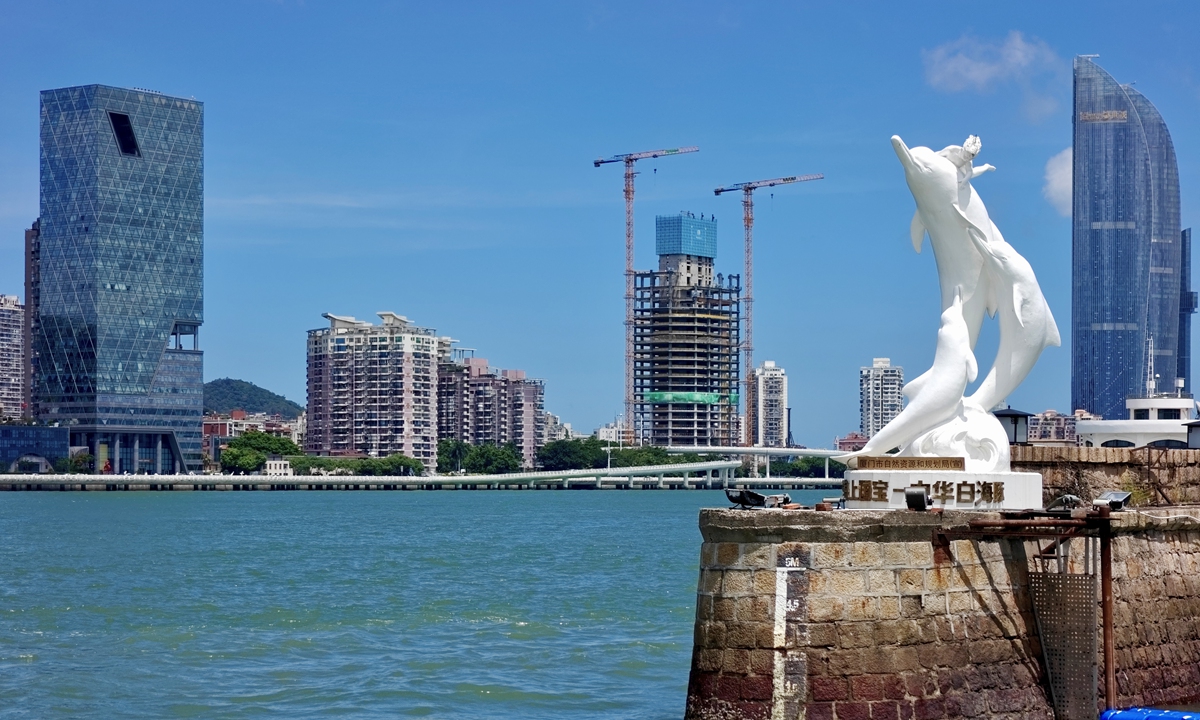
Seaside view in Xiamen, East China's Fujian Province on July 5, 2026 Photo: VCG
Editor's Note:
China has put high-quality development of its rich marine resources on the agenda. With a mainland coastline stretching 18,000 kilometers and a sea area under its jurisdiction of around 3 million square kilometers, China is a major maritime country with vast potential for developing the marine economy. To document its development, the Global Times launches the "Blue Momentum" series of in-depth reports from local marine economic powerhouses. The fourth installment focuses on Xiamen, East China's Fujian Province.
Amid the roars of machines at a factory in Xiamen Biomedicine Industrial Park, rows of capsules roll off the production line and move along the conveyor belts for final filling and packaging.
At this factory of Xiamen Blue Bay Science and Technology Co, discarded shrimp and crab shells that once sold for only a few hundred yuan per ton are processed through drying, extraction and other steps into glucosamine sulfate with a purity of more than 99 percent, increasing their value by millions of times.
Such examples of turning marine resources into valuable products can be found across Xiamen, a major coastal city in East China's Fujian Province.
The seahorse farming sector has grown into a billion-yuan industry from scratch, covering breeding, processing and sales. A little-known marine actinomycete is now used to produce vanillin through fermentation, with the product accounting for more than 60 percent of the global market.
Xiamen is making good use of its rich marine resources, strong research capabilities and industrial foundation to bring more marine technologies from laboratories to production lines and markets, industry insiders said.
From 'nothing' to 'something'
At Xiamen Biomedicine Industrial Park, 58-year-old Lin Xiufen, chairperson of Xiamen Blue Bay Science and Technology Co, keeps various bottles and jars of different sizes on her office desk. These items represent more than a decade of work by Lin and her team, including the development of glucosamine sulfate, a product used in the treatment of osteoarthritis.
Lin and her team have broken the technological monopoly once held by companies in Europe, the US and Japan in marine polysaccharide production, and helped replace imported products with domestically made alternatives.
Lin, one of Xiamen's successful female entrepreneurs who has received multiple city- and provincial-level rewards and extensive media coverage, told the Global Times how she used the city's coastal resources and policy support to build a business from scratch.
"Before 2005, China did not have the technology to produce high-purity glucosamine sulfate. We could only sell chitin extracted from shrimp and crab shells as raw materials to overseas companies at low prices, and then buy glucosamine products back from abroad at prices dozens or even hundreds of times higher," said the businesswoman.
Her company started out in a 20-square-meter office in a former government building. The meeting room was shared with other organizations.
As a pioneer in China's high-purity glucosamine sulfate industry, the company's monthly laboratory output was less than one kilogram two decades ago. Today, the company operates a glucosamine sulfate production line with an annual capacity of more than 100 tons and an annual output value of at least 1 billion yuan. Meanwhile, its chitooligosaccharides production line has also reached an annual capacity of 100 tons.
Scaling up a laboratory breakthrough into industrial production was another major challenge for the company. Instead of relying on expensive commercial equipment, the company invested more than 100 million yuan ($14.76 million) to modify and upgrade its own production systems. A small drying machine that could only process several grams of samples a day in the laboratory was transformed into an industrial production line capable of producing 10 tons of raw materials per month. This enabled the company to move from gram-level experiments to ton-level production through its own equipment innovation.
After thousands of days and nights of research and countless experiments, the company achieved mass production of glucosamine in 2008, breaking the long-standing overseas monopoly and cutting raw material costs to one-tenth of those under traditional methods.
"Only by continuously making breakthroughs in core technologies can we develop more high-quality Chinese medicines," Lin said.
The company currently holds more than 10 granted invention patents and is actively expanding into domestic and overseas markets.
Another example of turning marine resources into valuable industries is Chen Mingxian's seahorse business, which has maximized the value of seahorses by developing products ranging from seahorse liqueur to seahorse capsules.
For generations, some local fishermen in Xiamen used wild seahorses for their traditional health benefits. However, as wild seahorses later became protected animals, they were rarely caught. As a local resident, Chen saw the potential of developing the medicinal value of seahorses in a sustainable way.
More than a decade ago, supporting industries such as feed supply were underdeveloped and breeding technologies were still immature. As a result, survival rates of seahorses were only around 20 to 30 percent. Today, Chen's company has greatly improved breeding efficiency.
Chen said Xiamen's natural conditions have provided a strong foundation for seahorse farming, citing the city's suitable climate, high-quality seawater and strict environmental protection standards that create favorable conditions for the growth of seahorses.
In addition, government support has helped the industry grow. The city provides subsidies for areas such as biopharmaceutical development, seedling research and the introduction of overseas breeding stock, according to Chen. With support from local research resources, Chen's company has been able to carry out seahorse-related research and further improve its products.
Nowadays, the company has more than 2 million seahorses in stock, with a market value of nearly 20 million yuan.
Chen's seahorse products mainly target the domestic market, as many overseas consumers are still unfamiliar with the medicinal value of seahorses. However, its seahorse liqueur products have already been exported in small quantities to Malaysia and Indonesia. Hong Kong is another exporting destination of Chen's seahorse products.
Turning 'blue' into 'gold'
Beyond individual breakthroughs, a broader marine innovation ecosystem is taking shape in Xiamen.
For example, Oamic, a manufacturer and supplier of natural food and flavor ingredients, uses marine actinomycetes to produce vanillin through fermentation, with a global market share of more than 60 percent in vanillin production.
Kingdomway Group, a company specializing in biological manufacturing technologies, uses marine microorganisms to produce coenzyme Q10, a vitamin-like substance used in the treatment of a variety of disorders. Kingdomway has become one of the world's largest raw material suppliers in the nutrition and health sector, with more than 50 percent of the global market share.
"In the past, marine resources were mainly used for traditional purposes such as fishing and basic processing. Today, technology is unlocking new value from these resources," Lin Boqiang, a professor of Xiamen University, told the Global Times.
Companies are transforming ordinary marine resources such as shrimp and crab shells, seahorses and marine microorganisms into high-value products through technological innovation and industrial development. This reflects a broader shift in the marine economy, from simply using resources to creating greater value from them, said Lin.
Efforts have also been made to support the development of emerging marine industries in Xiamen, including marine pharmaceuticals and biological products. Over the past five years, the city's special fund for marine and fisheries development has supported 43 companies, with total investment reaching 1.05 billion yuan, the Global Times learned from an official with Xiamen Municipal Bureau of Ocean Development.
Lin said that, during the 15th Five-Year Plan (2026-30), as China promotes high-quality development of the marine economy, such efforts are expected to become increasingly important in Xiamen, turning more "small resources" from the ocean into "big industries" through the power of technology.
RELATED ARTICLES