Illustration: Chen Xia/GT
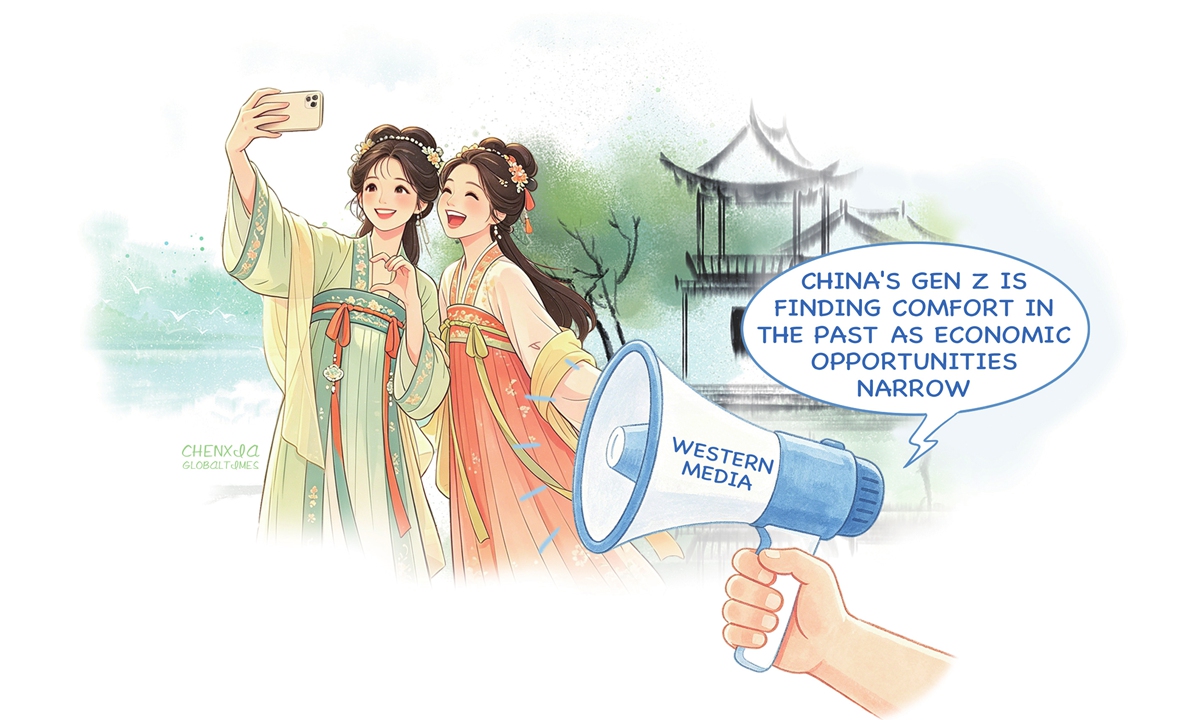
As members of China's Generation Z pose for photos in Hanfu at historic sites and share them on social media, they probably don't realize they have already been cast by some Western media into a "nostalgia script." In this narrative, they are portrayed as a "disillusioned generation" which has lost faith in the future and seek answers in the past.
A recent Bloomberg opinion column frames the Hanfu boom as a symptom of Chinese youth "finding comfort in an idealized version of the imperial era" amid the current economic uncertainties, even reducing Hanfu as a political tool used to promote sense of national greatness.
The interpretation is untenable. By that standard, US' Renaissance fairs, Europe's obsession with Greek mythology, and Japan's kimono culture should all be evidence of societies escaping into the past. Remarkably, Western media reserve this framing solely for China. In other context, it is recognized as cultural revival; in China, it is characterized as "nostalgia" precipitated by economic uncertainty .
Why are some Western media outlets so eager to pathologize an otherwise harmless cultural and consumer trend? Nie Shujiang, an associate professor at the Guangming School of Journalism and Communication of China University of Political Science and Law, told Global Times that this is simply the latest variation of a familiar Western doom-and-gloom narrative about China's economy - one shaped by its own self-imposed narrative framework.
It brings to mind the Greek myth of Procrustes's "iron bed," on which he compelled his victims to lie, stretching those who were too short and cutting down those who were too tall to fit. Similarly, these Western media outlets and observers try to put China on a Procrustean bed of Western narrative, chopping off what does not fit.
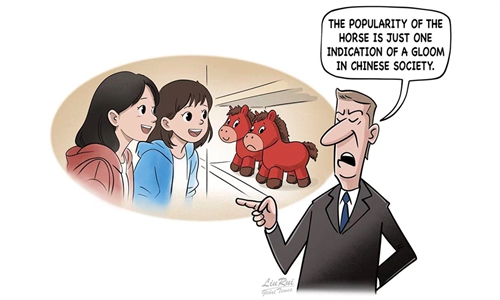
The new lifestyle of citywalk is labeled as a sign of consumer downgrading, while Chinese youth's love for trendy toys like crying horses are turned into symbols of frustration and anxiety. Now Hanfu has been drafted as the latest "evidence" that young Chinese are escaping into nostalgia because of a slowing economy. In this narrative, Chinese young people lose all agency in aesthetic preferences, consumption choices, and cultural interests. They are selectively trimmed, stretched, and repackaged until their behaviors fit a predetermined conclusion.
However, young Chinese choose to don Hanfu simply because they admire its beauty. The Hanfu boom doesn't reflect escapism, but Chinese youth's growing cultural confidence alongside China's economic development and rising living standards. Hanfu has evolved from a niche hobby into a nationwide booming industry. The trend shows that many young Chinese have shifted from chasing Western fashion trends to rediscovering and reimagining the aesthetics of their own culture and traditions. From public debates over intellectual property rights protection of mamianqun (horse-face skirt), to the phenomenal success of Black Myth: Wukong, to sharing Chinese aesthetics and the "becoming Chinese" lifestyle on overseas social media platforms, China's younger generations are reshaping their cultural identity and giving traditional culture renewed vitality.
More importantly, Hanfu itself has become one of China's fastest-growing consumer industries - a product of, rather than an escape from, China's economic development. From original design and textile production to styling, photography, e-commerce livestreaming and cultural tourism, an integrated value chain is creating jobs and fueling entrepreneurship. Driven by the evolving tastes and spending habits of China's youth, Hanfu is just one of many new products emerging from China's dynamic consumer market, underscoring the country's continuously renewing development momentum.
Reducing a phenomenon that embodies cultural revival, consumer innovation and industrial growth to "economic anxiety" or a "political tool" says less about Chinese youth than it does about the stale assumptions behind some Western media coverage.
Young Chinese are donning Hanfu in classrooms, workplaces and on the global stage not to retreat into the past, but to carry their culture into the future. The real nostalgia lies in the outdated lens through which some Western media continue to view China. Unless they rethink that perspective, the only ones going back in time will be themselves.
RELATED ARTICLES