Illustration: Liu Rui/GT
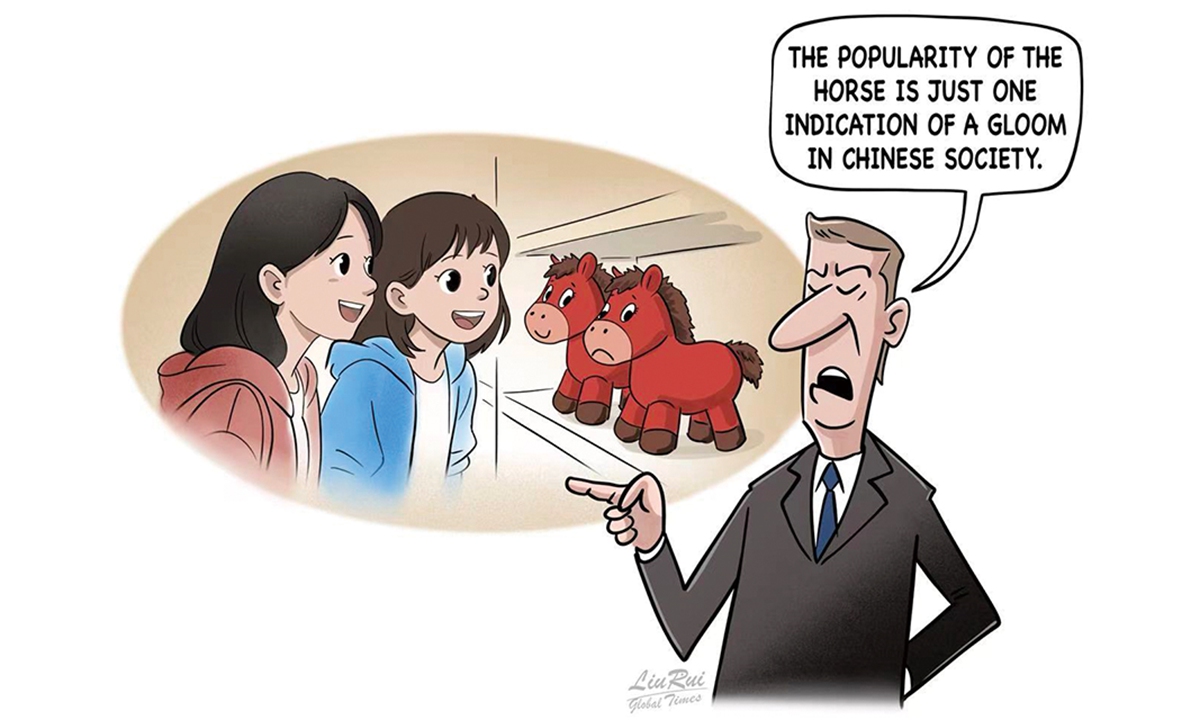
For China's youth, the "crying horse" plushie that recently went viral is a playful emblem; for a segment of the Western press, it has become a prop in a pre-written drama of economic decline and social pessimism.
Here is what's really happening in China. The "crying horse" was born from a happy accident - a factory worker sewed the smile upside down, leaving the toy looking adorably stubborn and unintentionally hilarious. This, in Chinese pop-culture terms, is what we call "emotional value." When a product delivers that kind of charm, it's bound to become a runaway hit.
Yet through the lens of some Western media, the narrative twists into something entirely different. They absurdly claimed they see an economic forecast from the stuffed horse. The New York Times and The Guardian hyped up the "workplace fatigue" and "the notorious 996 system." CNBC referred it to "one indication of a gloom in Chinese society".
It seems Western media outlets have been loading the Chinese economy and society with more dramatic weight than a "crying horse" could ever carry.
While some people in the West imagine a nation in sentimental slump, Yiwu's factories are humming along, exporting heaps of these "crying horses". On Chinese social media, a newest moody muse is already trending: An "angry bird" toy that needs no feeding - it's just there when you're upset; it may throw a tantrum, but here's the twist: it knows how to calm itself down. Chinese experts call this the rising momentum of the "emotion economy," illustrating how emotional fulfillment is increasingly becoming a key driver of the willingness for consumption, while also stimulating innovation and vitality on the supply side.
The persistent chasm between Western media portrayals and the authentic reality of the Chinese populace reflects a media ecosystem increasingly disillusioned with, or incapable of conveying, the nuanced reality of contemporary China. The West operates from a familiar playbook: conclusions first, evidence second. Their narrative framework - preloaded with tropes like "China's economic slowdown" and "societal confidence crisis" - forces reality into predetermined boxes. In this distorted lens, the subtlety of Chinese self-deprecating humor is mistaken for despair, while the vibrant culture of emotional consumption is misread as a symptom of social fragility. Such selective interpretation is not analysis; it is a deliberate exercise in narrative control, reflecting a long-standing habit of filtering China's complexity through the narrow aperture of Western discourse hegemony.
"Over the years, certain Western media outlets have consistently filtered China's story through a lens of stereotype and one-sidedness, overlooking the complexity, diversity, and inclusive progress of its development. Driven by ingrained bias, their coverage often seems less about reflecting reality and more about force-fitting facts into a predetermined narrative - one fixated on portraying China as a nation in decline," Nie Shujiang, an associate professor at the Guangming School of Journalism and Communication of the China University of Political Science and Law, told the Global Times on Wednesday.
Nie observed that as Chinese society grows more inclusive, the young generation has grown more self-assured - skillfully navigating their emotional landscape. The very act of turning serendipity into opportunity and emotion into consumption reflects the underlying resilience and latent potential of China's economy.
When the West starts from bias to prove bias, it creates a closed loop of reasoning. Any conclusion drawn in such an echo chamber is destined to be a self-fulfilling prophecy, utterly detached from the reality of China. When Western media churns out laments of China next time, the young Chinese will be sharing memes and buying the next viral "emotional must-have."