Philippines' provocations at multiple points in South China Sea show anxiety, craving for international attention: Chinese experts
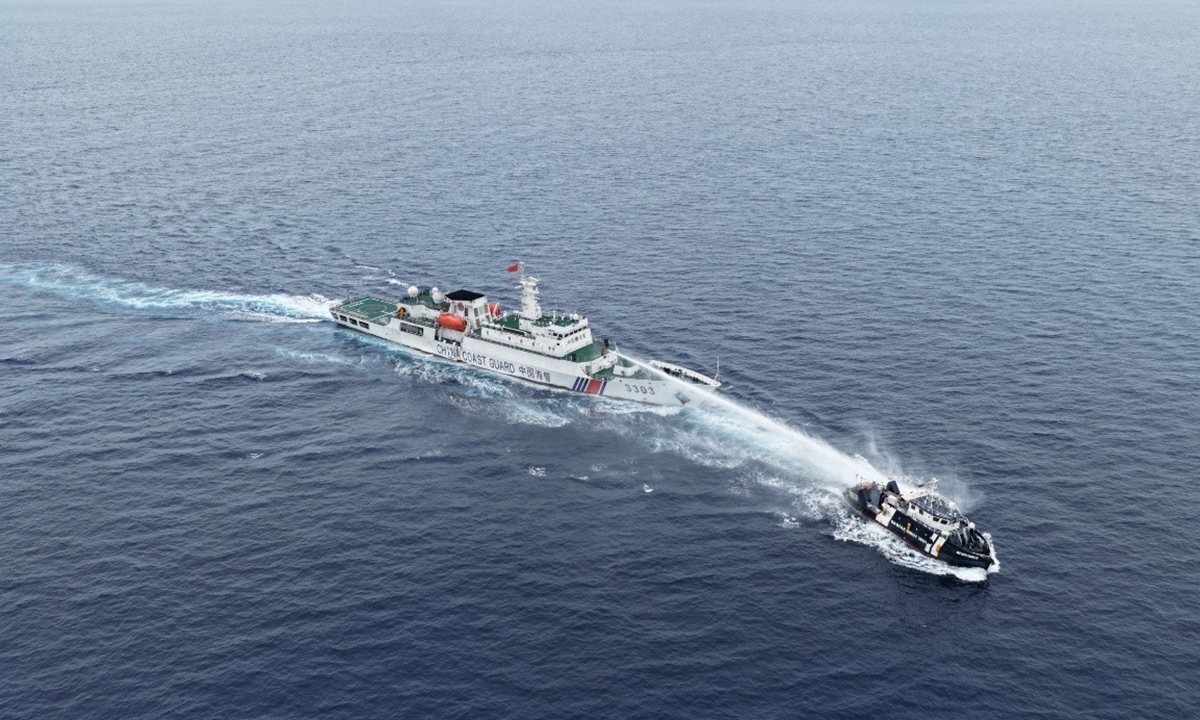
China Coast Guard vessel 3303 deploys water cannons on July 24, 2026, against Philippine public vessel MMOV 3001, which had intruded into China's Huangyan Dao waters, forcing the vessel to turn around and sail away from Huangyan Dao. Photo: Courtesy of China Coast Guard
Jiang Lue, spokesperson for the China Coast Guard (CCG), stated that the CCG on Friday took necessary countermeasures in accordance with the law against the Philippine rights-violation vessels. Chinese experts said that the Philippines is resorting to a tactic of "saturation incursions" that betrays its deep-seated anxiety. Lacking any prospect of gaining the upper hand through military means and having exhausted its arsenal of cognitive warfare tactics, Manila sees no other option but to orchestrate intense confrontations to generate media buzz and plead for attention on the international public opinion stage, experts added.
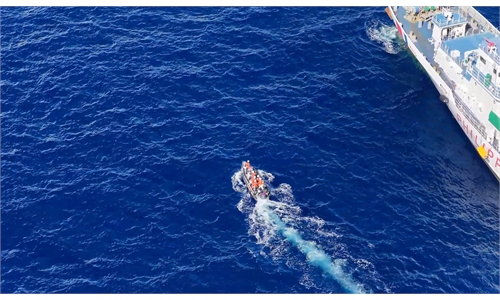
On Friday, the Philippine side organized seven public vessels, three coast guard ships and one fish transport ship, and egged on a large number of fishing boats to illegally assemble in the waters under China's jurisdiction at Huangyan Dao, Jiang said.
During this period, three Philippine public vessels - MMOV 3001, MMOV 3005 and MMOV 3017 - ignored repeated dissuasion and warnings from the CCG and obstinately intruded into the territorial waters of China's Huangyan Dao, Jiang added.
The CCG took necessary countermeasures in accordance with the law against the Philippine rights-violation vessels, including verbal warnings, blocking, and shooting water cannons, to resolutely expel them.
The Global Times learned that the Philippines harbored clear provocative intentions in this aggressive intrusion. Its vessel MMOV 3001 repeatedly charged at high speed into the 12-nautical-mile territorial waters surrounding China's Huangyan Dao. On-site footage obtained by the Global Times also shows this Philippine vessel was fitted with anti-collision padding, prepped for anticipated vessel collisions.
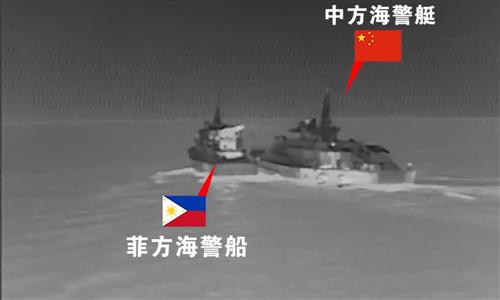
Also on the very same day, Philippine Coast Guard vessel 9701, which took part in the incursion, was repelled with water cannons by CCG vessel 5306. Sources told the Global Times that Philippine Coast Guard vessel 9701 deliberately closed in on CCG vessel 5306 in a blatant provocation and even maneuvered its stern directly toward the trajectory of CCG 5306's water cannons. After being repelled by water cannons, the Philippine ship swiftly turned and withdrew, leaving obvious traces of a deliberate staged provocation.
Yang Xiao, a research professor at the Institute of Peaceful Development under the Chinese Academy of Social Sciences, told the Global Times that footage from the scene proves that the Philippines' staged provocative incursion ended in failure. Yang said that is partly because China's response was unequivocal, resulting in any breach of the red line triggering immediate and forceful action, and partly because China's law enforcement presence on the scene is both ample and has gone through thorough preparations.
Spokesperson Jiang said that following its violent assault on CCG law enforcement personnel at Ren'ai Jiao on Monday, the Philippine side has, for two consecutive days, sent ships to intrude into the waters under China's jurisdiction at Huangyan Dao. It is stirring up troubles at multiple points in the South China Sea and deliberately making provocations, which seriously violates China's sovereignty and maritime rights and interests, and severely undermines peace and stability in the South China Sea, Jiang added.
Chen Xiangmiao, a research fellow at the National Institute for South China Sea Studies, believed that the Philippine military is currently gripped by acute attention anxiety as the Philippines' provocative ploys follow a rigid, predictable pattern, and its rhetoric targeting China is repetitive and formulaic. This series of moves has seriously eroded the credibility of the Philippine government and created a sense of "visual fatigue" in international public opinion, Chen said.
To grab headlines and sustain public attention, the Philippine military has no choice but to deploy its servicemen and so-called fishermen to the frontlines of provocation, urging them to act more aggressively, Chen said.
"This is the only way for Manila to stir up buzz and keep the spotlight on itself - consolidating its domestic narrative clout while soliciting more external backing," said Chen, adding "this partly explains the Philippine military's extraordinary belligerence as of late."
"We caution the Philippine side to immediately stop its rights-violation and provocative acts. Otherwise, the Philippine side shall bear responsibility for all consequences arising therefrom. The CCG will continue to carry out rights-protection and law-enforcement operations in accordance with the law in the waters under China's jurisdiction, and resolutely safeguard China's territorial sovereignty and maritime rights and interests," Jiang said.
RELATED ARTICLES