Tomato paste not spared: Australian media's latest well-rehearsed political performance
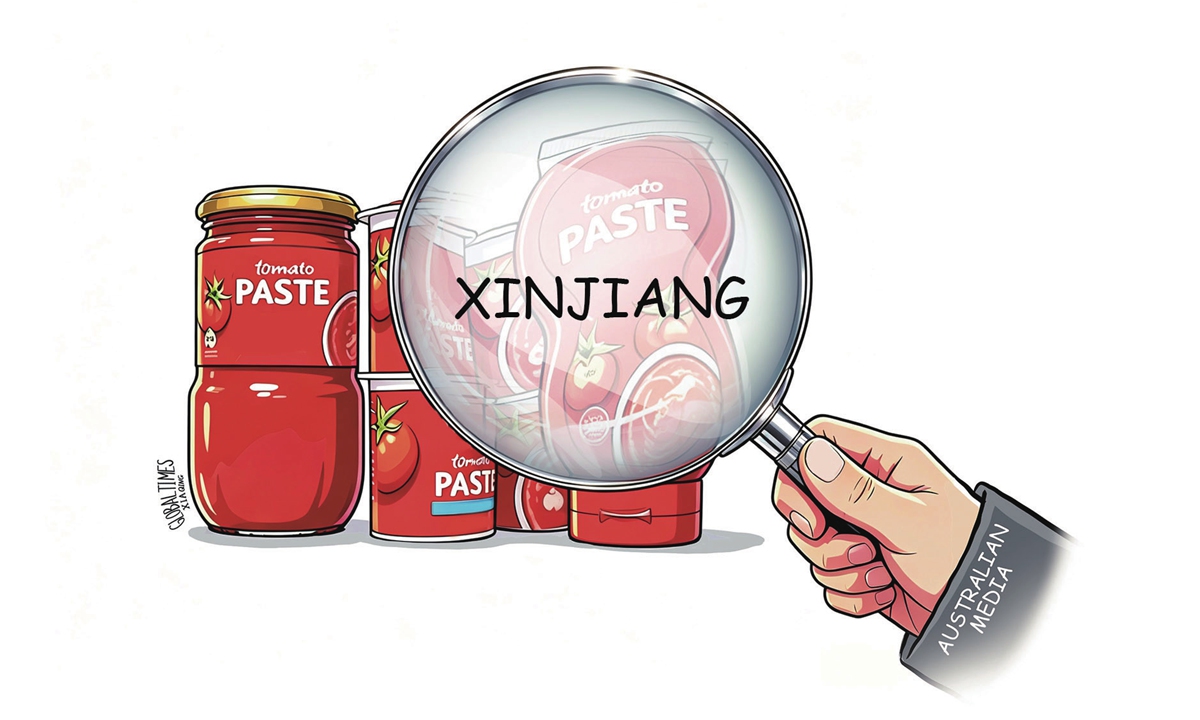
Illustration: Xia Qing/GT
Apparently, in parts of the Australian media, even a jar of tomato paste now requires a geopolitical security clearance.The Australian Broadcasting Corporation's (ABC) latest Four Corners programme began with what could have been a legitimate investigation into food labelling, but soon converted an ordinary question of commercial compliance into another ideological attack on China. When laboratory tests suggested that some tomato products sold in Australia might contain ingredients from China, and possibly from its Xinjiang region, the programme appeared unable to resist the temptation to turn a supermarket issue into a political spectacle.
If any producer or retailer has falsely described the origin of a product, Australian regulators should conduct an investigation, then impose penalties where violations are established. However, that regulatory issue is entirely different from the political narrative that ABC attempted to attach to Xinjiang.
The programme's laboratory testing was designed to identify the probable geographical origin of tomatoes by examining trace elements and stable isotopes. Such analysis may offer information about soil, water and growing conditions, but it cannot reveal employment relationships, working arrangements or the social circumstances behind production. Nevertheless, ABC moved rapidly from a claim about geographical provenance to insinuations concerning "forced labor," relying on familiar allegations spread by anti-China figures who have long been manufacturing hostility toward Xinjiang. No credible evidence was presented to show that the tested tomato products had any connection with coercive employment practices.
What ABC's reporting revealed was a broader and more disturbing tendency: Xinjiang itself has been transformed into an "accusation," which means that any cotton, tomato, solar component or manufactured product associated with the region can be portrayed as "questionable" without the accuser having to prove anything.
The report simply placed the word "Xinjiang" next to the phrase "forced labor" and expected viewers to complete the accusation themselves. This technique allows insinuation to do what evidence cannot, while giving the broadcaster room to pretend that it is merely raising questions.
The allegation of widespread "forced labor" in Xinjiang is a groundless political fabrication. It has been assembled through distorted reports, falsified testimonies, selective interpretation and the repeated claims of anti-China elements operating within a well-funded political campaign.
The Xinjiang region has natural conditions suitable for tomato cultivation, together with an extensive agricultural processing industry and an increasingly mechanised production system. Its position as a major tomato-producing area is the result of geography, investment and industrial development, none of which proves abuse. Yet Australian audiences are encouraged to believe that an agricultural product carries political "question" simply because it may have been grown there.
These double standards could hardly be clearer. Australian and European agricultural regions are not automatically placed under any suspicion. Their farmers are not required to prove their innocence every time their produce enters an overseas market. Western media has effectively invented a special rule under which the name of the region is considered sufficient evidence for "condemnation."
This campaign has purposes extending far beyond human rights. By associating products from Xinjiang region with groundless allegations, Western political forces can obstruct trade, pressure companies to abandon Chinese suppliers and weaken industries in which China has become internationally competitive. The language of morality helps conceal an agenda of economic containment. Once a Chinese product becomes successful, an ethical accusation is often not far behind.
Australian media has become remarkably practized at this form of geopolitical storytelling. A question involving trade is reframed as a security threat, a regulatory dispute is inflated into an ideological confrontation, and a jar of tomato paste becomes another exhibit in the smearing of China. The political conclusion comes first, while facts are selected and arranged afterwards. This approach may create dramatic television, but it does little to inform the public.
Australian consumers deserve honest product labels, and any proven violation should be dealt with according to the law. They also deserve honest journalism that distinguishes verifiable facts from politically manufactured accusations.
A tomato may contain a chemical fingerprint that suggests where it was grown. It does not contain evidence of "forced labor," nor does it carry the political guilt that some Australian journalists are so eager to paste onto Xinjiang. When geography itself is presented as proof of wrongdoing, journalism has ceased to investigate reality and fallen into a manufacturer of prejudice.
The author is director of the Asia Pacific Studies Centre at East China Normal University. opinion@globaltimes.com.cn
RELATED ARTICLES