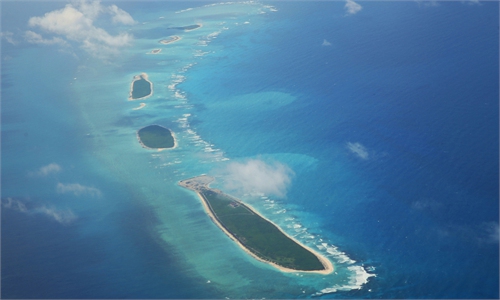
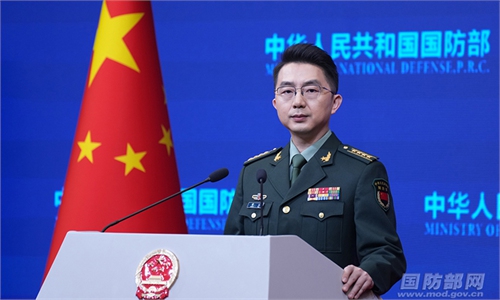
Chinese expert slams Marcos’ speech defending illegal ‘SCS arbitration’ as political grandstanding covering for unilateral provocations
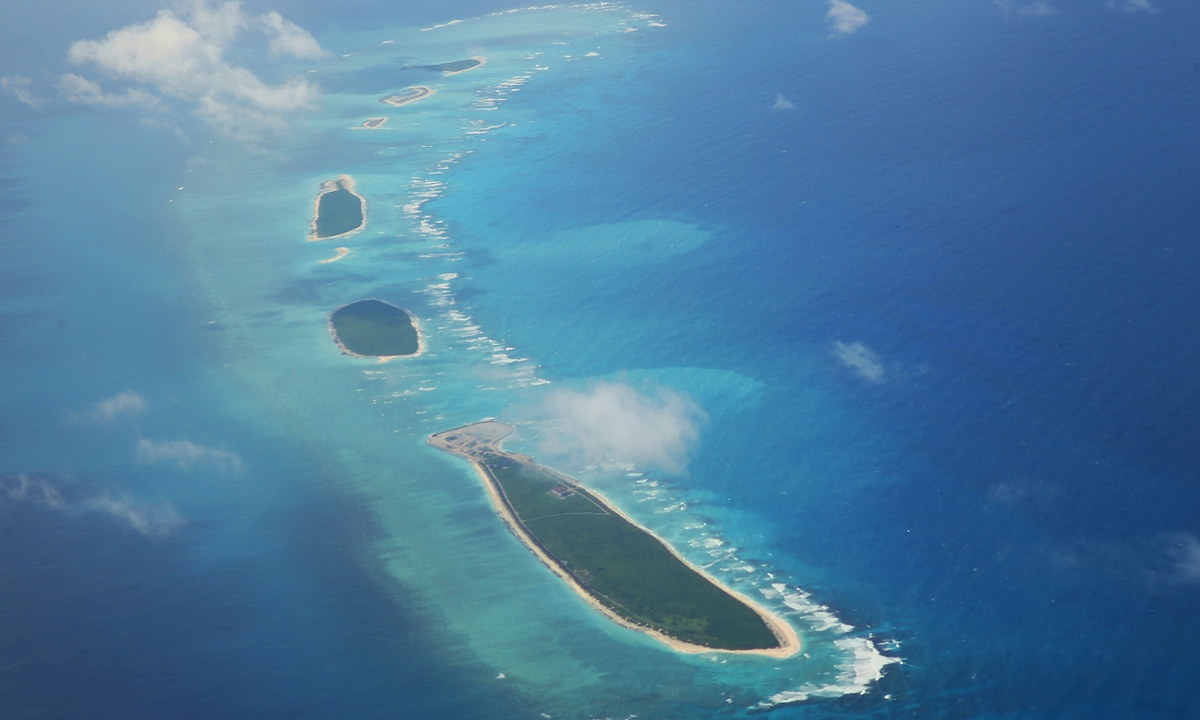
South China Sea Photo: VCG
Just days after the Philippines' deliberate provocations at multiple points in the South China Sea, Philippine President Ferdinand Marcos Jr. claimed in his state of the nation speech on Monday that Manila will defend the so-called "South China Sea arbitration award." A Chinese expert said on Tuesday that the Philippines constantly hypes the so-called "ruling" in an attempt to provide flimsy cover for its unilateral maritime provocations, amounting to nothing but political grandstanding.
According to AP, Marcos claimed that the "ruling" was a "definitive benchmark for the interpretation and application" of the 1982 UN Convention on the Law of the Sea, which was the basis of the decision, the report said.
The Philippine president also claimed that his government "will do all that is necessary to continue upholding this award" and that Filipinos "do not yield."
In his fifth State of the Nation Address (SONA), Marcos also presented a roadmap for the remaining two years of his term centered on accountability, economic transformation, social protection, food and energy security, education, and the defense of Philippine sovereignty, according to the Philippine News Agency.
Marcos' claim came days after the Philippines' deliberate provocations at multiple points in the South China Sea. Jiang Lue, spokesperson for the China Coast Guard (CCG), said in a statement on Friday, "We caution the Philippine side to immediately stop its rights-violation and provocative acts. Otherwise, the Philippine side shall bear responsibility for all consequences arising therefrom."
Chen Xiangmiao, director of the World Navy Research Center at the National Institute for South China Sea Studies, told the Global Times on Tuesday that by harping on this so-called "arbitral award," the Philippines is attempting to fabricate a flimsy justification for its unilateral and provocative maritime actions. Manila keeps hyping the supposed validity of the "ruling," all in a bid to win sympathy abroad and portray itself as a law-abiding defender of the international order.
Chen noted that Marcos' reference to the so-called "arbitral award" in his SONA a decade after the one-sided award was issued amounts to nothing more than grandstanding staged for both the international community and the domestic audience in an effort to project a tough stance.
According to AP, Marcos did not mention China by name or elaborate on his criticism of Beijing, which the US media outlet described as a "veiled rebuke."
"The rather vague wording may reflect the Philippines' conflicting mindset: while it seeks to project toughness and stir up tensions with China over the South China Sea, it cannot afford to sever ties with China, as it relies heavily on Chinese markets and cooperation to fuel its economic growth," Chen said.
The expert noted that the Philippines may face additional pressure in this delicate balancing act as the current ASEAN chair, since other ASEAN members may worry that Manila's aggressive maritime moves will affect broader China-ASEAN relations.
China has repeatedly stated that the so-called "award" is illegal, null and void, and non-binding. At a regular press conference on July 10, Chinese Foreign Ministry spokesperson Mao Ning stressed that China neither accepts nor recognizes the "award" and will never accept any claim or action arising from it.
China and ASEAN member states have agreed to formulate a Code of Conduct in the South China Sea (COC). This is part and parcel of implementing the Declaration on the Conduct of Parties in the South China Sea (DOC). China is committed to working with ASEAN countries to accelerate consultations toward the early conclusion of the COC and keep the South China Sea peaceful and stable, she said.
The "award" has absolutely no relevance to the COC. The Philippines must not obstruct the COC process with the phony "award," the spokesperson stressed.
RELATED ARTICLES