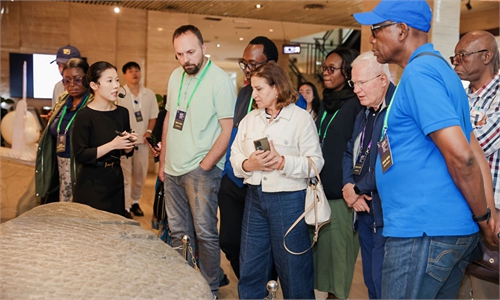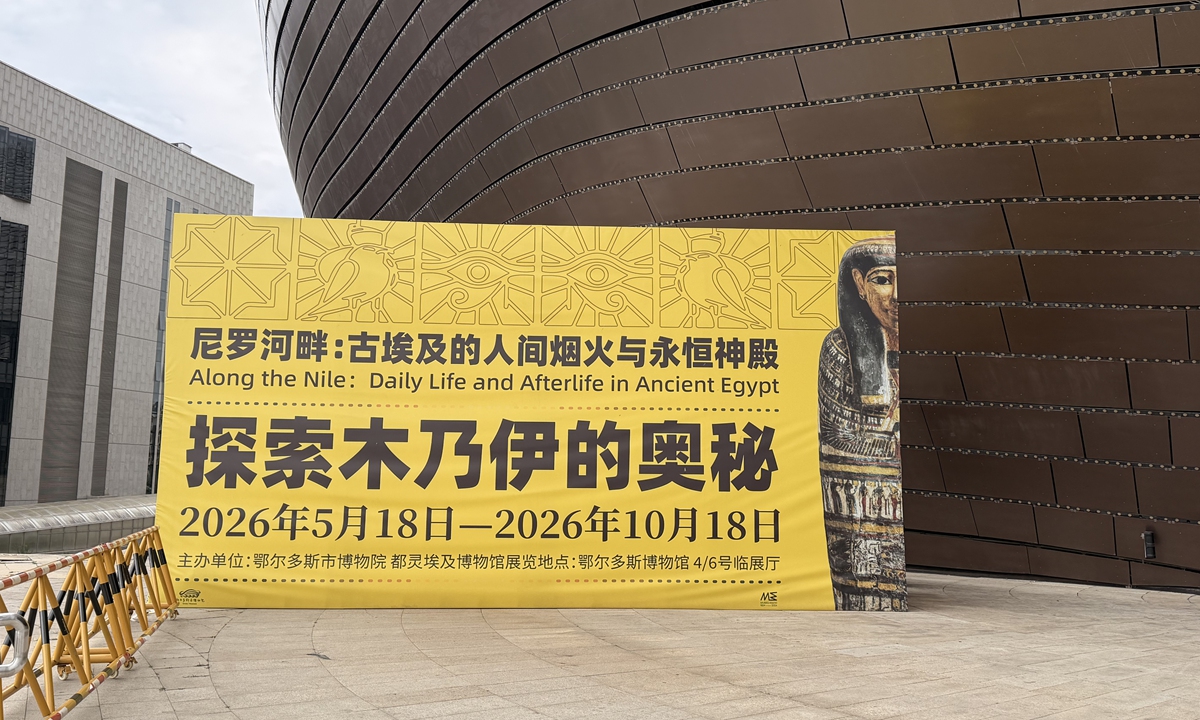
The exhibition "Along the Nile: Daily Life and Afterlife in Ancient Egypt" at the Ordos Museum in North China's Inner Mongolia Autonomous Region. Photo: Su Yaxuan/GT
I recently stepped into my hometown's municipal museum, Ordos Museum in North China's Inner Mongolia Autonomous Region, to visit the special exhibition "Along the Nile: Daily Life and Afterlife in Ancient Egypt." There I witnessed a cross-civilizational encounter that had traveled thousands of miles.Jointly curated by the Ordos Museum and the Museo Egizio - the world's oldest Egyptian museum with a history of over two centuries - the exhibition brings together 178 precious ancient Egyptian artifacts. Over its five-month run, this northern Chinese city has become a stage where the civilizations of the Nile and the Yellow River engage in a silent yet profound dialogue.
I was surprised to know that such an exhibition on ancient Egypt could be held in my hometown. I had long assumed that international exhibitions of ancient civilizations were largely confined to major cities like Beijing or Shanghai. Yet here they were - millennia-old relics from the Nile crossing continents and oceans to enter a small northern city in China. It made me realize that interest in Egyptian culture has expanded beyond academic circles or big urban centers in China. Exchanges and mutual learning between ancient Chinese and foreign civilizations are taking root across the country.
Inside the exhibition hall, mummies, temple statues, and inscribed stone steles stood in quiet display, each carrying the weight of history. Many visitors slowed their pace, observing carefully and reading each piece with attention. During the visit, I met a local middle school English teacher who was enthusiastically explaining the exhibits to strangers. He told me he had been fascinated by ancient Egyptian culture since his school days - the myths of that civilization had long accompanied him. Today, that passion has become part of his teaching. He incorporates stories of ancient Egypt into his lessons, using images of pyramids, the Nile, and hieroglyphs to bring language classes to life.
"Many students become curious about Egypt after my classes," he told me. Some begin researching ancient Egyptian history on their own, while others quietly develop a dream of visiting Egypt one day - to see in person what they have encountered in textbooks and classrooms. For them, this is more than just expanding knowledge; it is the beginning of a genuine connection with a distant civilization. Such cultural exposure plants seeds of understanding between two ancient cultures in the hearts of the younger generation.
I was also struck by a couple who had traveled all the way from Xi'an, Northwest China's Shaanxi Province, just to visit the exhibition. As dedicated enthusiasts of ancient Egyptian civilization, they had already visited Egypt and seen the pyramids firsthand. They also make it a point to attend similar exhibitions across China.
Reflecting on their passion, they shared a thoughtful perspective: "Both China and Egypt are ancient civilizations nurtured by great rivers, with thousands of years of history and world-renowned cultural heritage." In their view, the growing number of Egyptian-themed exhibitions across Chinese cities is deeply meaningful. "There are more and more Egypt enthusiasts in China. People are not just driven by curiosity - they are comparing two ancient civilizations to better understand history and respect cultural diversity."
This heartwarming cross-civilizational encounter in an ordinary Chinese city perfectly embodies the vision of the Global Civilization Initiative proposed by China. Rooted in the principles of equality, mutual learning, dialogue and inclusiveness among civilizations, the initiative advocates the respect for the diversity of civilizations, the common values of humanity, the importance of inheritance and innovation of civilizations, and robust international people-to-people exchanges and cooperation.
No civilization on earth is superior to others, and diversity constitutes the fundamental charm of human civilization. Civilizations thrive through exchanges and progress through mutual learning. The frequent cultural exchanges between China and Egypt set a fine example for global civilizational interaction. As two time-honored civilizations that have nourished humanity for millennia, China's Yellow River civilization and Egypt's Nile civilization carry unique historical memories and cultural genes. Rather than remaining isolated or competitive, they resonate and complement each other through equal dialogue. Such grassroots, people-centered cultural activities break geographical and temporal barriers, turn state-level cultural cooperation into tangible public experience, and make civilizational mutual learning accessible to ordinary people.
Each artifact in the exhibition hall in my hometown has endured millennia of wind and sand and traveled vast distances. They transcend geography and time, becoming gentle bridges of dialogue between civilizations. This small-city exhibition brings together scholars' dedication, educators' passion, and the public's curiosity - allowing two great civilizations to meet, understand, and resonate with one another. People admire the brilliance of distant civilizations while rediscovering the richness of their own. Through comparison and shared resonance, the diversity and coexistence of human civilizations become clearer.
This encounter across thousands of miles vividly illustrates the profound bond between China and Egypt. From scholarly exploration to public enthusiasm, and from youthful curiosity to shared admiration, ancient civilizations find new vitality through exchange and mutual appreciation. This resonance across time and space transcends distance and geography, becoming a gentle yet resilient bond that brings the two peoples closer and keeps their civilizational ties alive - allowing these ancient cultures to shine ever more brightly in the modern world.
Going forward, guided by the Global Civilization Initiative, China will continue to support more inclusive, grassroots, and diversified cross-civilizational activities, enabling different cultures to communicate freely, learn from each other, and flourish together. In an era of profound global changes, continuous civilizational dialogue and mutual learning will surely consolidate global solidarity, inject lasting vitality into human progress, and build a more harmonious and interconnected world for all humanity.
The author is a reporter with the Global Times. The article was originally published in Egyptian media Sout Al Omam. suyaxuan@globaltimes.com.cn
RELATED ARTICLES