China’s Unitree Robotics flags risks to future US sales under FCC restrictions; barriers can’t erase firm’s competitiveness: expert
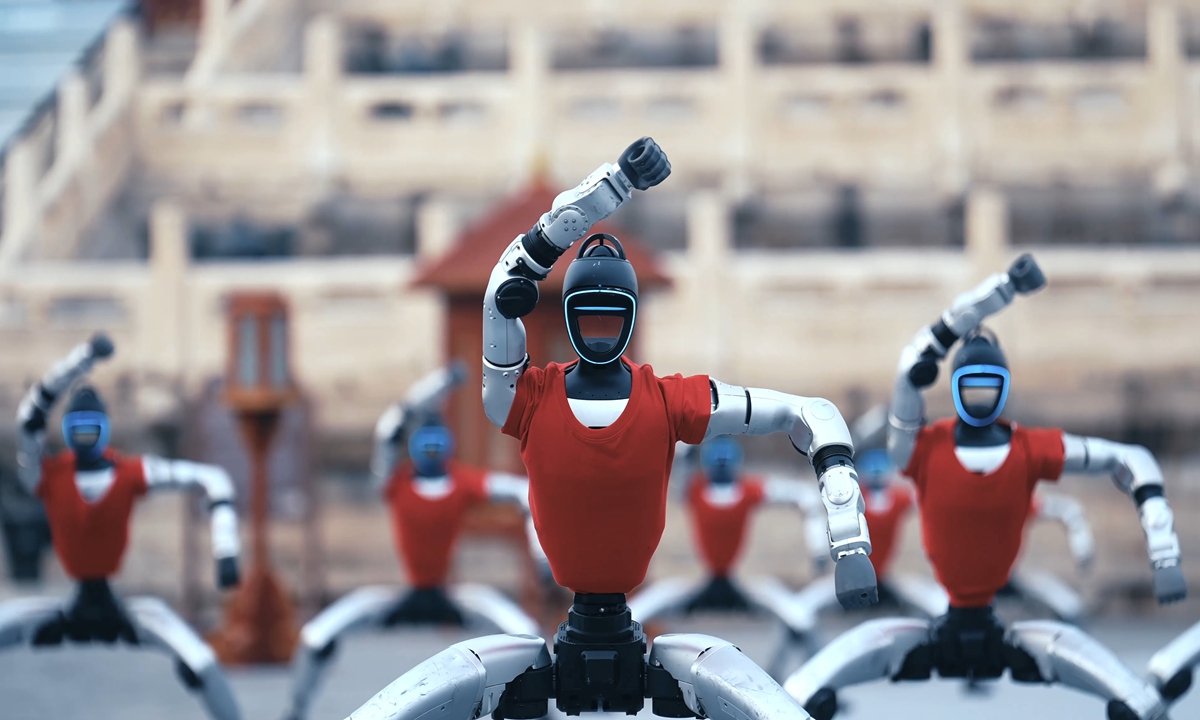
Unitree's G1 humanoid robots performe a synchronized martial arts demonstration in front of the Hall of Prayer for Good Harvests at the Temple of Heaven in Beijing. Photo: Screenshot of Unitree's video clip
Chinese robotics company Unitree Robotics on Friday warned that its future robot models could be unable to enter the US market under new restrictions imposed by the US Federal Communications Commission (FCC), while stressing that its existing major products remain authorized for sale.
While the US restrictions may erect barriers to the US market, they cannot erase the competitiveness Chinese robotics companies have built through technological innovation, supply-chain strength and rapid commercialization in the long-run, Chinese analysts said. They also warned that the restrictions could backfire by slowing US robotics research and development.
Unitree's warning, contained in its updated IPO prospectus, came as the company entered the final stage of its listing on the Shanghai Stock Exchange's STAR Market, with preliminary price consultations scheduled for August 5 and subscriptions set to open on August 10.
Since 2025 in particular, shifts in US tariff policies on foreign goods have heightened uncertainty in international trade and overseas business conditions, the company said in the prospectus.
The FCC on Tuesday added foreign-produced advanced robotic devices and power inverters to its Covered List. Under the new policy, new models of advanced robots produced outside the US will, in principle, be unable to obtain the FCC equipment authorization required to enter the US market unless they qualify for a specific exception or receive conditional approval, Unitree said in the prospectus.
Previously authorized models may continue to be sold in the US under the latest policy, the company said.
Unitree's major products currently on sale - including the G1, H2 and R1 humanoid robots and the Go2, B2 and A2 quadruped robots - have all received FCC authorization and fall within the category of advanced robotic devices covered by the announcement. The policy change therefore does not currently affect the continued sale of these products in the US market, according to the prospectus.
The restrictions, however, create uncertainty for Unitree's next generation of products. New robot models developed by the company could be barred from sale in the US, if they fail to obtain a specific exemption or conditional approval, Unitree warned.
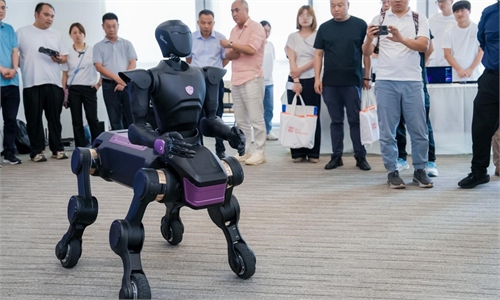
Unitree is a global frontrunner in commercializing high-performance legged robots. Its portfolio spans humanoid and quadruped robots, components and embodied-AI models, with humanoid shipments ranking first worldwide in 2025, according to the company.
In the prospectus, the company also pointed to the risk of further policy tightening. If the FCC were to revoke authorizations for products currently on sale or extend the restrictions to previously authorized robot models, Unitree's existing products could also lose access to the US market.
Overseas markets contributed more than 40 percent of Unitree's revenue in each of the three reporting periods, while the US share declined from 18.39 percent and 19.54 percent in the first two periods to 13.30 percent in the latest period.
Liu Gang, chief economist at the Chinese Institute of New Generation Artificial Intelligence Development Strategies, told the Global Times on Friday that Unitree's robots have gained traction overseas and have increased their global competitiveness.
"The restrictions could create real uncertainty for Unitree's future sales in the US, but they affect market access rather than the company's underlying technological capabilities and long-term competitiveness," Liu said.
Although the FCC's announcement on Tuesday did not single out China, Reuters reported that the measures target imports of new Chinese robots and power inverters and, citing four sources, said many non-Chinese suppliers are expected to be exempted, as under recent restrictions on foreign drones and routers.
China firmly opposed the latest restrictions. A spokesperson for China's Ministry of Commerce (MOFCOM) said on Thursday that although the FCC measures were presented as "non-discriminatory," they in fact discriminated against and suppressed Chinese companies and products.
The MOFCOM spokesperson said that China urges the US to immediately withdraw the measures and stop its erroneous practices. "If the US persisted, China would take resolute countermeasures to safeguard its legitimate rights and interests," the spokesperson added.
China's robotics industry benefits from a wide range of applications, a strong manufacturing base and a deep pool of engineering talent, Liu said, adding that these strengths help turn research breakthroughs into market-ready products, underpinning the industry's growing strength.
Restricting advanced, cost-effective Chinese robots could raise costs and slow robotics research and applications in the US, Liu said.
Unitree is entering the final stretch of its STAR Market listing. The company plans to issue 40.446434 million shares, or 10 percent of its enlarged share capital, through strategic placement, offline price inquiry and placement, and an online fixed-price offering. Successful subscribers are required to make payment on August 12.
Unitree plans to direct IPO proceeds toward four projects with a combined planned investment of 4.2017112 billion yuan: intelligent robot model research and development, robot hardware research and development, new intelligent robot product development, and the construction of an intelligent robot manufacturing base.
The projects will support continued technological innovation and an expansion of the company's production and operations, the company said.
Unitree's steady progress toward a listing shows that market confidence in its growth prospects remains strong despite external restrictions, as China's vast domestic market and diversified demand from overseas markets beyond the US will provide ample room for continued growth, Liu said.
RELATED ARTICLES