New ‘new three’ become China’s new calling card as nation advances Chinese modernization
By Published: Jul 31, 2026 11:09 PM

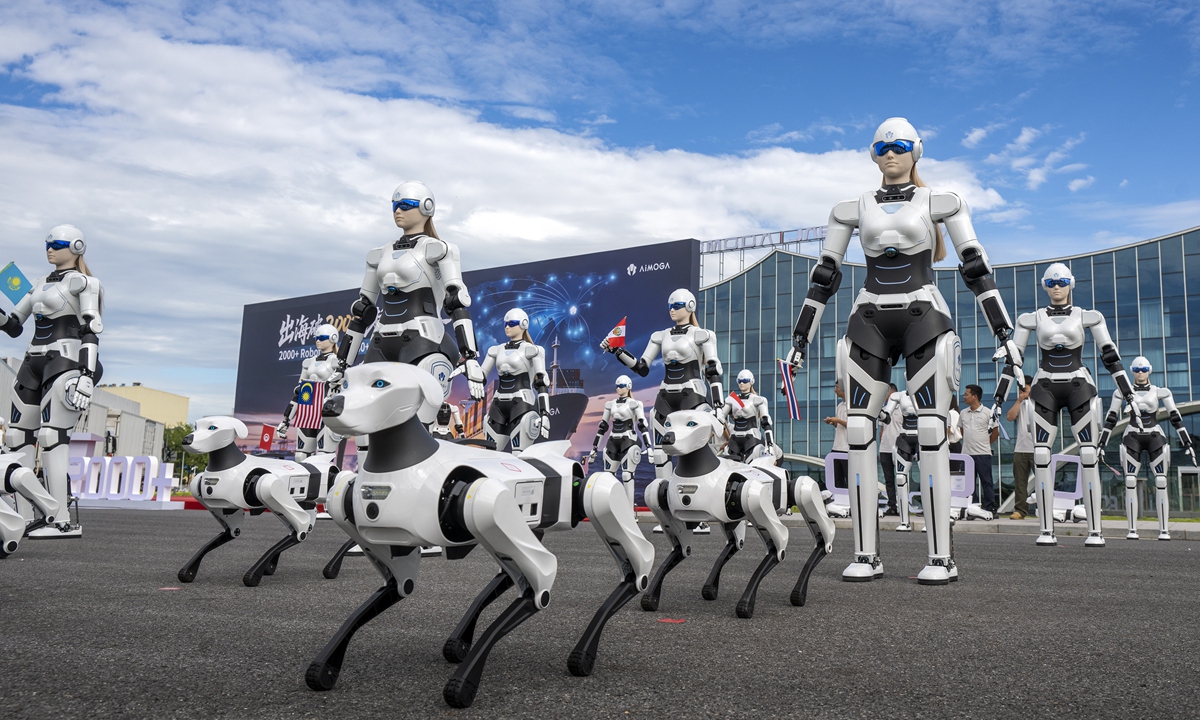
Robots produced by Chinese robotics company AiMOGA wait to be exported to Malaysia on July 30, 2026 in Wuhu, East China's Anhui Province. China's robotics sector saw rapid development in the first half of this year, as the country developed more than 400 complete humanoid robot products, accounting for more than half of the world's total, official data showed. Photo: VCG
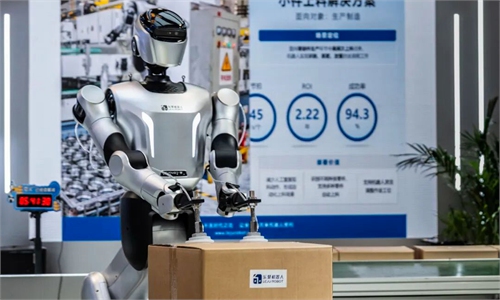
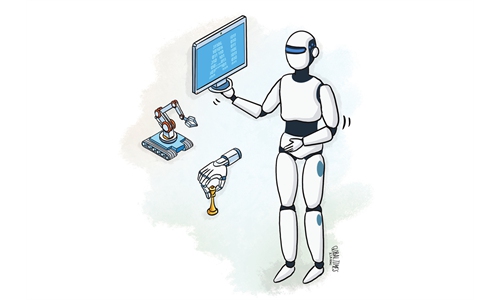
From the "old three" exports of clothing, furniture, and appliances, to the "new three" of electric vehicles, lithium batteries, and solar cells, China's industrial evolution has now entered a new era defined by its newest industrial champions: robotics, artificial intelligence (AI), and innovative drugs. These sectors have firmly established themselves as the new "new three," reflecting not only the continued growth in China's innovation capacity but also the accelerated iteration of its industrial system.
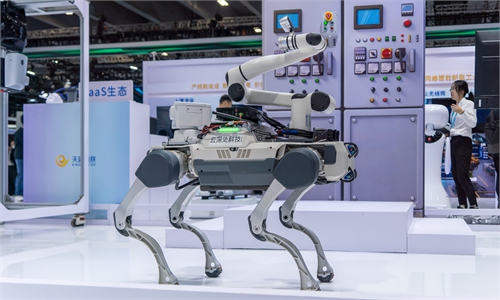
This momentum was unmistakable in the first half of 2026. According to data released by the Ministry of Industry and Information Technology on July 20, China-developed quadruped robots accounted for nearly 70 percent of global sales during the period, while cumulative global downloads of China's open-source AI models surpassed 10 billion.
This surge is backed by a series of landmark breakthroughs: humanoid robots setting a new half-marathon record this April, world's first global mass production of T1200 ultra-high-strength carbon fiber, and the release of the Kimi K3 open-source large model. Together, these three industries are shaping the future of the Chinese economy, serving as strategic pillars for national core competitiveness, public well-being, and the intelligent manufacturing transformation.
However, to understand why China is succeeding in the intelligent economy, one must look beyond the algorithms themselves and examine the ecosystem that enables these technologies to take root and scale.
The first advantage lies in the deep coupling of market depth and scenario diversity. With a population of 1.4 billion and the world's largest middle-class cohort, China pairs its most comprehensive industrial system with extraordinarily complex use cases spanning manufacturing, agriculture, and public administration. This arguably creates the world's most fertile proving ground for AI applications - a place where promising prototypes can be stress-tested and scaled at a speed few other markets can match.
Complementing this is a foundation of solid infrastructure. China's lead in digital infrastructure, including 5G coverage, data centers, and Internet of Things networks, is already well established. What is newer and equally significant is the rapid buildout of next-generation assets: intelligent computing clusters and integrated energy-compute facilities. This significantly lowers the cost of turning research into real-world deployment.
Furthermore, decades of digitization across government services, industry, and consumer platforms have generated an unparalleled reservoir of structured and unstructured data. In an economy increasingly driven by machine learning, this data is not merely an input; it is the fuel that powers every iteration and upgrade.
Finally, institutional coordination also plays crucial role. Rather than leaving outcomes to chance, China has laid out a coherent, multi-layered framework encompassing R&D incentives, industrial deployment, infrastructure investment, and governance guardrails. The result is a policy environment in which experimentation is encouraged and setbacks can be absorbed, creating a feedback loop of "learning by doing and innovating by applying."
As the 15th Five-Year Plan (2026-30) places building a modern industrial system at the top of the national agenda, the vigorous growth of new quality productive forces is profoundly reshaping China's economic driving structure.
By maintaining the strategic focus on expanding domestic demand, fostering technological innovation, and harnessing its combined strengths in institutional capacity, market scale, industrial chains, and its talent pool, China is well positioned to seize the strategic initiative amid external headwinds. Advancing steadily along the path of high-quality development, China is not only strengthening the material and technological foundation for achieving its 2035 long-term goals and advancing national rejuvenation, but also creating a platform for global innovation cooperation.
According to data released by Chinese customs authorities, the country exported 9.36 trillion yuan ($1.38 trillion) worth of high-tech and high-value-added mechanical and electrical products, an increase of 20.1 percent, with these products accounting for more than 60 percent of its total exports.
At the 2026 World Artificial Intelligence Conference, China emphasized that AI development should not be a solo performance by any one country, but a symphony of international cooperation. China has also pledged to offer developing countries 5,000 AI programs training and seminar opportunities in the next five years. China will also provide 30 countries with access to the AI-powered meteorological early-warning system, known as MAZU, to safeguard homes around the world.
These concrete commitments reflect China's broader philosophy: cutting-edge advances, including the new "new three," should not be confined by national borders. The new "new three" are not merely products of China; they represent the opportunities for the world. The history of global industrial competition has repeatedly shown that isolation breeds stagnation, while open innovation offers the only path forward.
This article is compiled based on an interview with Zhang Hui, dean of the School of Economics at Peking University. bizopinion@globaltimes.com.cn
RELATED ARTICLES