A fantasy of occupation: Manila’s illegal delimitation of so-called ‘baselines of territorial sea’ for Huangyan Dao
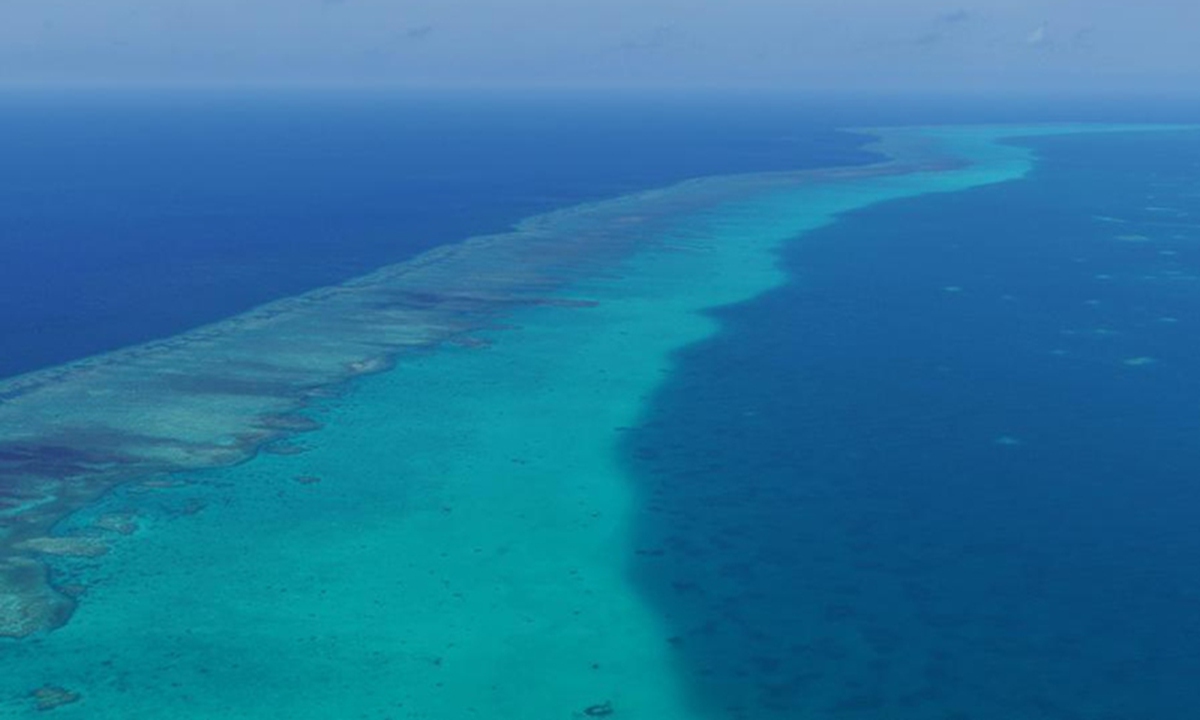
An aerial drone photo taken on May 2, 2026 shows reefs in the territorial waters of China's Huangyan Dao in the South China Sea. (Xinhua/Chen Bin)
The Philippines, disregarding China's consistent position on sovereignty over Huangyan Dao and its maritime rights and interests, unilaterally announced the delimitation of the so-called "baselines of the territorial sea" for China's territory of Huangyan Dao, and claimed that it had deposited relevant documents with the United Nations (UN) Secretariat on Friday. In response, China's Ministry of Foreign Affairs promptly issued a stern statement, pointing out that Manila's move is a grave infringement upon China's territorial sovereignty, which is illegal, null and void, and will be firmly rejected by China. The ministry also criticized the Philippines for deliberately escalating maritime tensions and undermining peace and stability in the South China Sea.
It is clear that Huangyan Dao is China's inherent territory, and China is the only country entitled to declare the territorial sea baselines of Huangyan Dao in accordance with international law. The Philippines' insistence on announcing the so-called "territorial sea baselines" of Huangyan Dao is not only an illegal infringement upon China's territorial sovereignty and maritime rights and interests, but also a serious violation of international law and the basic norms governing international relations. The Philippines' attempt to realize its fantasy of "occupying" Huangyan Dao by drawing baselines is destined to remain nothing more than a pipe dream.
Huangyan Dao is China's inherent territory, and the Philippines' territorial claim over it has no historical or legal basis. China has indisputable sovereignty over it and its adjacent waters, and has continuously, peacefully and effectively exercised sovereignty and jurisdiction over Huangyan Dao. In fact, prior to its interference with an international amateur radio project approved by China in 1997, the Philippines had never raised any territorial claims over Huangyan Dao. Since then, driven by its own interests, the Philippines has attempted to advance illegal territorial claims over Huangyan Dao through various means, including issuing occupation-related statements, presidential decrees, constitutional amendments and legislation.
The legal scope of Philippine territory was clearly defined by a series of effective international treaties. According to the 1898 Treaty of Peace between the United States of America and the Kingdom of Spain, the 1900 Treaty between the United States of America and the Kingdom of Spain for Cession of Outlying Islands of the Philippines, and the 1930 Convention between His Majesty in Respect of the United Kingdom and the President of the United States regarding the Boundary between the State of North Borneo and the Philippine Archipelago, the western limit of the Philippine territory is 118 degrees east longitude line. Huangyan Dao lies beyond this boundary and has never been part of Philippine territory. The Philippines' so-called claim has neither historical grounds nor legal support.
The Philippines' move constitutes an internationally wrongful act and produces no legal effect under international law. Its unilateral announcement of so-called "baselines of the territorial sea" of Huangyan Dao is in complete violation of international law, including the UN Charter and the United Nations Convention on the Law of the Sea (UNCLOS), and has no legal effect. Under international law, including UNCLOS, only the sovereign state of a given territory has the right to declare territorial sea baselines for islands and reefs. Therefore, China is the only country entitled to declare the territorial sea baselines of Huangyan Dao in accordance with international law.
China's sovereignty over Huangyan Dao has a long historical foundation. On November 10, 2024, the Chinese government delimited and announced the baselines of the territorial sea adjacent to Huangyan Dao in accordance with the Law of the People's Republic of China on the Territorial Sea and the Contiguous Zone. On December 2 of the same year, China deposited relevant statements and charts with the UN, in compliance with international laws, including UNCLOS, and international practice. The Philippines' attempt to usurp the rights of a coastal state by unilaterally declaring the so-called "baselines of the territorial sea" constitutes a serious violation of international law and has no legal validity.
The Philippines should bear state responsibility for its unlawful acts, while China has the right to take countermeasures. Under the international law regime of state responsibility, the Philippines' illegal acts constitute an internationally wrongful act that infringes upon China's territorial sovereignty and should entail corresponding state responsibility, including immediately ceasing the wrongful act and providing appropriate forms of reparation such as an apology and compensation. Meanwhile, no country or international organization, including the UN, should recognize the legal validity of the so-called "territorial sea baselines" unilaterally declared by the Philippines. China has the right to invoke the Philippines' state responsibility and take necessary countermeasures permitted under international law to firmly safeguard its territorial sovereignty and maritime rights and interests.
Huangyan Dao is China's inherent territory. Both history and reality demonstrate China's unwavering determination to safeguard its territorial sovereignty and maritime rights and interests. The Philippines' attempt to seize Chinese territory through unilateral domestic legislation and the illegal declaration of baselines has neither historical basis nor legal support, and is ultimately doomed to fail. Any attempt to "occupy what belongs to others" will remain nothing more than a fantasy. Whether viewed from a legal or political perspective, the Philippines should immediately stop all acts of infringement and provocation; otherwise, it will bear all consequences arising from its own actions.
The author is an expert at the China Institute for Marine Affairs under the Ministry of Natural Resources. opinion@globaltimes.com.cn
RELATED ARTICLES