Illustration:Chen Xia/GT
Recently, tens of thousands of undocumented migrants entered the Spanish enclave of Ceuta in North Africa via Morocco, triggering a new wave of the "migrant crisis" that has left at least 72 people dead. Through a series of crisis-management measures and the deportation of the vast majority of migrants who reached Ceuta, the Spanish government has seen this wave of illegal crossings abate. Yet, the episode has sparked "deep concern" across several EU member states. In response, Spanish Prime Minister Pedro Sánchez sent a letter to European Commission President Ursula von der Leyen, criticizing the reactions of certain EU member states during the Ceuta crisis as "selfish, polarizing and unlawful."From the EU level down to individual member states, hardline intervention on immigration has become the prevailing trend, shaping an increasingly uncompromising political discourse and policy landscape. "Anti-immigration" policies have become a primary lever for far-right and populist parties to boost their poll ratings. This has placed immense public and governance pressure on mainstream establishment parties, particularly on the center-right, while public demand for tough measures at both the EU and national levels grows by the day.
Consequently, immigration in Europe is no longer a purely economic or social topic; it has escalated into a sharp political battleground directly tied to votes and the transfer of power. On this basis, a strong sense of inter-state and inter-party rivalry permeates the issue across Europe, rendering statements and policy moves driven more by political expediency than governance realities.
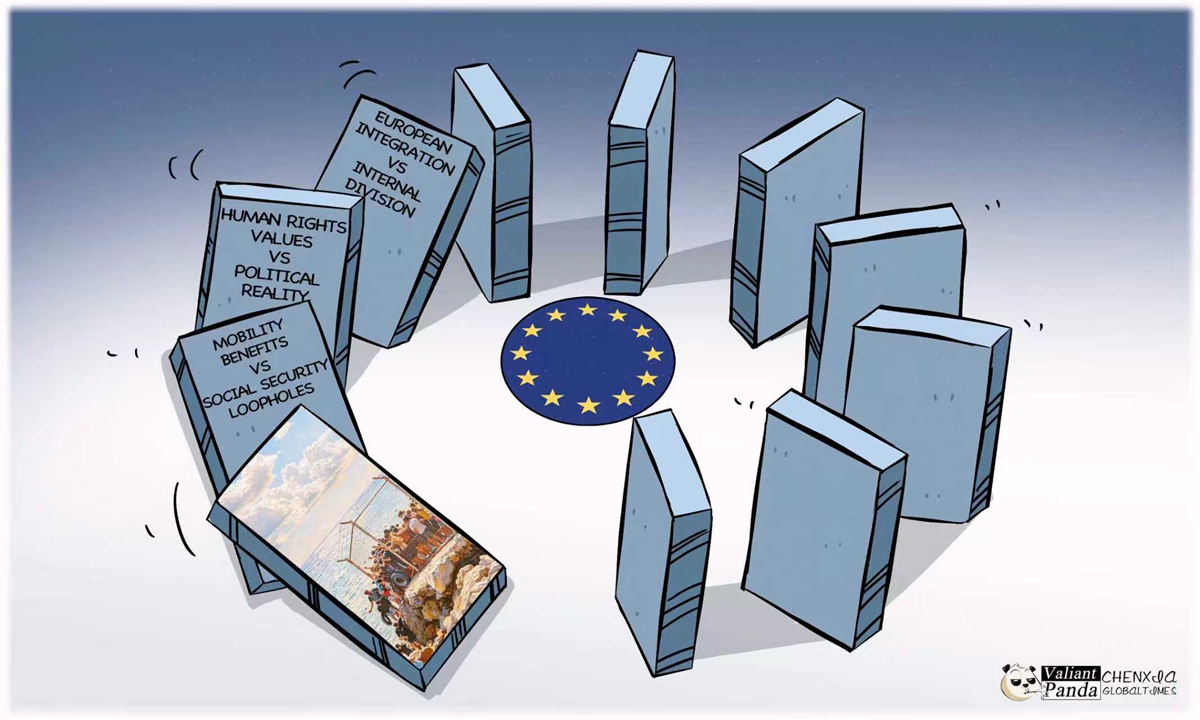
Europe's migration governance exposes several deep-seated structural challenges. First, migrant control policies are frequently shaped by political maneuvering rather than administrative efficacy - resembling political theater far more than actual problem-solving. For instance, Italy invested substantial financial and diplomatic capital to offload the identification, detention and deportation of refugees and migrants to Albania, courting accusations of "trampling on human rights," only to process a negligible number of migrants in practice.
Second, Europe faces a growing imbalance between open internal borders and uncontrolled external frontiers. The Schengen system represents a hallmark achievement of European integration, generating massive dividends in labor mobility and cultural exchange while serving as a key benchmark for how citizens experience the EU's economic and social cohesion and identity. However, as large inflows of refugees and migrants arrive in peripheral member states, the Schengen Area has rapidly shifted from a symbol of integration into a potential social security vulnerability.
Third, Europe is caught in a clash between human rights values and political reality. Since World War II, Europe has treated the protection of human rights and dignity as a core humanitarian obligation. This commitment forms not only an essential component of the EU's identity, but also the political bedrock of several nations. Yet, as Europe continues to bear the costs in security, social order and public resources, the tension between real-world pressures and moral imperatives continues to widen.
The Ceuta migrant crisis has ripped open a fresh fissure in EU unity and policy consensus. Spain's left-wing government, which acknowledges the various benefits legal immigration brings to its national economy and labor market, has bucked the trend amid Europe's broader rightward shift on migration.
As refugee influxes along the Western Mediterranean route have surged, several EU member states have seized the opportunity to criticize Spain, showing little regard for EU solidarity or coordinated migration stances. In reality, compared to the Central and Eastern Mediterranean routes favored by the vast majority of migrants and refugees, the situation along the Western route through the Strait of Gibraltar remains relatively manageable. Furthermore, special regulatory frameworks already govern entry from the enclave into mainland Europe, leaving the security concerns voiced by other EU states over Schengen mobility devoid of practical foundation.
Ultimately, the bickering among member states over the Ceuta crisis reflects how political headwinds are continually squeezing the space for compromise, coordination and mutual support on EU refugee and migration policy. This persistent governance dilemma and societal anxiety are bound to add fuel to the fire of Europe's ongoing political rightward shift.
The author is an associate research fellow at the Academy of International and Regional Studies, and vice director of the Turkish Studies Center of Beijing Language and Culture University. opinion@globaltimes.com.cn
RELATED ARTICLES