Illustration: Liu Rui/GT
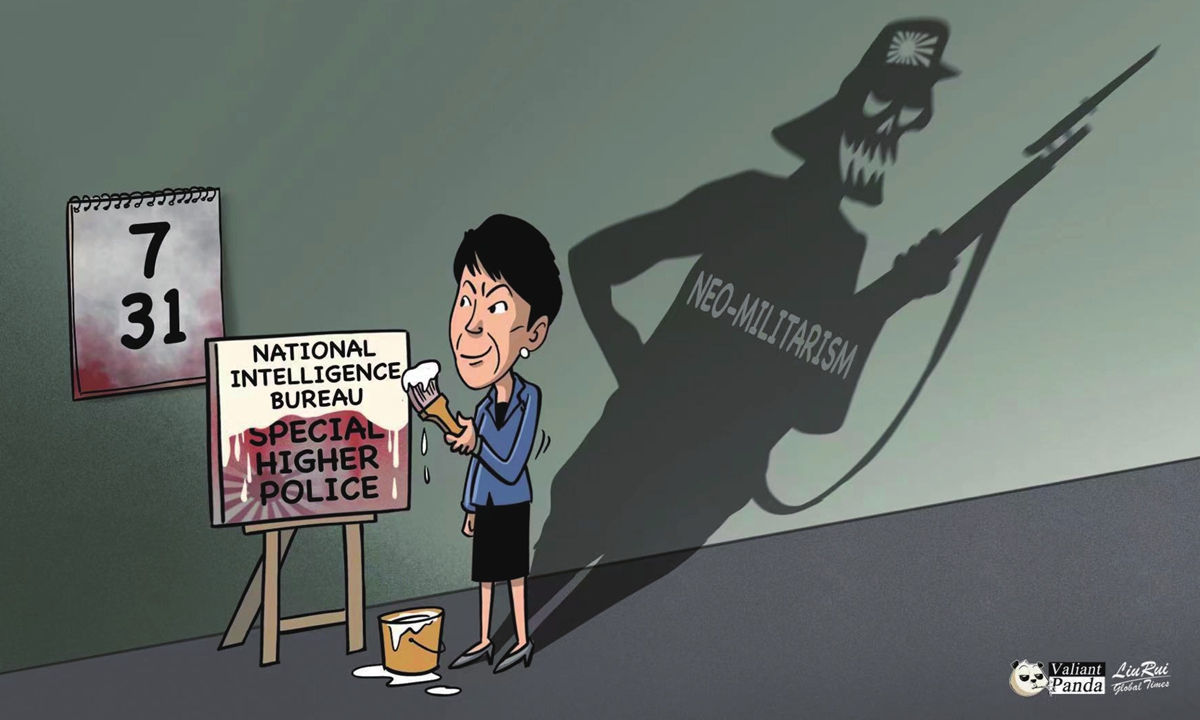
Japan's right-wing forces celebrated jubilantly after the launch of its national intelligence bureau on July 31. Elated by what they call a breakthrough from the "shackles of the post-war system," they advocate building a Japanese version of the CIA modeled after the US Central Intelligence Agency and UK's MI6. They even envision pushing Japan to evolve into a "world-class intelligence power" - an extremely dangerous political declaration.
A nation that has yet to offer sincere atonement for its historical atrocities, one that is rapidly tearing down the constraints of its pacifist constitution and the "exclusive defense-oriented security policy," is suddenly clamoring to become an intelligence power. People cannot help but wonder: What does it plan to do next? Are those unspoken yet fiercely pursued ambitions lurking beneath the surface pointing toward the long-gone "Empire of Japan" that was already consigned to the dustbin of history?
Japan's right wing views the establishment of the national intelligence bureau as yet another breakthrough against the "post-war institutional shackles." However, it's an open violation of the bottom line of the international order. Japan has not only massively expanded its military capabilities and developed offensive weapons, but is also seeking to establish a centralized foreign intelligence hub under the direct leadership of the prime minister.
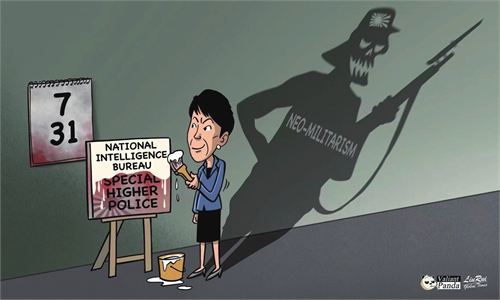
This is clearly paving the way for intelligence gathering, infiltration and even preemptive operations. Japanese scholar Kotaro Ochiai recently said in an interview that Japanese intelligence personnel would erase their identities as members of the Self-Defense Forces and disguise themselves as civilians after arriving in target countries. Such practices bear a striking resemblance to the notorious wartime organizations such as the Special Higher Police (Tokko), the "Mei agency" and the "Take Kikan," which used disguise, infiltration and covert reconnaissance to serve as the vanguard of Japanese militarism.
A country burdened with historical blood debts owed to its Asian neighbors refuses to devote itself to reconciliation and cooperation. It makes no effort to become a top-tier partner for political coordination, a major contributor to the global economy, a champion of cultural exchange or a force for peaceful development. Instead, it chases the status of an "intelligence power" and even a "military power." Such misplaced priority lays bare the deep-seated obsessions Japan's right wing has never abandoned.
The launch of the national intelligence bureau will equip Japan's core decision-making body with far greater capacity to manipulate intelligence. It will be easier for Tokyo to fabricate "artificial crises," stoke public sentiment and fabricate pretexts for military expansion. This playbook was already mastered by Japan's military clique ahead of World War II.
The international community must stay alert to the reckless ambitions of Japan's right wing. Regional countries have every reason to keep the closest watch on Japan's intelligence apparatus. Should Japan insist on racing down the dangerous path of neo-militarism, it will pay the painful price of repeating the mistakes of history.