COMMENTS / EXPERT ASSESSMENT
How can China's 'next new three' grow without losing the strengths of the 'old trio'?
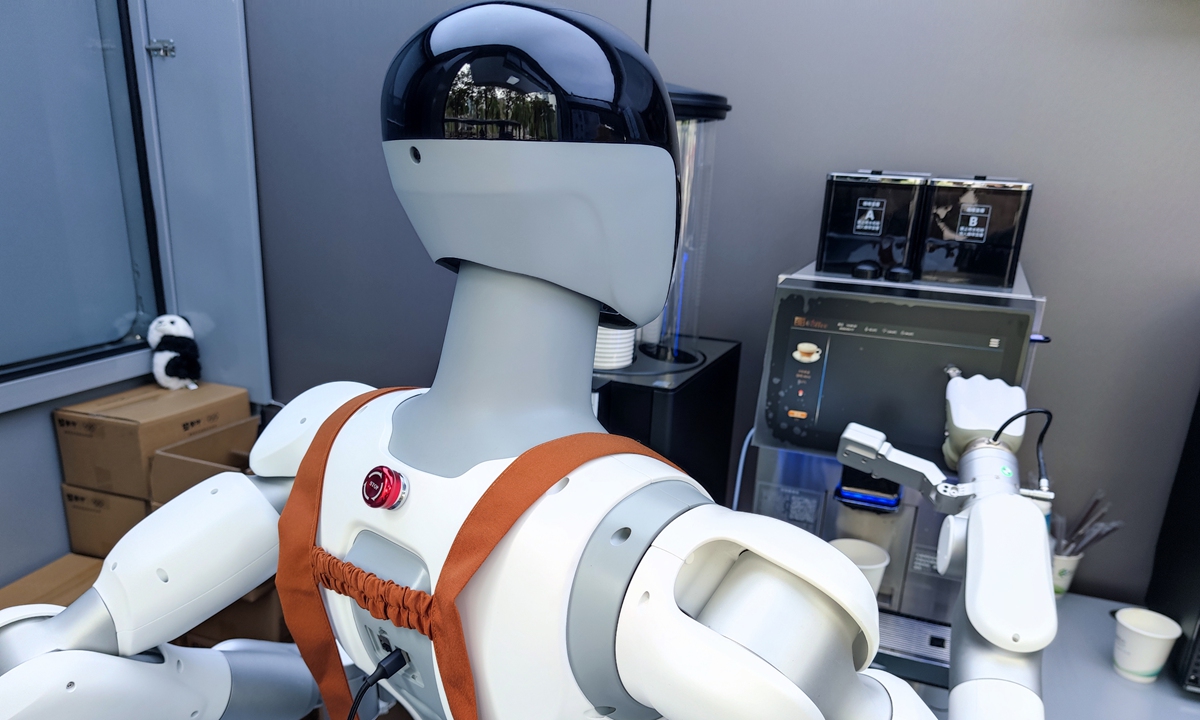
A robot brews a cup of coffee for a customer at a beverage stand in Shenzhen, South China's Guangdong Province, on May 17, 2026. Photo: VCG
Editor's Note:
Last year, the "new trio" of new-energy vehicles, lithium batteries and photovoltaic products made a strong impression in global markets, becoming standout symbols of Chinese manufacturing. This year, artificial intelligence, robotics and innovative medicines - dubbed the "next new three" - are expected to emerge as new pillars of growth. The Global Times will publish a series of commentaries titled "The 'next new three': from industrial upgrading to people-centered modernization." This is the first article in the series.
From the "old trio" of garments, furniture and household appliances that once drove China's foreign trade, to the "new trio," and now the "next new three," this evolution reflects the steady advancement of China's manufacturing sector. It reflects how industrial capabilities have been built over time, continuously evolving and upgrading on the foundation of a deep manufacturing ecosystem.
The progress made by the "next new three" should not be seen as a series of isolated successes, but as a visible result of China's long-term industrial accumulation, spanning the entire supply chain and supported by greater coordination across sectors. The key to balancing new and traditional industries is to embrace the new without discarding the old - cultivating new growth drivers while retaining the hard-earned advantages of established industries.
As the "next new three" gain momentum, this approach is becoming increasingly important. Building new industries does not mean leaving behind existing foundations or starting from scratch. New growth areas can become pillars of future growth only when they build on the industrial capabilities, real-world applications and market support accumulated over years of industrial development, while new technologies and emerging demand help upgrade existing sectors in return.
From foundation to industrial upgrading
As the "old trio" of garments, furniture and household appliances expanded into global markets, it also laid a strong foundation for China's real economy. Beyond providing the world with a wide range of affordable, quality products, these industries also fostered the growth of entire value chains. In the process, they helped cultivate a large pool of skilled industrial workers and engineering professionals. This deep industrial foundation provided essential support for subsequent industrial advancement.
The rise of the "new trio" reflects how the comparative advantages of Chinese manufacturing have evolved from cost and scale toward greater strengths in green development, technology and system integration. While strengthening China's advantages in green exports, these industries have also accelerated the upgrading of traditional manufacturing: garments are becoming more functional and personalized, furniture production more digital and flexible, and household appliances smarter and greener. Technological and industrial upgrading has not pushed the "old trio" aside; instead, new technologies are helping these traditional industries evolve and renew themselves.
'Next new three' build new sources of advantage
The rapid growth of the "next new three" reflects a profound change in global industrial competition. The focus is expanding beyond individual products and production capacity toward underlying technologies, system solutions, standards and innovation ecosystems. Accordingly, China's comparative advantages are evolving from cost, scale and engineering capabilities toward greater strengths in original innovation and ecosystem building.
This evolution does not mean moving away from traditional industries; rather, it places higher demands on overall industrial capabilities. Artificial intelligence (AI) needs real-world industrial applications to train and evolve, robotics depends on complete supply chains for engineering deployment and cost reduction, and innovative medicines require the close integration of research, clinical translation and commercialization.
As industries advance toward the frontiers of innovation, the challenges become more complex and persistent, increasing the need for a strong real economy foundation and broader industrial capabilities. The "next new three" represent not only a new source of growth, but also a new pillar for upgrading existing industries and creating new advantages for Chinese manufacturing.
Smooth transition between new, old
Whether the "next new three" can truly grow into pillar industries should not be measured only by the number of companies, financing scale or short-term production capacity. It depends on whether these sectors can develop sustained original innovation capabilities, broad industrial impact and global market influence.
Embracing the new without abandoning the old does not mean preserving outdated, energy-intensive and inefficient models. Rather, it means ensuring a smooth transition between building new capabilities and upgrading existing ones - using new technologies to renew old growth drivers while relying on established foundations to support emerging industries.
This approach of linking new and traditional industries not only strengthens China's own development, but also creates value for the world. The "old trio" has helped ease global inflationary pressures by providing quality products at competitive prices, while the "new trio" has lowered the costs of the global green transition. The "next new three" could help bring smart technologies and advanced medical solutions to more countries and communities.
Amid rising protectionism and disruptions caused by "decoupling," China is safeguarding its own development interests while participating in global innovation cooperation through greater openness. AI can lower technological barriers through open-source ecosystems, robotics can support industrial upgrading through localized integration, and innovative medicines can serve more patients through cross-border research, licensing partnerships and clinical collaboration. China's industrial upgrading is not a zero-sum process that pushes others out of the market, but a way to expand shared opportunities through more diverse and accessible products and solutions.
The evolution from the "old trio" to the "next new three" reveals the deeper logic behind China's industrial development. It reflects an industrial development path aligned with Chinese modernization. Through the transition between old and new growth drivers, China continues to strengthen the resilience and competitiveness of its industries. This is the driving force behind the rapid upgrading of China's industrial capabilities.
Chen Kaihua is a specially appointed professor at the School of Public Policy and Management, University of Chinese Academy of Sciences. Zhang Yue is an associate research fellow at the Institutes of Science and Development, the Chinese Academy of Sciences. bizopinion@globaltimes.com.cn
RELATED ARTICLES